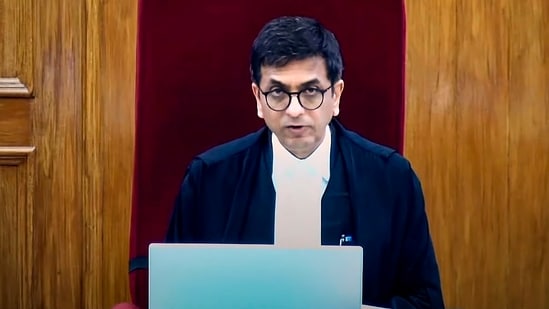
The unanimous decision of the Supreme Court’s five-judge bench to uphold the Centre’s 2019 decision to abrogate Article 370 should, hopefully, ensure closure in the challenge to the status of Jammu and Kashmir within the Indian Union. In his judgment, Chief Justice of India DY Chandrachud held that Article 370, which gave a special status to J&K, was a transitory and temporary provision. Article 370, he held, is an example of “asymmetric federalism”, not evidence of internal sovereignty. The SC did not rule on the validity of the J&K Reorganisation Act, 2019. The Centre has said it proposed to restore statehood to J&K. The SC also upheld the creation of the UT of Ladakh, which until 2019 was part of the state of J&K, while leaving open the question if Parliament can change the status of a state to a UT.
The abrogation of Article 370 in 2019 only turned the de facto situation in J&K into a de jure status. The accession of the princely state of J&K to India happened in extremely chaotic conditions. Article 370 negotiated the state’s accession to India, by providing it a special status. However, the instrument acquired a life of its own and emerged as a contentious constitutional provision often held up to argue that J&K was different and separate from the rest of India. This posed a challenge to the integrity of the Indian State, especially since Pakistan disputed J&K’s accession with India, interpreted it as the unfinished task of Partition, waged multiple wars to annex it, and finally, deployed non-State actors to fuel a violent insurgency in the state. In a new climate of assertive nationalism, Article 370 appeared to be an anomaly, a provision that only encouraged negative emotions. The SC’s endorsement of the Centre’s repeal of Article 370 removes a cloud over J&K’s relations with the Union and holds out the message to various stakeholders to accept the new paradigm and move on.
The SC has also done well to ask the Election Commission to hold assembly polls by September 30 next year. J&K has been under the governor’s rule for nearly four years, which is an oddity in a democracy and contradicts the government’s claim that the situation in the region is under control. The challenge now is to restore the democratic process, statehood, and hand over the administration to an elected government in Srinagar. The political mainstream in J&K and New Delhi should not ignore this opportunity.
{{/usCountry}}The SC has also done well to ask the Election Commission to hold assembly polls by September 30 next year. J&K has been under the governor’s rule for nearly four years, which is an oddity in a democracy and contradicts the government’s claim that the situation in the region is under control. The challenge now is to restore the democratic process, statehood, and hand over the administration to an elected government in Srinagar. The political mainstream in J&K and New Delhi should not ignore this opportunity.
{{/usCountry}}