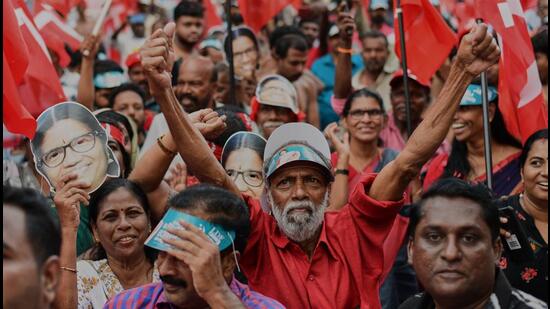
The defeat of the Left Democratic Front (LDF) government in Kerala has significance beyond the borders of the state. For the first time since 1977, when the CPM-led Left Front won office in West Bengal, India will not have a single government led by a Communist party. Ironically, this comes two years after the Communist movement in India marked its birth centenary.
The Communist movement has had a chequered history in both pre- and post-independent India. The internationalism underpinning its
The defeat of the Left Democratic Front (LDF) government in Kerala has significance beyond the borders of the state. For the first time since 1977, when the CPM-led Left Front won office in West Bengal, India will not have a single government led by a Communist party. Ironically, this comes two years after the Communist movement in India marked its birth centenary.
The Communist movement has had a chequered history in both pre- and post-independent India. The internationalism underpinning its ideology has led to the organisation adopting tactics that often went against nationalist undercurrents and the State. The Communist Party of India (CPI) went underground in 1948 for a brief period, only to emerge as the largest non-Congress opposition in Parliament in 1952. In 1957, the Communists won office in Kerala and, since then, the party has helmed governments in West Bengal and Tripura in the past 50 years. In the recent polls, the CPM, which emerged from the CPI in 1964, and became the larger party, lost office in Kerala, failed to revive in West Bengal, and remained irrelevant in Tamil Nadu and Assam.
What happens next? Will it reflect on how it lost the plot? Or will it self-destruct by refusing to change? In European and Latin American democracies, the Communist parties mutated into new Left outfits, engaging with market economies and the idea of social democracy to remain electorally relevant. Governments led by the CPI and CPM in Kerala have had some success in building welfare societies, though these parties are reluctant to acknowledge their engagement in social democracy. Contradictions arise when demands of governance clash with the party’s ideological goals and the leadership fails to communicate with cadres, as it happened in Kerala. The battle between dogma and electoral pressures, when combined with anti-incumbency and poor tactics, creates the perfect storm.
One Subscription.
Get 360° coverage—from daily headlines
to 100 year archives.
Archives
HT App & Website