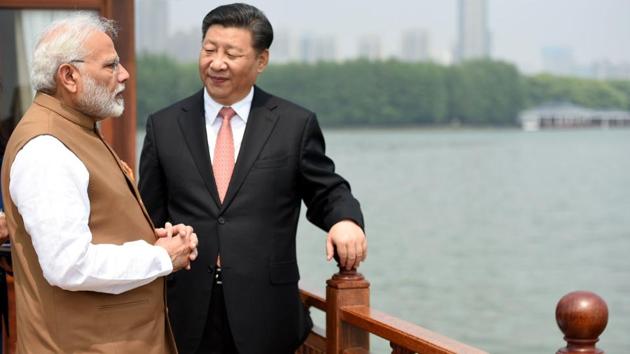
The informal summit between Indian Prime Minister Narendra Modi and Chinese President Xi Jinping at Wuhan in April 2018 was supposed to “reset” the bilateral ties after the 73-day Doklam standoff in 2017. To some extent, Mr Modi and Mr Xi have been able to cool the tempers. However, a leader-level initiative was never going to offset structural factors like territorial disputes that make the two Asian giants each other’s adversary. As a result, both countries continue to prepare for a conflict that may break out notwithstanding the recent confidence-building measures.
It is clear that China is still smarting from its failure in Doklam to extend its road to the south in disputed territory. Since then, it has taken various measures to prevent a repeat. It has beefed up its presence to the north of the stand-off site. Tibet has seen a flurry of activity, including air force exercise and construction of expressways, heliports and airstrips. China is developing the world’s first electromagnetic surface-to-surface rocket specifically meant for India. The idea is to use cheap systems such as rockets to overwhelm India’s military (or possibly civilian) targets with improved accuracy afforded by electromagnetic catapult. China has also deployed vehicle-mounted howitzers in Tibet to enhance its high-altitude combat capability.
India too has responded vigorously. It has adopted a more offensive posture on the China border. It is planning to deploy Akash missile systems along with attack helicopters and long range fighter aircraft in the eastern sector. Mr Modi inaugurated, with much fanfare, the five-kilometre long railroad bridge at Bogibeel in Assam, which will expedite troop movements to Arunachal Pradesh. The construction of other strategically important roads is being speeded up both in the eastern as well as the western sector. A plan to construct hardened shelters for India’s aircraft stationed on the China border has also been green-lighted. This will help in case the electromagnetic rockets try to take out Su-30MKIs.
India should continue to strengthen its capabilities — that is its best insurance against a stronger rival — but be sure to leave the onus of escalation on China. This strategy proved to be successful in Doklam and looks good for the medium term. India should hope for the best but prepare for the worst.
{{/usCountry}}India should continue to strengthen its capabilities — that is its best insurance against a stronger rival — but be sure to leave the onus of escalation on China. This strategy proved to be successful in Doklam and looks good for the medium term. India should hope for the best but prepare for the worst.
{{/usCountry}}