The Supreme Court has equated the practice of manual scavenging with “sending people to gas chambers.” Expressing concerns over the working conditions of manual scavengers, a three-judge bench questioned the Centre on the lack of protective gear like oxygen cylinders and masks.
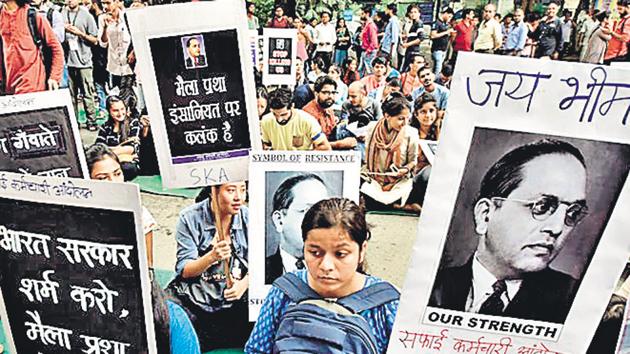
The court is on the right track, but the problem is deeper. India remains the only country to employ manual scavengers, largely from the Schedule Castes (SCs) and Schedule Tribes (STs). This is no coincidence, for the entire caste system rests on the notion of “purity” and “pollution”, with tasks considered impure assigned to those at the bottom of the hierarchy. This is despite a ban enforced in 1993. The law has only been observed in breach. Fifty workers have died cleaning sewers in the first half of 2019 alone, according to the National Commission for Safai Karamcharis (NCSK). This comes after a survey conducted in 2018 by the Centre which identified around 40,000 manual scavengers in 14 states. The number is likely much higher.
The rest of the world has invested in mechanised methods of cleaning sewers and septic tanks. It is imperative for the Centre, states and local bodies to emulate global best practices, and eradicate this dangerous and inhuman practice by following the directives and guidelines of the NCSK. This must be accompanied with reintegration into society of those considered “untouchable” through rehabilitation, re-skilling and new employment opportunities (within and outside the field of sanitation). Ensuring strict punishment for those who break the law is long overdue. Swachh Bharat will remain incomplete without restoring the dignity of manual scavengers.
{{/usCountry}}The rest of the world has invested in mechanised methods of cleaning sewers and septic tanks. It is imperative for the Centre, states and local bodies to emulate global best practices, and eradicate this dangerous and inhuman practice by following the directives and guidelines of the NCSK. This must be accompanied with reintegration into society of those considered “untouchable” through rehabilitation, re-skilling and new employment opportunities (within and outside the field of sanitation). Ensuring strict punishment for those who break the law is long overdue. Swachh Bharat will remain incomplete without restoring the dignity of manual scavengers.
{{/usCountry}}