Even as a controversy rages over the ‘A’ certificate to Hansal Mehta’s real-life-based drama ‘Aligarh’, which is based on the life of Aligarh Muslim University professor SR Siras, who was suspended because he was a homosexual, the Supreme Court on Tuesday made a significant intervention on the question whether Section 377 of the Indian Penal Code should be decriminalised or not. The court referred a batch of curative petitions on Section 377, a colonial era law criminalising consensual sexual acts of lesbian, gay, bisexual and transgender (LGBT) adults in private, to a five-judge Constitution Bench for hearing. Many view this as a positive sign because the court did not dismiss the curative petition. Typically, judges decide a curative petition after discussing it among themselves through a procedure called ‘hearing by circulation’. The fact that the top court has departed from established practice of not hearing oral submissions on curative petitions is perhaps a judicial acknowledgement of changing social realities on the contentious issue.
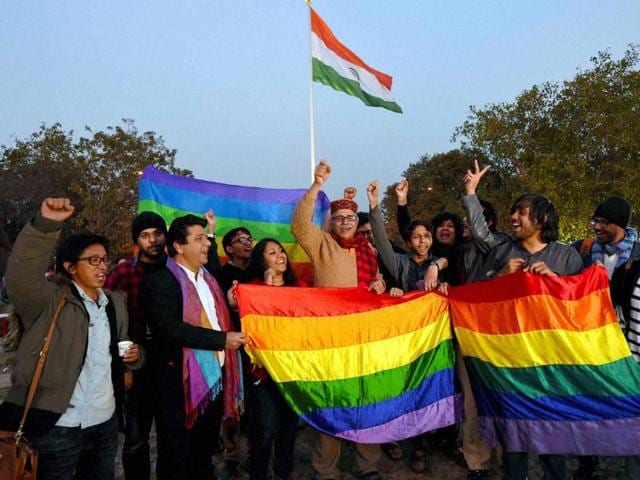
By doing so, the court chose to reconsider its own 2013 verdict. Upholding the constitutional validity of Section 377, a bench headed by Justice GS Singhvi (since retired), put the ball in Parliament’s court, saying it was for the legislature to take a call on the desirability of the controversial provision. The Delhi High Court had in July 2009 de-criminalised consensual homosexual acts in private by declaring as unconstitutional a part of Section 377 of IPC that criminalises unnatural sex, saying “the section denies a gay person a right to full personhood…” The case has implications for heterosexuals also, as consensual sexual acts of adults such as oral and anal sex in private are currently treated as unnatural and punishable under the Section. Successive governments have defended the archaic Section 377 IPC, based on Victorian morality.
Those against legalising homosexuality argue that it is against the moral values of society. What is forbidden in religion need not be prohibited in law. Morality cannot be grounds for restricting the fundamental rights of citizens. A legal wrong is necessarily a moral wrong but the converse is not correct. A moral wrong becomes a legal wrong only when its consequences are for society and not just the person/s committing it. Constitutional benches usually take time to deliver judgments because of non-availability of judges. But this case must be ‘fast tracked’ because it just doesn’t involve the issue of criminality but also concerns the constitutional right of a section of the population.
{{/usCountry}}Those against legalising homosexuality argue that it is against the moral values of society. What is forbidden in religion need not be prohibited in law. Morality cannot be grounds for restricting the fundamental rights of citizens. A legal wrong is necessarily a moral wrong but the converse is not correct. A moral wrong becomes a legal wrong only when its consequences are for society and not just the person/s committing it. Constitutional benches usually take time to deliver judgments because of non-availability of judges. But this case must be ‘fast tracked’ because it just doesn’t involve the issue of criminality but also concerns the constitutional right of a section of the population.
{{/usCountry}}