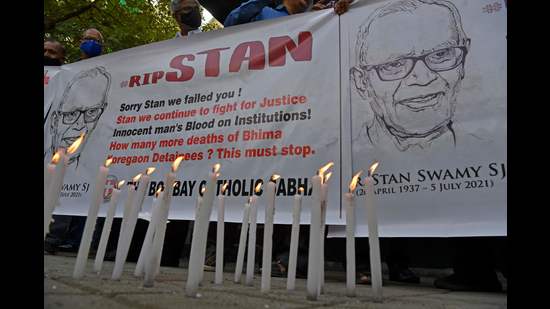
Eight months after he was arrested under the Unlawful (Activities) Prevention Act (UAPA), Father Stan Swamy, an activist who worked with tribals in Jharkhand, died on Monday. The 84-year-old died of cardiac arrest, but had a history of illness, including Parkinson’s and a recent Covid-19 infection. But this must not be treated as a natural death. His death is an outcome of India’s disturbing political climate, where civil society activists are painted as anti-national and the law is abused for partisan purposes. It is an outcome of politicised investigative agencies, which now face allegations of having planted evidence in the broader case (Bhima Koregaon-Elgar Parishad) where Swamy was an accused. And it is an outcome of a broken judicial system which has developed its own extreme brand of bail jurisprudence, where even those who are entitled to it on humanitarian grounds and pose no threat are kept in prison.
The fundamental problem is political illiberalism. And this spans ideological lines. The Congress came up with the draconian anti-terror legislative frameworks, did not hesitate to charge protesters with sedition (remember Kudankulam), and deployed State surveillance on political rivals and civil society leaders. But the Bharatiya Janata Party-led government has built on this, making UAPA even more draconian and showing a deep distrust of civil society. Politically uncomfortable with assertive Ambedkarite and subaltern politics, the government often clubs activism on Dalit and tribal issues within the democratic framework with being a Maoist. The Bhima Koregaon case, where some of India’s finest public-spirited individuals such as Sudha Bharadwaj (arrested in August 2018) and Anand Teltumbde (arrested in April 2020) have been in prison, rests on weak evidence.
The National Investigative Agency (NIA) is India’s premier counter-terrorist body. But in this case, despite no incriminating evidence of Swamy’s complicity in violence, and based on flimsy charges, NIA not just arrested him but opposed his bail and didn’t factor in his age and health. The NIA special court rejected his bail petitions, including on the grounds that “collective interests of society”, a vague, legally untenable category, must prevail over personal liberty and didn’t enable his medical care early on. The Bombay High Court too didn’t cover itself in glory in delaying his bail, not allowing Swamy’s final wish to be in Ranchi. Swamy’s death must force the regime to revise its ways, courts to have a hard look at their evolving jurisprudence, and citizens to speak up for prisoners of conscience.
{{/usCountry}}The National Investigative Agency (NIA) is India’s premier counter-terrorist body. But in this case, despite no incriminating evidence of Swamy’s complicity in violence, and based on flimsy charges, NIA not just arrested him but opposed his bail and didn’t factor in his age and health. The NIA special court rejected his bail petitions, including on the grounds that “collective interests of society”, a vague, legally untenable category, must prevail over personal liberty and didn’t enable his medical care early on. The Bombay High Court too didn’t cover itself in glory in delaying his bail, not allowing Swamy’s final wish to be in Ranchi. Swamy’s death must force the regime to revise its ways, courts to have a hard look at their evolving jurisprudence, and citizens to speak up for prisoners of conscience.
{{/usCountry}}