At least 45 people (as of Wednesday morning) have died in Uttarakhand after heavy rainfall caused extensive flooding and landslides in the eastern part of the state on Monday and Tuesday. The toll is likely to rise since many people are trapped under the rubble. The Char Dham Yatra, a key event in the state’s tourism calendar, has been temporarily halted. The under-construction Char Dham all-weather highway, which is being built despite protests due to its ecological costs, has been
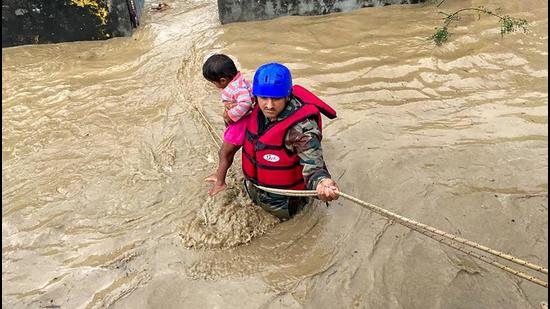
At least 45 people (as of Wednesday morning) have died in Uttarakhand after heavy rainfall caused extensive flooding and landslides in the eastern part of the state on Monday and Tuesday. The toll is likely to rise since many people are trapped under the rubble. The Char Dham Yatra, a key event in the state’s tourism calendar, has been temporarily halted. The under-construction Char Dham all-weather highway, which is being built despite protests due to its ecological costs, has been affected too. On Tuesday, chief minister Pushkar Singh Dhami announced ₹4 lakh compensation for families of those killed and ₹1.9 lakh for those whose houses were destroyed.
The trigger for this disaster, as always, has been record-breaking rainfall: According to the India Meteorological Department (IMD) data, the state reported 178.4mm rain in the first 18 days of October — 485% more than the average. But the reason for the destruction and loss is the state’s unsustainable development trajectory. For years, governments, businesses, and citizens have twisted and flouted laws to build hydropower projects, houses, hotels, roads, cut hill slopes, slash forests and concretise water bodies (the Nainital Lake is a prime example) without considering the fragile ecology of the region. With the climate crisis leading to heavy rainfall in a short period, the unstable hills are now giving way, and rivers and lakes are reclaiming their lost ground. In addition, no one seems to have been aware of the warning signs: According to IMD, Uttarakhand reported over 7,750 extreme rainfall events and cloudbursts since 2015 — a majority of them in the last three years. Until July, the state reported 979 extreme rainfall events. In 2020, this number was 1,632, and went as high as 3,706 in 2018. In the last two editions of the Forest Survey of India, the state did not report even a 1% increase in forest cover between 2015 and 2019.
Whenever these episodes happen, the climate crisis is blamed. But blaming this reality will not change the situation, which is a combined result of the climate crisis, short-sighted policies (destruction in the name of development, as ecologist Madhav Gadgil puts it), and election cycle-focused governance. Politicians, policymakers, and people must recognise that the surge in development projects is untenable because the economic, human, and social costs of such episodes are enormous and intergenerational, and will keep the state trapped in a climate emergency forever.
One Subscription.
Get 360° coverage—from daily headlines
to 100 year archives.
Archives
HT App & Website