In West Bengal, chief minister (CM) Mamata Banerjee declared she was born in a Hindu family, recited from Hindu scriptures, and warned the Bharatiya Janata Party (BJP) not to play the “Hindu card” with her. The card, one assumes, refers to the BJP’s effort to often portray itself as the defender of majority interests, and its rivals as somewhat insensitive to Hindus while being closer to Muslims. As a Hindustan Times data-based analysis showed, Ms Banerjee’s efforts at countering possible political polarisation on religious lines did not stop at the level of rhetoric. There has been a dip in the number of Muslim candidates the Trinamool Congress has put up in the elections — from 54 in the 2016 polls to 45 in 2021, with the biggest fall in south Bengal where the BJP is hoping to make substantial inroads. Not putting up a Muslim candidate, by this logic, prevents the BJP from turning the election into an “H-M”, Hindu-Muslim contest.
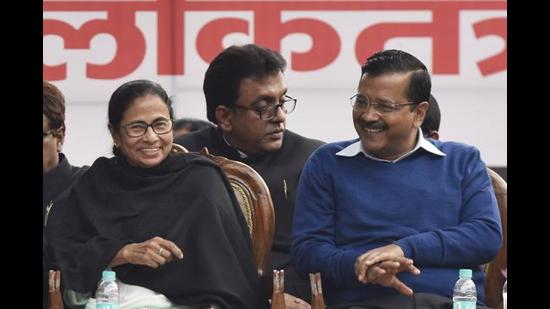
In Delhi, CM Arvind Kejriwal, on Wednesday, said his government’s ideal was “Ram rajya” — and enunciated a set of governance principles under the framework of what Ram rajya would constitute. In addition, he declared that his government would facilitate the pilgrimage of the city’s elderly to the Ram temple in Ayodhya once it is constructed. Mr Kejriwal has, for at least three years now, been carefully portraying himself as a Hindu leader — advertising his devotion to Hanuman, staying away from potentially polarising issues such as the Shaheen Bagh agitation and organising pujas under state government auspices, among other steps.
Ms Banerjee and Mr Kejriwal represent strong regional challengers to the BJP. And their position today is a reflection of how far the BJP has moved the needle of Indian politics. If secular politics, in the past, was electorally equated with being seen as sensitive to Muslim aspirations, secular politicians, today, are investing all their energy in both, not being seen as pro-Muslim, and being seen as adequately sensitive to Hindu sentiments. The Congress has attempted to do this too, most recently seen in the Rajasthan government’s decision to legalise mining to supply stones to the Ram temple construction. What this, however, indicates is that even if the Opposition is able to defeat the BJP electorally and politically, the BJP’s ideological dominance is only getting reinforced. This will have implications for representative democracy and inter-community ties.