
 E-Paper



Design for the hot earth
‘The Neralu Heat Shelter’ is futuristic climate art with an emphasis on function — what this growing genre could look like in months and years to come

 Prefer HTon Google


Once, the future was a fantastic place. All you need to remember — or look up — are the “electronic superhighways” of the South Korean oracle artist Nam June Paik. In the 1970s, he created a network of communication pathways, akin to modern highways, but using electronic signals, that would bridge distances and connect cultures. The concept anticipated the Internet and a global communication networks dominating the world.
Today, the future isn’t all that fantastic — if it is, the fantastic has an eerie ring to it. What happens when heat begins to subsume all life? It’s a quintessentially Gen-Z anxiety.
It isn’t anyway easy to foresee something which does not yet exist. Artists, filmmakers and writers have always done that. Now, with the inexorably looming threats of a shrinking, hot planet, the artist is having to imagine alternatives.
The Neralu Heat Shelter by architect-urban planner duo Ankritya Diggavi and Sagar Kandal, which navigates the world of both functional design and art, tell us there are alternatives to the way things are and could be — that another world is possible.
How might the waste pickers, haulers, street vendors, gig workers on the street and coolies of Bengaluru — the city’s floating population of manual wage workers — find reprieve from heat, sweat and concrete? This functional climate design model offers a solution. The Neralu Heat Shelter is part of Sweat & Concrete 2025, an exhibition of multimedia storytelling and live performance art organised by People First Cities, an initiative by Purpose — a strategy consultancy, creative agency and social movement incubator — that helps drive inclusive, participatory approaches to urban planning and management.
The two-day exhibition to be held at the Sabha Space in Bengaluru, a 160-year-old building transformed into a public space for arts, culture, and community events, on May 29 and 30, delves into the lived realities of informal workers including construction labourers, street vendors and domestic helpers who bear the biggest brunt of rising temperatures in cities.
The Neralu Heat Shelter is a combination of mechanical and natural ventilation — louvres on the front face block direct glare from the road, and double as a mechanically operable fan system. A service tower on the side provides storage and a space to dispense potable water. The structure folds up against the wall, when not in use. A light, easily scalable road-side heat shelter design aimed at finding affordable, scalable solutions for the vulnerable population of workers on city streets, the Shelter won a contest held last years by the Ashoka Trust for Research in Ecology and Environment (ATREE), in collaboration with the Wipro Foundation and Azim Premji University.
This sculptural installation shows what futuristic art with an emphasis on function could look like in months and years to come.
Climate art isn’t predictably functional. A majority of eco-narratives — in words, images, materials or other vehicles — are doom-laden. But it’s beginning to show up is art galleries, big and small, everywhere. To celebrate Earth Month in April, New York’s Museum of Modern Art (MoMA) highlighted of artists, designers, architects, filmmakers, and other creatives who are dedicated to thinking critically about and advocating for our fragile world. From artists making environmental activism a hallmark of their work, to documentaries about the climate crisis, to architectural projects that create more sustainable cities — MoMA in April showed that art is a central force in addressing the changing planet.
Globally, a growing number of artists are seeking alternatives to the doom we have nightmares about — art and design that navigate the intersection of climate justice and creative expression, meant not only to spark dialogue on the role of art and design in addressing global challenges to environmental challenges of the day, like rising temperatures, floods and forest fires, but going a step further, to make such a design functional in cities specific to a region or a country. The Shelter is one such pioneering work. “We feel the basic “mandate” for all of design is to achieve a good degree of sensitivity and sensibility. Academically, we have been a part of forums and tables that are trying to recognize sensible, sensitive and nuanced design possibilities in various realms,” says Diggavi, an architect and researcher currently working at the Charles Correa Foundation.
Kandal, also an architect, is lead designer at the Indian Institute of Science, exploring modular and mobile spaces, and the duo’s work looks ahead to a better urban environment.
A precursor to this competition was an urban study on informal heat shading methods in Ahmedabad. During the course of this study, conversations with vendors and service providers on the street revealed their grievances and tussle with local authority, for taking up public space. “We observed, recorded, and derived. The primary gesture is of defiance — detached from the ground, from ‘public space’ and completely supported by a privately owned compound wall,” says the creators.
The materials used were sourced from Bengaluru’s markets and the industrial area of Yeshwanthpur. Diggavi and Kandal say they went back and forth on alternative materials, ultimately deciding that the materials could change based on availability and location. In this context, it is bamboo, reclaimed wood, repurposed industrial metal waste and other found materials.
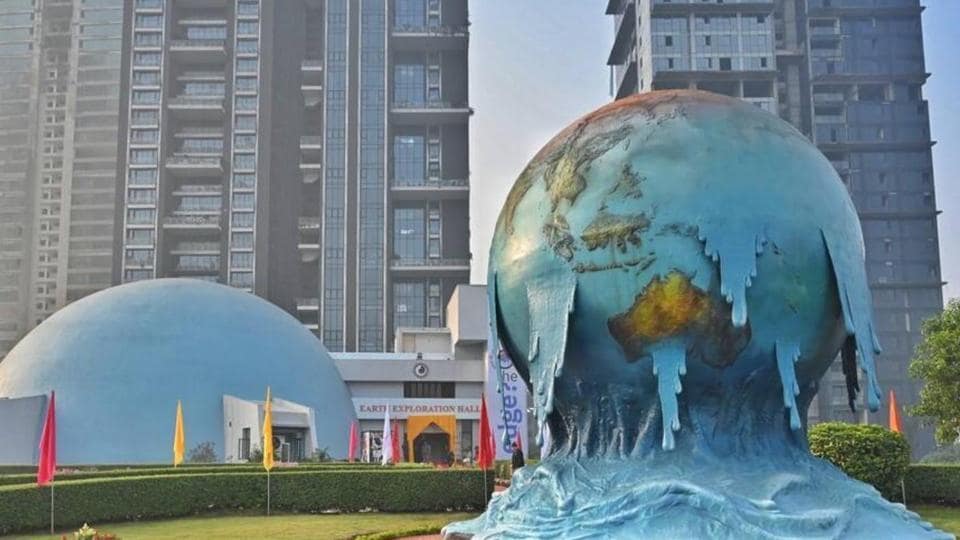
Iterations of this idea have been brainstormed, but a majority of site-specific works tend to be inflexible infrastructure attempts. In January this year, the Union culture and tourism minister Gajendra Singh Shekhawat inaugurated a gallery dedicated to climate change at Science City, Kolkata, where artists and sculptors create site-specific, fixed installations inspired by familiar eco-narratives around the world today.
The Shelter upturns the rigid site-specific installations to a functional, scaleable template — one that not only reimagines the impact of climate crises on vulnerable human populations, but solution it offers is adaptable and mutable. As Kandal says, “Public infrastructure right now is designed with durability and longevity in mind, hence its rigidity, both in design and material. We feel this is a double-edged sword. While the designs may last, they are not accommodating of change. Why not design for flux instead?” Says Sonali Bhasin, associate strategy director at Purpose, “Heat stress, unlike sanitation, or floods, heat is an ‘invisible’ factor - one that impacts people differently based on a variety of factors. And no two cities or human settlements have the same conditions. As a result, participatory research, storytelling and surfacing locally relevant solutions are essential towards building a more inclusive, resilient, enduring response to the rising heat in cities - especially high-growth, high-density cities which are expanding rapidly.”
Climate architecture and design has several practitioners in India, which includes Chitra Vishwanath, Sanjay Puri, Priyanka Gunjikar and Dhruvang Hinmire, Laurie Baker and others. But the Shelter, in form as well as aesthetic, is more akin to works of artists rather than urban planners or architects — a functional nod to climate artists such as such as Ravi Agarwal, Atul Bhalla, Gigi Scaria, Chandra Bhattacharjee, Thukral and Tagra, Meera George, Tapan Moharana, Sashikant Thavudoz and many more who have explored themes of ecological degradation in their works through painting, installation, mixed media and photography.
Other artists such as Sharbendu De, Manav Gupta, Tapan Moharana and Sadhna Prasad are known for their immersive and sustained engagement with climate-related displacements and destruction. Manav Gupta’s Beehive Garden Project uses earthen chilams (earthen rural cigars) and kullars (earthen cups) to create beehives that can occupy every garden and home, a gentle creative reminder to preserve bees and biodiversity.
The Delhi-based artist duo Jatin Thukral and Sumir Tagra, largely known for their playful, often surreal multi-media installations, run the Sustaina India platform, which brings together art and climate science to inspire collective action. They explore the cultural and political dimensions of climate change, often incorporating sustainable materials into their installations. “As creators, we firmly believe in the power of materials to channel a sensorium of touch, smell, sound, and vision as paths to climate awareness and retention for the current and future generations,” the duo writes in their mandate for Sustaina India.
The power of art to initiate and vitalise pressing issues of the world has some spectacular examples. When it comes to the climate crisis, Icelandic-Danish artist Olafur Eliasson is a pioneer. His ecologically-minded sensorial experiences have often shown how valuable firsthand experience is when it comes to raising awareness and delivering lasting impact. His mammoth sculptural work Ice Watch, a travelling show of glacial ice taken from the sea near Nuuk, Greenland from 2014 blurred the idea of the artist and the activist in astounding ways: Eliasson and a team of geologists navigated the ice chunks to Paris’ Climate Change Conference and other major cities. Imagine the buzzing heart of a modern city, with colossal ice chunks — the idea being, to bring the urgent reality of melting glaciers closer to home.
In 2019, Chinese artist Ai Weiwei, possibly the most renowned artist-activist of the 21st century, created Roots, a series of monumental sculptural works in iron, cast from giant tree roots sourced in Brazil. It was a plea to sensitise his followers and fans about deforestation, specifically the destruction of the Amazon rainforests.
Cultural theorist Malcolm Miles, the author of ‘Art Rebellion: The Aesthetics of Social Transformation’, has said that if eco-narrative becomes entertainment, the message may be lost. Miles writes that there is hope if the art actively showcases the future and “imagines what alternative futures might be”. The Neralu Heat Shelter is eloquent and human-forward in such an imagining.
Heat & Sweat 2025, at The Sabha Space, No. 44/A, Kamaraj Road, Bharati Nagar, Shivajinagar, Bengaluru, May 29-30.
Sanjukta Sharma is a Mumbai-based journalist.


