Every year, on Diwali evening, India’s stock exchanges open for a special hour of trading known as Muhurat trading, a ritual that marks the start of the new financial year (or “Samvat”) for many trading communities. This year’s Muhurat trading session will take place on Tuesday, October 21, 2025. Considered an auspicious time to invest by many, it draws both seasoned investors and first-time traders who believe it heralds prosperity for the year ahead.
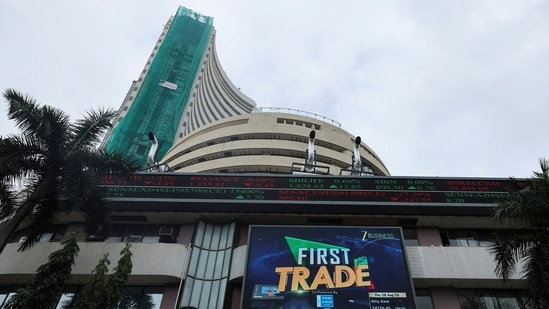
FILE PHOTO: A man walks near a screen outside the Bombay Stock Exchange (BSE) in Mumbai (REUTERS)
How have the markets actually performed
Muhurat trading at Stock Exchange
Muhurat days usually see upbeat markets
On the day itself, Muhurat trading is usually cheerful. Across the past three decades, about four in five sessions finished higher, and the typical gain recorded by the benchmark BSE Sensex was just above 0.4%. However, the optimism tends to moderate over the following weeks. While about seven in ten sessions are followed by higher levels a month later, the one-month median gain is only around 3%. This shows that while Diwali brings a short-term uplift driven by festive sentiment and increased retail participation, it is not a consistent indicator of sustained market momentum.
Markets in the run-up to Diwali have been a mixed bag historically
In the weeks before Diwali, the Sensex has rarely moved in a predictable direction. The month leading up to Muhurat trading has typically seen modest changes, with a median move of less than 1%, but the range has been wide. There have been years of sharp rallies, such as 2003 and 2020, when the index rose by more than 10% and 6% respectively, and steep declines, such as 2000, 2005, and during the 2008 global financial crisis when markets were under severe stress. Yet even in 2008, the Muhurat session saw the Sensex jump by nearly 6%. In more recent years, the pre-Diwali pattern has again been weak, with the Sensex slipping around 2% before the 2023 session and nearly 6% ahead of 2024. Despite that, both Muhurat sessions closed higher, albeit modestly. As for 2025, the Sensex has moved up 1.5% over the last month.
Cyclical sectors lead festive gains
A comparison of median Muhurat-day returns from 2005 onward shows that cyclical and growth-oriented sectors have continued to lead the market’s festive optimism, though the composition of outperformers has shifted slightly over the past decade. Cyclical sectors are industries whose performance tends to mirror the broader economic cycle, including automobiles, industrials and metals, among others. Between 2005 and 2014, sectors such as telecom, health care, and metals registered the strongest median gains, while financials and capital goods lagged. In the more recent period from 2015 to 2024, industrials, PSUs, and auto stocks have come ahead, each recording median gains of over 0.6-0.8%. Technology, which had been a laggard in the earlier decade with negative median returns, has also turned positive, reflecting renewed investor confidence in the IT sector’s long-term growth story. Consumer-focused sectors such as durables and discretionary have remained steady performers across both periods, suggesting that the Diwali mood consistently favours themes linked to consumption.
The month-after data reinforces the short-lived nature of these rallies. Over the years, even the sectors with the strongest Muhurat-day rally rarely sustain their momentum, suggesting that the gains were driven more by sentiment and liquidity than by lasting fundamentals.
Overall, Samvat 2081 saw muted returns
Samvat 2081 (the year ending on this Diwali according to Hindu calendar) has delivered a lukewarm outcome for investors. The Sensex is only barely higher from a year ago, while midcaps have lagged and smallcaps have been hit particularly hard after a volatile year marked by foreign outflows, hawkish global rates, tightening liquidity and weak corporate earnings. According to data from the Centre for Monitoring Indian Economy database, between December 2024 to September 2025, foreign institutional investors have shed net equity investments worth around ₹1.37 lakh crore. After two years of rapid gains, Samvat 2081 was shaped more by cautious risk appetite and consolidation rather than a broad momentum. Looking ahead to Samvat 2082, a cautious optimism may prevail—if inflation stays in check, earnings revive, and domestic flows offset external pressure. But any renewed stress from global rates or external shocks could again test market breadth
Sreedev Krishnakumar is a data journalist who specialises in stories at the intersection of the economy, geopolitics, politics and finance. His work combines data analysis, reporting and visual storytelling to explain complex issues through evidence-based journalism, with a focus on making public data accessible and meaningful for readers. He joined the Data and Political Economy team at Hindustan Times in 2024 after working as a correspondent/data journalist at Moneycontrol, where he covered macroeconomics, markets, public finance and business. Over the course of his career, he has developed expertise in analysing large datasets, building interactive visualisations and using computational methods to uncover trends and patterns that inform public debate. Sreedev holds a Postgraduate Diploma in Integrated Multimedia Journalism from the Asian College of Journalism. His reporting interests include finance, economics, geopolitics, trade, technology and development.
Unlock a world of Benefits with HT! From insightful newsletters to real-time news alerts and a personalized news feed – it's all here, just a click away! -Login Now!
Unlock a world of Benefits with HT! From insightful newsletters to real-time news alerts and a personalized news feed – it's all here, just a click away! -Login Now!
Home/Editors Pick/Diwali and the significance of Muhurat trading | Number Theory
{{^htLoading}}
Advertisement
{{/htLoading}}
SHARE THIS ARTICLE ON
{{#usCountry}}{{/usCountry}}
Hindustantimes wants to start sending you push notifications. Click allow to subscribe