The first part of this series explained that an El Nino may not crimp monsoon rainfall in all parts of the country uniformly. This could partly be because the relationship between the monsoon and El Nino has weakened in some parts of the country. At the same time, large parts of the Indo-Gangetic plains have seen deficient monsoons over the past decade, irrespective of whether there was an El Nino. What does this mean for food production and water availability?
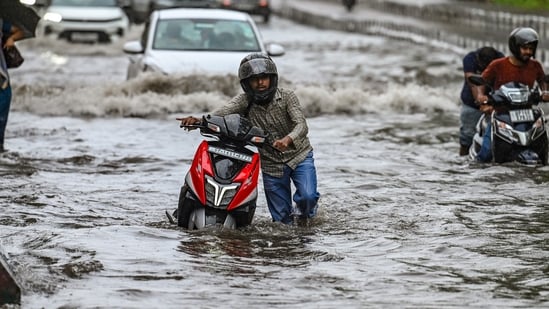
HT photo (RAJ K RAJ/HT Photo)
Most areas where monsoon rainfall has become persistently dry are also well-irrigated
One reason why persistent dryness in India’s cereal bowl has not led to a food crisis is irrigation. The Indo-Gangetic plains are covered with a dense network of canals. As the accompanying map shows, the area of persistent dryness is almost neatly covered with the command area – the area that is capable of receiving water supply from an irrigation project – of major and medium irrigation projects. HT had also highlighted this in June through data on paddy irrigation from the 2018-19 Situation Assessment Survey (SAS). This data showed that around 69% of annual paddy output is concentrated in states where over 75% of paddy area is irrigated.
But it is not just crops that need water in the Indo-Gangetic plains
If the Indo-Gangetic plains were a sparsely populated region where farming was the only major activity, the dense irrigation network could provide a sufficient cushion against declining rainfall. But the region is also one of the most densely populated in the country. This can be seen in the Global Human Settlement Layer (GHSL) data, which uses satellite imagery to estimate built-up area. This means that there is a large demand for water in the region even for other human needs besides food. This is also a problem that isn’t easing up or plateauing soon. While the 2027 census will make things clearer on this front, the Total Fertility Rate (TFR) data from the Sample Registration System (SRS) or National Family Health Survey (NFHS) shows that the TFR in the region is still significantly above replacement rate of 2.1, which ensures a stable population in the long run. In other words, the population in the region is expected to continue to grow in the near future.
High water demand with deficient monsoons means that this is a water-stressed region within a couple of months of the monsoon season
This can also be seen from satellite data. Satellites can detect changes in terrestrial water storage – water stored in soil moisture, surface water (such as rivers, canals, lakes), and ground water (such as that extracted from tubewells) – because a shift in the mass of this water alters earth’s gravitational field. Calculations (needed for translating gravitational anomaly data into water storage deviation) done on one such gravitational data by two different organisations shows that the water storage in Indo-Gangetic plains in mid-December (two months after the June-September monsoon season) decreased in the last decade compared to the 2004-09 period. This result also likely holds true for mid-October (the month just after the monsoons season), but is excluded here because the October water storage data is sparser than the December data. At any rate, declining water storage in the region is consistent with decreasing monsoon rainfall combined with the increasing demand for water.
Abhishek Jha is Assistant Editor-Data at Hindustan Times. He uses statistical programming to generate newsworthy insights from large datasets. He is part of the team that produces Number Theory, a daily data story feature of the paper’s print edition. Since March 2024, he has been writing Weather Bee, a weekly column for the Hindustan Times website. He is a chemical engineer by training, who specialises in stories related to weather, climate, and the environment. Jha has been at HT since 2018, where he offers data-driven perspective and analysis on politics, environment, weather, climate, economy and society. His work includes data coverage of elections in India and abroad, including the 2019 and 2024 Lok Sabha elections; the disasters and extreme weather resulting from changing climate, such as floods, droughts, heat waves, cold waves, and dwindling snow cap in the Himalayas; the factors that drive poor air quality in northern India; the changing patterns of land use; the Covid-19 pandemic and its impact on labour market conditions; the changing pattern of consumer spending seen in the new consumer spending surveys; and social norms seen in the surveys such as the National Family Health Survey.
Unlock a world of Benefits with HT! From insightful newsletters to real-time news alerts and a personalized news feed – it's all here, just a click away! -Login Now!
Unlock a world of Benefits with HT! From insightful newsletters to real-time news alerts and a personalized news feed – it's all here, just a click away! -Login Now!
Home/Editors Pick/El Nino and long-term monsoon rain pattern | Number Theory
{{^htLoading}}
Advertisement
{{/htLoading}}
SHARE THIS ARTICLE ON
{{#usCountry}}{{/usCountry}}
Notifications
Get breaking alerts directly from the newsroom
Notifications are on!You'll be notified when news breaks