Global warming worsens fury of falling glaciers, floods | Number Theory
While the exact sequence of events that triggered the flood remains under investigation, a warming climate is making these cataclysmic events more likely
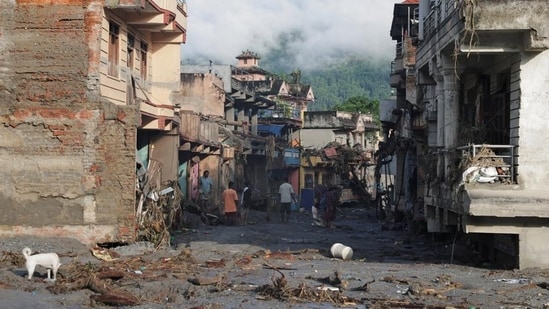
Scientists are considering a rock and ice avalanche as a possible primary cause of the flash flood that travelled downstream of Bhote Koshi, Trishuli, and Narayani (called Gandak on the Indian side) rivers in Nepal, causing unprecedented loss of lives and property.
Reuters photo
“Landsat 9 captured very clear images of the Himalayan glacier that collapsed, triggering the catastrophic flash floods in Nepal. Estimating very roughly from these images, it appears that the area that failed may have spanned ~1 km² of
Decline in glacier mass appears to be accelerating
While it is not clear what triggered the ice avalanche in the first place, the conditions associated with glacier-related adverse events are the most favourable in recorded history. While historical glacier mass tracking for all glaciers in the world is difficult, the mass of some glaciers monitored annually appears to be in rapid decline, according to the State of the Global Climate report published earlier this year.
Snow pack is declining in the Himalayas
Recent disasters in India in the past few years make an acceleration in glacier melting even more believable. A glacial lake outburst flood (GLOF) in Sikkim in October 2023 led to a flood similar to the one seen in Nepal this week. The floods in Uttarakhand in February 2021 were also caused by a rock and ice avalanche like the one in Nepal this week. This is expected when snow pack – ice and glacier formation often happen through compaction or the process of pressing or crushing materials together to make them denser and tightly packed of snow – is declining every year in the Hindu Kush Himalayan (HKH) region, the mountain ranges of the Himalaya, the Hindu Kush, the Karakoram, and the Tibetan plateau.
These trends can only intensify in a warming climate
Declining snow pack and melting glaciers are somewhat self-perpetuating processes in a world where earth’s energy balance is out of whack. Ideally, over somewhat long periods of time, earth should send back whatever energy comes in from the sun. But the increasing accumulation of greenhouse gases means that it is keeping some of this energy back on earth, thereby increasing earth’s internal energy. Melting snow and ice aids this process because their loss decreases sunlight reflection and darker surfaces absorb more energy, leading to more snow and ice melting. This may be part of the reason why even the air temperature (or what is commonly knowns as temperature) of the HKH region is increasing faster than of lower latitudes in mainland India.
The consequences can travel far downstream
Although the Nepal flood originated in the mountains, its consequences put downstream regions, including parts of Bihar and Uttar Pradesh, on alert. It will not be surprising if this becomes a regular feature of climate in the future. In other words, the arms of Himalayan floods are made very long by the rivers that originate there and feed the populous Indo-Gangetic plains below. The region will not be able to support its population without these river systems. To be sure, a warming climate does not just mean more water melting but also more evaporation. Frequent avalanches and GLOFs can trigger big floods, but that does not necessarily imply that rivers will be consistently run deeper and longer in the future.
Abhishek Jha is Assistant Editor-Data at Hindustan Times. He uses statistical programming to generate newsworthy insights from large datasets. He is part of the team that produces Number Theory, a daily data story feature of the paper’s print edition. Since March 2024, he has been writing Weather Bee, a weekly column for the Hindustan Times website. He is a chemical engineer by training, who specialises in stories related to weather, climate, and the environment. Jha has been at HT since 2018, where he offers data-driven perspective and analysis on politics, environment, weather, climate, economy and society. His work includes data coverage of elections in India and abroad, including the 2019 and 2024 Lok Sabha elections; the disasters and extreme weather resulting from changing climate, such as floods, droughts, heat waves, cold waves, and dwindling snow cap in the Himalayas; the factors that drive poor air quality in northern India; the changing patterns of land use; the Covid-19 pandemic and its impact on labour market conditions; the changing pattern of consumer spending seen in the new consumer spending surveys; and social norms seen in the surveys such as the National Family Health Survey.
Unlock a world of Benefits with HT! From insightful newsletters to real-time news alerts and a personalized news feed – it's all here, just a click away! -Login Now!
Unlock a world of Benefits with HT! From insightful newsletters to real-time news alerts and a personalized news feed – it's all here, just a click away! -Login Now!
Home/Editors Pick/Global warming worsens fury of falling glaciers, floods | Number Theory
{{^htLoading}}
Advertisement
{{/htLoading}}
SHARE THIS ARTICLE ON
{{#usCountry}}{{/usCountry}}
Notifications
Get breaking alerts directly from the newsroom
Notifications are on!You'll be notified when news breaks