The India Meteorological Department (IMD) expects India to get only 90% of its usual monsoon rainfall this year. A 10% monsoon rain shortfall will be a first since 2015. With the monsoon rainfall deficit at 43% as of June 28 (June accounts for 19% of overall monsoon rain), both central and state governments have already started working on a mitigation plan.
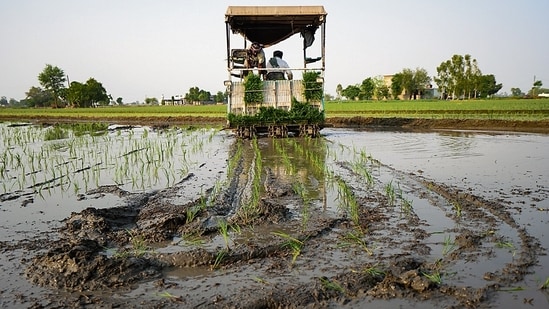
A basic economic geography of paddy production tells us that rice output should not be linearly correlated with country-level monsoon rain. (PTI)
One of the most important reasons monsoon rainfall is so important for India is its impact on agricultural production
A big deficit may decrease production compared to recent past
A big deficit may decrease production compared to recent past
India’s crop production estimates – they are still extrapolated from crop cutting experiments – are perhaps the weakest link in its economic statistics. Even so, they show a consistent pattern during years of severe monsoon shortfall. Since 1968, every year in which the all-India monsoon rainfall deficit reached 10% or more has seen rice production — India’s most important kharif crop — decline relative to the average of the preceding three years.
Much depends on where the rain deficit is high
To be sure, a basic economic geography of paddy production tells us that rice output should not be linearly correlated with country-level monsoon rain. There are at least three reasons for this. First, not all paddy in India is cultivated in the June-September Kharif season, with agriculture ministry’s numbers for the past five years suggesting the non-kharif share to be around 17%. Second, some states’ paddy production has a much bigger share in India’s annual output than others. Third, paddy farmers in some states may be better equipped to deal with poor rains. For example, according to the Situation Assessment Survey (SAS) data, paddy’s irrigation coverage is more than 90% in six states whose paddy output accounts for around 50% of India’s annual production. Irrigation coverage is 75%-90% in another four states with 18% share in output. In other words, around 69% of annual output is relatively more resilient to a below par monsoon. It is in the states with relatively patchy irrigation that monsoon’s importance is high. To be sure, this does not mean that the monsoon is irrelevant to more irrigated states. Even the water in canals or groundwater is replenished by monsoon rains. It is just that these sources allow farmers to draw on storage created before the current season.
And a big deficit at the national level need not mean a big deficit everywhere
There are eight states in the chart that have at least 1% share in India’s annual paddy output and that have less than 80% of paddy area under irrigation. Among the 19 years since 1901 when monsoon at all-India level has had at least 10% deficit, there is no year when all eight states have also had at least 10% deficit. Similarly, there are just four years when at least six of eight have had at least 10% deficit, although 4-5 states crossed that threshold in 13 years. The IMD considers deficits under 20% as “normal” at the state level. Usually only 1-3 of these states reach deficits beyond that threshold when India has at least 10% deficit. Only in 1977 did the count reach four. Rainfall timing matters as much as total rainfall. This means that a normal monsoon even at the state level may not be useful if the normal is made up by rains that come too late
Taken together, the data suggests that one should prepare for a weaker-than-usual kharif output and resulting loss of income for farmers. However, monsoon deficit will have to be widespread across poorly irrigated paddy states for anything close to a serious food shortage.
Abhishek Jha is Assistant Editor-Data at Hindustan Times. He uses statistical programming to generate newsworthy insights from large datasets. He is part of the team that produces Number Theory, a daily data story feature of the paper’s print edition. Since March 2024, he has been writing Weather Bee, a weekly column for the Hindustan Times website. He is a chemical engineer by training, who specialises in stories related to weather, climate, and the environment. Jha has been at HT since 2018, where he offers data-driven perspective and analysis on politics, environment, weather, climate, economy and society. His work includes data coverage of elections in India and abroad, including the 2019 and 2024 Lok Sabha elections; the disasters and extreme weather resulting from changing climate, such as floods, droughts, heat waves, cold waves, and dwindling snow cap in the Himalayas; the factors that drive poor air quality in northern India; the changing patterns of land use; the Covid-19 pandemic and its impact on labour market conditions; the changing pattern of consumer spending seen in the new consumer spending surveys; and social norms seen in the surveys such as the National Family Health Survey.
Unlock a world of Benefits with HT! From insightful newsletters to real-time news alerts and a personalized news feed – it's all here, just a click away! -Login Now!
Unlock a world of Benefits with HT! From insightful newsletters to real-time news alerts and a personalized news feed – it's all here, just a click away! -Login Now!
Home/Editors Pick/How does a weak monsoon affect India’s agricultural output | Number Theory
{{^htLoading}}
Advertisement
{{/htLoading}}
SHARE THIS ARTICLE ON
{{#usCountry}}{{/usCountry}}
Hindustantimes wants to start sending you push notifications. Click allow to subscribe