Consumer sentiment is often a key metric to ascertain the state of the economy. There are private and institutional estimates of the measure across countries. In India none other than the RBI conducts the survey. How objective are such measures? More and more data, including one released recently for the UK shows that people’s reporting of consumer sentiment might have to do more with their political partisanship than objectively determined. A comparison of data for the UK, USA and India
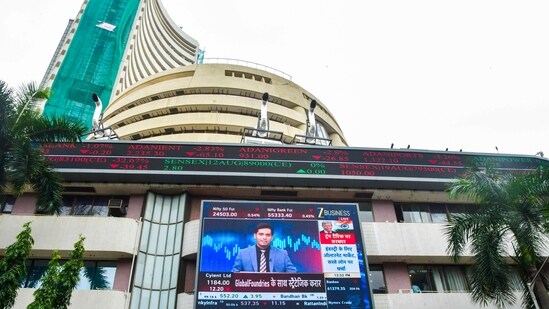
The Bombay Stock Exchange building in Mumbai. (PTI)
Is economic sentiment real or imagined?
Divergence in outlook between younger and older voters in the UK
A recent FT report highlighted that the GfK consumer confidence index fell to minus 38 among people aged 65 and above, an 18-point decline compared with August last year. In contrast, sentiment among those aged 16 to 29 rose by six points to 13, the highest in eight years. The survey’s age-wise breakdown is not publicly available but data from consultancy PwC show a similar pattern: confidence among 25- to 34-year-olds jumped to 49 in July, up from 25 a year earlier, reaching the highest level since records began. This number was -26 for the 65+ age-cohort. This divergence in outlook between younger and older groups also mirrors the UK’s political divide. Data from 2024 UK elections show that Labour, which is in power, has larger support among younger voters. Older voters favoured the Conservatives. It is not surprising therefore that the Labour government has announced plans to lower the voting age from 18 to 16 before the next general election. To be sure, the real X factor in UK politics is now Nigel Farage’s Reform party.
Gap in consumer confidence across party lines has widened in the US
While younger voters in the US too tend to lean towards the Democrats than the Republicans, age-wise gap in political affiliation in the country is not as wide as in the UK. However, data from consumer surveys by the University of Michigan shows that how people across the party lines view their economic situation have increasingly diverged over the last decade, with Democrats expressing more positive outlook of the economy when their party is in power, and Republicans doing the same when their party is in power.
The sentiments in India
India presents a slightly different picture. Analysis by HT of unit-level data from the RBI’s July 2025 round of consumer confidence surveys shows that optimism is higher among younger age groups than older ones. In urban India, the 21-29 age group were the only ones to report a consumer confidence index above 100, signalling optimism, while respondents aged 40 and above recorded values below 100 in both urban and rural areas, reflecting pessimism. Overall, consumer confidence currently stands at 100.6 in rural India and 96.5 in urban India. However, RBI data also shows perceptions of the economy are shaped more by income than by age. Consumer confidence is notably lower among those earning less than ₹5,000 a month, or between ₹5,000 and ₹10,000, compared with higher-income groups. This also aligns with findings from the YouGov-Mint-CPR Millennial Survey (July 2024), which showed that the ruling BJP draws its weakest support from economically disadvantaged sections.
What we understand...
These numbers raise the question of whether increasing partisanship is contaminating important economic indicators, making them increasingly detached from the actual economy, especially in advanced economies? A University of Michigan study published in April says, although partisan differences in economic perceptions are significant, their monthly sentiment trends are not simply artefacts of party bias and still reflect meaningful shifts in how people view the US economy overall. Even so, concerns remain that growing partisanship is distorting key indicators and sources of information on the economy. As Robert Ford, professor of political science at the University of Manchester, told the FT: "There’s a kind of economics-dominated world view that suggests political phenomena flow from economic phenomena, but I think we’re increasingly in a world where the opposite can be true."
Sreedev Krishnakumar is a data journalist who specialises in stories at the intersection of the economy, geopolitics, politics and finance. His work combines data analysis, reporting and visual storytelling to explain complex issues through evidence-based journalism, with a focus on making public data accessible and meaningful for readers. He joined the Data and Political Economy team at Hindustan Times in 2024 after working as a correspondent/data journalist at Moneycontrol, where he covered macroeconomics, markets, public finance and business. Over the course of his career, he has developed expertise in analysing large datasets, building interactive visualisations and using computational methods to uncover trends and patterns that inform public debate. Sreedev holds a Postgraduate Diploma in Integrated Multimedia Journalism from the Asian College of Journalism. His reporting interests include finance, economics, geopolitics, trade, technology and development.
Unlock a world of Benefits with HT! From insightful newsletters to real-time news alerts and a personalized news feed – it's all here, just a click away! -Login Now!
Unlock a world of Benefits with HT! From insightful newsletters to real-time news alerts and a personalized news feed – it's all here, just a click away! -Login Now!
Home/Editors Pick/Is economic sentiment real or imagined? | Number Theory
{{^htLoading}}
Advertisement
{{/htLoading}}
SHARE THIS ARTICLE ON
{{#usCountry}}{{/usCountry}}
Notifications
Get breaking alerts directly from the newsroom
Notifications are on!You'll be notified when news breaks