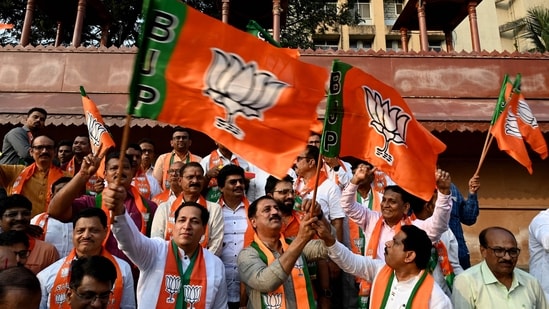
The Bhartiya Janata Party (BJP), along with its allies, won all 25 parliamentary constituencies (PCs) in Rajasthan in the 2014 and 2019 Lok Sabha elections. Can it repeat this feat in 2024 as well? Twelve out of the 25 PCs in the state have already polled in the first phase, and the remaining 13 will vote on Friday. Here are three charts which explain the factors which could play a role in the Rajasthan contest.
Can BJP repeat its 2014 and 2019 clean sweep in Rajasthan?
- How big were the BJP’s victory margins in 2019?The BJP contested 24 of the 25 PCs in Rajasthan in 2019 and gave one PC to its ally Rashtriya Loktantrik Party (RLTP). The National Democratic Alliance (NDA) won all . How big were the BJP’s victory margins in these PCs in 2019? This question matters because it can tell us the BJP’s vulnerability or lack of it to vote share swings on individual PCs. NDA’s median victory margin in Rajasthan in 2019 was 25.2% of the vote share, which is two percentage points higher than its median victory margin in 2014. A PC-wise comparison of victory margins also shows that this number increased in 15 out of the 25 PCs for the BJP between 2014 and 2019. In no PC was the NDA’s victory margin in 2019 Rajasthan elections lower than 7%. This means that it will take a huge swing away from the BJP to make even a small dent in its Rajasthan tally. That’s not impossible in politics, but has a low probability.
- BJP’s clean sweep in 2019 happened despite the Congress improving its vote share from 2014This is an interesting statistic about the 2019 Rajasthan elections. The rise in the BJP’s vote share between the 2014 and 2019 elections in the state was not because of voters deserting the Congress to support the BJP. Both the Congress and the BJP actually increased their vote shares by around four percentage points between the 2014 and 2019 elections. To be sure, the vote share difference between the two parties was a massive 26 percentage points. The rise in BJP’s vote share, as is obvious, was a result of a complete squeeze of all other political parties and candidate in the 2019 elections. This also shows in the trend of median Effective Number of Participants (ENOP) in the state, which was the lowest in 2019 since 1977 when it fell to just 1.92. ENOP is the reciprocal of sum of squares of vote shares of every candidate in a constituency and a higher number denotes a more fragmented contest.
- Will a fall in turnout hurt the BJP’s prospects?Voter turnout statistics released by the Election Commission of India (ECI) after the first phase of voting show that Rajasthan has seen a drop in turnout in all of the 12 PCs which went to polls. The median drop in turnout in the first phase is 5.71 percentage points compared to 2019. Can a drop in voter turnout hurt the BJP? Speculating on relationship between voter turnout and outcomes is pointless at this stage, especially when the final number of registered voters at the PC-level has not been published by ECI and the turnout figure itself is not final and does not include postal votes. It is entirely possible that a decrease in turnout percentage did not lead to a decrease in absolute number of voters, which is the base for calculating vote shares. For example, there was no relation between the change in turnout percentage in 2019 and the change in BJP and Congress vote shares in that election compared to 2014. But it is also entirely possible that the decrease reflected lower enthusiasm among voters.
- Can alliances in three PCs help the Congress?The Congress has struck alliances in three seats in these elections: with the Communist Party of India (Marxist) or CPI(M) in Sikar, with the Bharat Adivasi Party (BAP) in Banswara, and with the RLTP in Nagaur. Will this help the Congress win these seats by a consolidation of votes, going by 2019 vote shares? In Sikar, a simple addition of votes of the Congress and CPI(M) is unlikely to help it because the BJP posted a 58% vote share in 2019. In Banswara, BJP posted a 49% vote share, which means that the Congress has a chance if all anti-BJP votes consolidate behind it. However, the Congress candidate in that PC refused to withdraw his nomination (the alliance was struck after his name was announced) and can possibly play spoiler for the BAP candidate. The most optimal alliance struck by the Congress appears to be in Nagaur, where a winning BJP ally in 2019 has shifted to the Congress’s side.
Unlock a world of Benefits with HT! From insightful newsletters to real-time news alerts and a personalized news feed – it's all here, just a click away! -Login Now!
Unlock a world of Benefits with HT! From insightful newsletters to real-time news alerts and a personalized news feed – it's all here, just a click away! -Login Now!
Advertisement
{{/htLoading}}{{#usCountry}}