On the face of it, Assam is India’s politically most counter-intuitive state. Here is why. It has the largest share of Muslim population among all states in the country after the conversion of Jammu & Kashmir into a Union territory in 2019. And yet, the Bharatiya Janata Party (BJP) and its allies have won a majority of seats in every election, big or small, since the 2014 Lok Sabha polls. What explains this otherwise surprising political result from Assam? Here
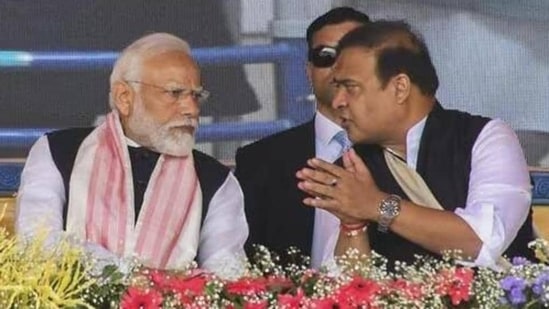
Assam CM Himanta Biswa Sarma with Prime Minister Narendra Modi in Guwahati. (PTI File Photo)
How BJP has changed Assam's political game
Congress’s seat share to vote share ratio has fallen drastically since 2014
In the 2004 Lok Sabha elections, the Congress and its allies won 64.3% of the parliamentary constituencies (PCs) in Assam with a vote share of 36.5%. The Congress alliance’s seat share fell to just 21.4% in 2019 despite its vote share remaining relatively flat at 35.7%. These numbers clearly show that the Congress’s poor showing in the 2014 and 2019 elections is not a result of the party losing popular support in a big way.
The BJP’s vote share increased much more than the Congress’s in most PCs
A comparison of 2014 and 2019 vote shares of the Congress (plus allies), and the BJP (plus allies) shows this clearly. Though the Congress and its allies increased their vote share in nine out of the 14 parliamentary constituencies (PCs) in the state, the BJP and its allies still outdid the Congress on this front. They increased their share in all constituencies, and in seven out of the 14 PCs their vote share increase was larger than that of the Congress and its allies.
Assam’s politics has become extremely polarised since 2014
Two key statistics show this clearly. The median value of Effective Number of Parties (ENOP) in Assam in 2019 was 2.2, which is the lowest this number has been since 1977, when it was 2.11. ENOP is the reciprocal of the sum of squares of each candidate’s vote share in a constituency, and a lower ENOP suggests that fewer candidates are getting more and more votes. For example, if just two candidates get 70% and 30% of the votes in a constituency, the ENOP value will be 1.72. If three candidates get 40%, 21% and 19% of votes, ENOP will be 4.16. The median vote share of the winning candidate in Assam was the highest in the state in 2019 since the 1977 elections.
Massive communal polarisation might be the driving factor
This is what a subregion-wise disaggregation of vote shares between 2009 and 2019 Lok Sabha elections suggests. Assam’s Muslim population is not distributed uniformly across the state. There are subregions such as the Barak valley where Muslims are almost half of the total population and there are areas such as Upper Assam where the share of Muslims is less than 10% of the total population. A subregion-wise vote share comparison of the BJP and allies with that of the Congress-All India United Democratic Front (AIUDF) and allies shows that in three out of the five subregions with the highest share of Muslim population, the combined vote share of the Congress and the AIUDF has fallen to levels almost identical to the share of the Muslim population. So the BJP, it is very likely, has gained by eating into the Hindu votes of the Congress across the state.
Abhishek Jha is Assistant Editor-Data at Hindustan Times. He uses statistical programming to generate newsworthy insights from large datasets. He is part of the team that produces Number Theory, a daily data story feature of the paper’s print edition. Since March 2024, he has been writing Weather Bee, a weekly column for the Hindustan Times website. He is a chemical engineer by training, who specialises in stories related to weather, climate, and the environment. Jha has been at HT since 2018, where he offers data-driven perspective and analysis on politics, environment, weather, climate, economy and society. His work includes data coverage of elections in India and abroad, including the 2019 and 2024 Lok Sabha elections; the disasters and extreme weather resulting from changing climate, such as floods, droughts, heat waves, cold waves, and dwindling snow cap in the Himalayas; the factors that drive poor air quality in northern India; the changing patterns of land use; the Covid-19 pandemic and its impact on labour market conditions; the changing pattern of consumer spending seen in the new consumer spending surveys; and social norms seen in the surveys such as the National Family Health Survey.
Roshan Kishore is the Data and Political Economy Editor at Hindustan Times. He heads the newsroom's data journalism team, which produces Number Theory, a daily data-driven feature for the print edition and the HT app. Number Theory uses data analysis and story-telling based on it to add value to the newsroom’s daily coverage by putting stories in a larger context on a range of issues, including politics, macroeconomy, markets, global affairs and climate. Under his leadership HT’s data journalism work has established itself as a niche product in Indian journalism and pushed the boundaries of marrying academic rigour with news sense and speed. Along with writing and editing data stories, he has also been writing a weekly political economy column called Terms of Trade for HT Premium. A trained economist with an MPhil degree from Jawaharlal Nehru University, Kishore has also been a visiting fellow at the Centre for Advanced Studies of India (CASI) at the University of Pennsylvania. Along with his journalistic work, his writings have also appeared in journals such as the Economic and Political Weekly and working papers for CASI and UNESCAP.
Unlock a world of Benefits with HT! From insightful newsletters to real-time news alerts and a personalized news feed – it's all here, just a click away! -Login Now!
Unlock a world of Benefits with HT! From insightful newsletters to real-time news alerts and a personalized news feed – it's all here, just a click away! -Login Now!
Home/Editors Pick/Number Theory: How BJP has changed Assam's political game
{{^htLoading}}
Advertisement
{{/htLoading}}
SHARE THIS ARTICLE ON
{{#usCountry}}{{/usCountry}}
Notifications
Get breaking alerts directly from the newsroom
Notifications are on!You'll be notified when news breaks