E-Paper



Number Theory: How BJP has changed Assam's political game
The Congress alliance’s seat share fell to just 21.4% in 2019 despite its vote share remaining relatively flat at 35.7%.

 Prefer HTon Google


On the face of it, Assam is India’s politically most counter-intuitive state. Here is why. It has the largest share of Muslim population among all states in the country after the conversion of Jammu & Kashmir into a Union territory in 2019. And yet, the Bharatiya Janata Party (BJP) and its allies have won a majority of seats in every election, big or small, since the 2014 Lok Sabha polls. What explains this otherwise surprising political result from Assam? Here are four charts that answer this question.
To be sure, the fact that Assam has undergone delimitation after the 2021 results might change the electoral arithmetic in the state. Its exact impact on the religious arithmetic of the poll contest, however, can only be ascertained by using micro-level population data which is not available in the public realm.
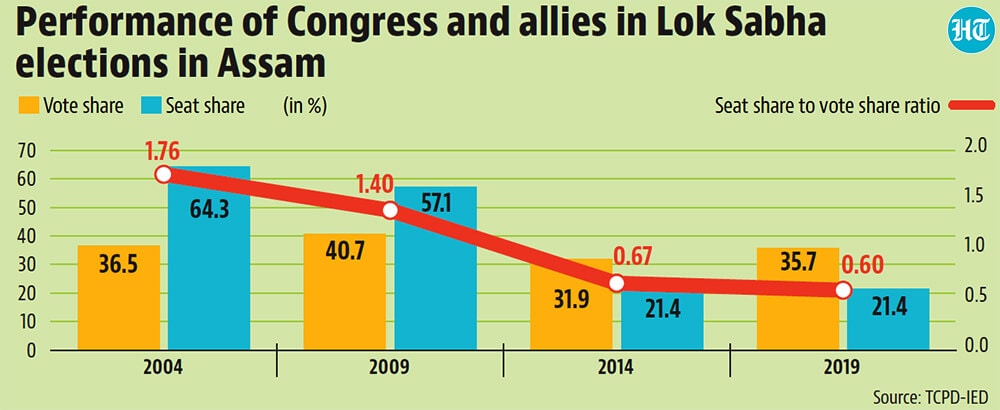
 Congress’s seat share to vote share ratio has fallen drastically since 2014In the 2004 Lok Sabha elections, the Congress and its allies won 64.3% of the parliamentary constituencies (PCs) in Assam with a vote share of 36.5%. The Congress alliance’s seat share fell to just 21.4% in 2019 despite its vote share remaining relatively flat at 35.7%. These numbers clearly show that the Congress’s poor showing in the 2014 and 2019 elections is not a result of the party losing popular support in a big way.
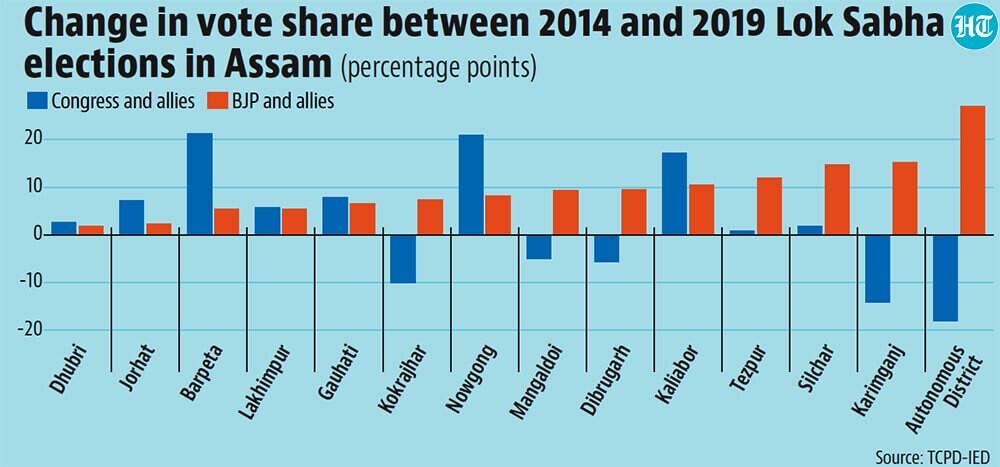
- The BJP’s vote share increased much more than the Congress’s in most PCsA comparison of 2014 and 2019 vote shares of the Congress (plus allies), and the BJP (plus allies) shows this clearly. Though the Congress and its allies increased their vote share in nine out of the 14 parliamentary constituencies (PCs) in the state, the BJP and its allies still outdid the Congress on this front. They increased their share in all constituencies, and in seven out of the 14 PCs their vote share increase was larger than that of the Congress and its allies.
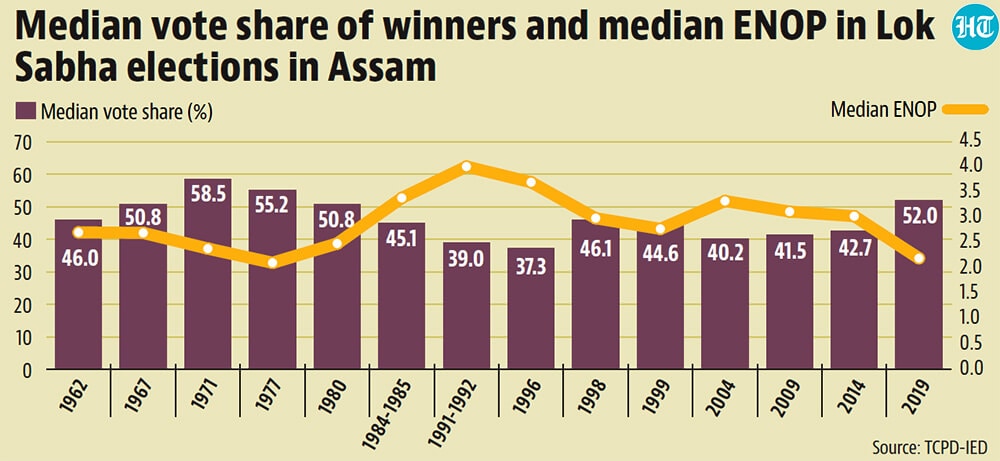
- Assam’s politics has become extremely polarised since 2014Two key statistics show this clearly. The median value of Effective Number of Parties (ENOP) in Assam in 2019 was 2.2, which is the lowest this number has been since 1977, when it was 2.11. ENOP is the reciprocal of the sum of squares of each candidate’s vote share in a constituency, and a lower ENOP suggests that fewer candidates are getting more and more votes. For example, if just two candidates get 70% and 30% of the votes in a constituency, the ENOP value will be 1.72. If three candidates get 40%, 21% and 19% of votes, ENOP will be 4.16. The median vote share of the winning candidate in Assam was the highest in the state in 2019 since the 1977 elections.
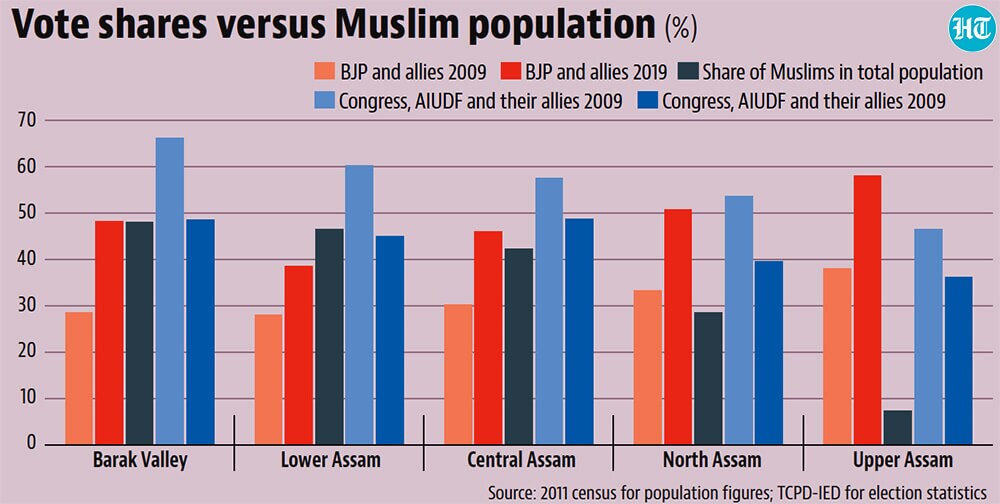
- Massive communal polarisation might be the driving factorThis is what a subregion-wise disaggregation of vote shares between 2009 and 2019 Lok Sabha elections suggests. Assam’s Muslim population is not distributed uniformly across the state. There are subregions such as the Barak valley where Muslims are almost half of the total population and there are areas such as Upper Assam where the share of Muslims is less than 10% of the total population. A subregion-wise vote share comparison of the BJP and allies with that of the Congress-All India United Democratic Front (AIUDF) and allies shows that in three out of the five subregions with the highest share of Muslim population, the combined vote share of the Congress and the AIUDF has fallen to levels almost identical to the share of the Muslim population. So the BJP, it is very likely, has gained by eating into the Hindu votes of the Congress across the state.