Number Theory: In Maharashtra, how BJP traded uncertainty for influence
The problem for the both the BJP and every other party in the state is that nobody knows how much support the NCP and Shiv Sena have with the factions.
Maharashtra sends the second largest number of MPs to the Lok Sabha, 48, after Uttar Pradesh, which sends 80. The Bhartiya Janta Party (BJP) and its allies – the Shiv Sena and the Swabhimani Paksa in 2014 and just the Shiv Sena in 2019 -- swept the state in both Lok Sabha elections winning 42 and 41 of the 48 parliamentary constituencies (PCs) respectively. The political landscape in the state, however, has changed drastically for the 2024 elections because of
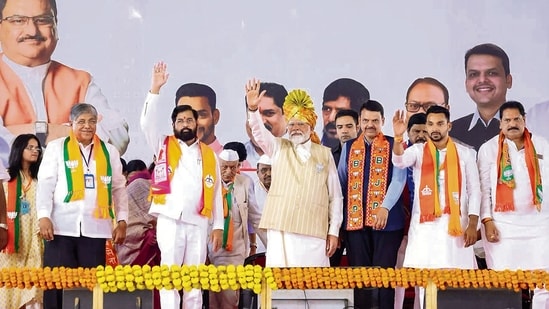
Prime Minister Narendra Modi with Maharashtra Chief Minister Eknath Shinde, Deputy Chief Minister Devendra Fadnavis and others in Kolhapur. (PTI)
In Maharashtra, how BJP traded uncertainty for influence
NDA did not only win more PCs, it also won them with much bigger margins in 2014 and 2019
The median victory margin in 2014 and 2019 in Maharashtra was higher than what it has been in any Lok Sabha elections after 1984 in the state. This was primarily a result of NDA candidates winning with much bigger margins in 2014 and 2019. The median victory margin of NDA candidates in 2014 and 2019 was 20.21% and 17.45%. This number was just 4.59% and 4.07% for the Congress-NCP alliance in the state. In fact, both in 2014 and 2019, PCs won by the NCP and Congress candidates saw among the lowest victory margins in the state.
But the 2014 and 2019 assembly elections suggested that the BJP cannot win on its own
Despite a landslide victory in the 2014 Lok Sabha elections, the BJP and the Shiv Sena could not agree on an alliance for the 2014 assembly elections in Maharashtra which were held months after the Lok Sabha polls. What made the elections more interesting was that even the Congress and the NCP fought the polls separately. The BJP emerged as the single largest party in terms of vote share and seat share in the assembly but fell short of the majority mark and formed a government in a post-poll alliance with the Shiv Sena. In the 2019 assembly elections, the BJP and the Shiv Sena had a pre-poll alliance. While the BJP Shiv Sena alliance crossed the majority mark in the assembly, their combined tally fell from 185 to 161 between 2014 and 2019. The Congress and the NCP, on the other hand, increased their strength from 83 to 98 between the 2014 and 2019 assembly elections.
BJP’s problems began after the 2019 results
The Shiv Sena walked out of its pre-poll alliance with the BJP after the latter refused to give it the chief minister’s post in 2019. What followed was an alliance of the Shiv Sena, Congress and NCP in the state with the BJP ending up as the single largest and pretty much the single opposition party in the state – till 2022, when it engineered a split in the Sena; the NCP split came last year. The combined vote share of the Shiv Sena, Congress and NCP in the state in the 2014 (when all four parties contested separately) assembly elections was 54.5% against the 27.8% polled by the BJP. This meant that even if there was no perfect transfer of votes between the three parties, the BJP would still be vulnerable in a lot of places when faced with a combined strength of the three parties. This is borne out by the statistic that the BJP crossed the 50% vote share threshold in only 27 out of the 288 ACs in the state in 2014 assembly elections. The BJP’s successful efforts to create splits within the Shiv Sena and the NCP are clearly an attempt to cut into the combined strength of the Opposition bloc in the state. The problem for the both the BJP and every other party in the state is that nobody has any idea how much of the support base of the NCP and the Shiv Sena remains with any of the factions. This is exactly why the Maharashtra contest is among the most difficult to predict in 2024. Given that the BJP and the Shiv Sena could have been together had the Sena been given the chief minister’s post, this is an uncertainty the BJP has embraced to keep its dominance intact in the state.
Sreedev Krishnakumar is a data journalist who specialises in stories at the intersection of the economy, geopolitics, politics and finance. His work combines data analysis, reporting and visual storytelling to explain complex issues through evidence-based journalism, with a focus on making public data accessible and meaningful for readers. He joined the Data and Political Economy team at Hindustan Times in 2024 after working as a correspondent/data journalist at Moneycontrol, where he covered macroeconomics, markets, public finance and business. Over the course of his career, he has developed expertise in analysing large datasets, building interactive visualisations and using computational methods to uncover trends and patterns that inform public debate. Sreedev holds a Postgraduate Diploma in Integrated Multimedia Journalism from the Asian College of Journalism. His reporting interests include finance, economics, geopolitics, trade, technology and development.
Roshan Kishore is the Data and Political Economy Editor at Hindustan Times. He heads the newsroom's data journalism team, which produces Number Theory, a daily data-driven feature for the print edition and the HT app. Number Theory uses data analysis and story-telling based on it to add value to the newsroom’s daily coverage by putting stories in a larger context on a range of issues, including politics, macroeconomy, markets, global affairs and climate. Under his leadership HT’s data journalism work has established itself as a niche product in Indian journalism and pushed the boundaries of marrying academic rigour with news sense and speed. Along with writing and editing data stories, he has also been writing a weekly political economy column called Terms of Trade for HT Premium. A trained economist with an MPhil degree from Jawaharlal Nehru University, Kishore has also been a visiting fellow at the Centre for Advanced Studies of India (CASI) at the University of Pennsylvania. Along with his journalistic work, his writings have also appeared in journals such as the Economic and Political Weekly and working papers for CASI and UNESCAP.
Unlock a world of Benefits with HT! From insightful newsletters to real-time news alerts and a personalized news feed – it's all here, just a click away! -Login Now!
Unlock a world of Benefits with HT! From insightful newsletters to real-time news alerts and a personalized news feed – it's all here, just a click away! -Login Now!
Home/Editors Pick/Number Theory: In Maharashtra, how BJP traded uncertainty for influence
{{^htLoading}}
Advertisement
{{/htLoading}}
SHARE THIS ARTICLE ON
{{#usCountry}}{{/usCountry}}
Notifications
Get breaking alerts directly from the newsroom
Notifications are on!You'll be notified when news breaks