
 E-Paper



Number Theory: Rain records tumble in face of climate crisis
.
Updated on: Jan 13, 2025, 09:46:52 IST

 Prefer HTon Google
Share via


Copy link

As the planet warms up, heat is not the only record which is likely to be broken. As more water evaporates from warmer oceans and warmer air holds more water vapour, scientists also expect to see an increase in cloud formation and sudden precipitations leading to extreme rainfall events. Latest data released by a global rainfall dataset on Thursday confirms these predictions with 2024 becoming the year of highest recorded extreme rainfall. Here are three charts which explain this in detail.
Rain records tumble in face of climate crisis
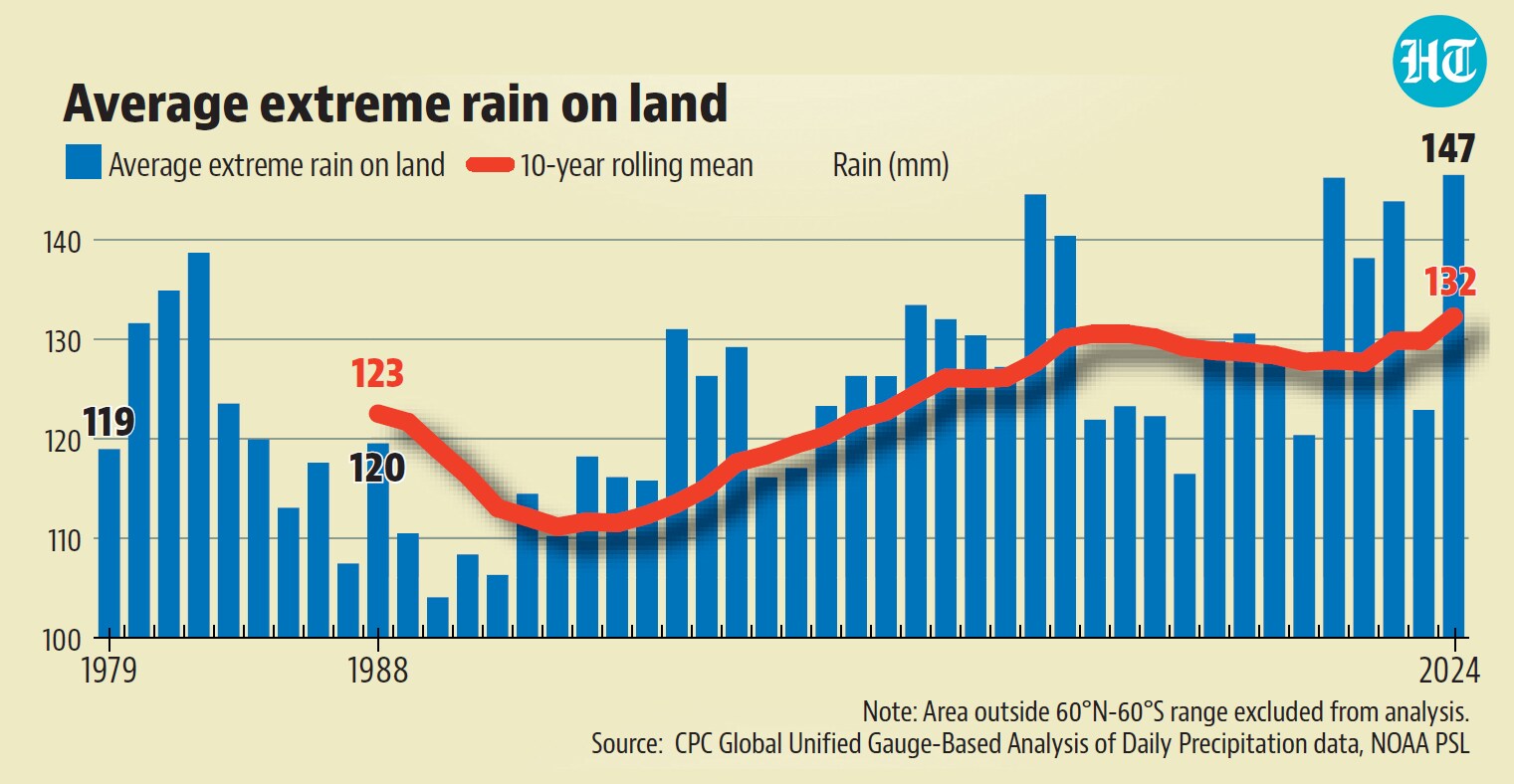
 Average extreme rain over inhabited land highest in 2024The Global Unified Gauge-Based Analysis of Daily Precipitation data from the Climate Prediction Center (CPC), an agency of the United States government, has daily rain data from January 1, 1979. On January 2, this dataset released readings till 31 December, 2024. The data shows that average extreme rain (more on this later) for inhabited land – taken as the land bounded by the 60°N and 60°S latitudes – was 146.5 mm in 2024. This is the highest ever annual figure recorded in the dataset. To track extreme rain, HT calculated the 99th percentile of daily rain for all places – these are grids of 0.5 degrees longitude and latitude each – on land from 1979 to 2023. Daily rain higher than this value would be ranked in the top 1% at the place during the 1979-2023 period. This is a common practice for tracking extreme rain specific to a place which tracks abnormalities in rainfall in comparison to usual rains in a given area. The 146.5 mm number given above is basically the sum of extreme rainfall (as described above) through the year averaged across all land area. To be sure, 2024 is not an aberration in the data. A long-term analysis shows that extreme rain has an increasing trend in the CPC data, which is why the 10-year rolling average of extreme rain also reached its highest value in the decade ending 2024. On the other hand, the total rainfall in 2024 was 789.8 mm, which is ranked 20th highest (or 27th lowest) in the 46 years of data we have. Total rainfall also does not have any long-term trend in this 46-year period.
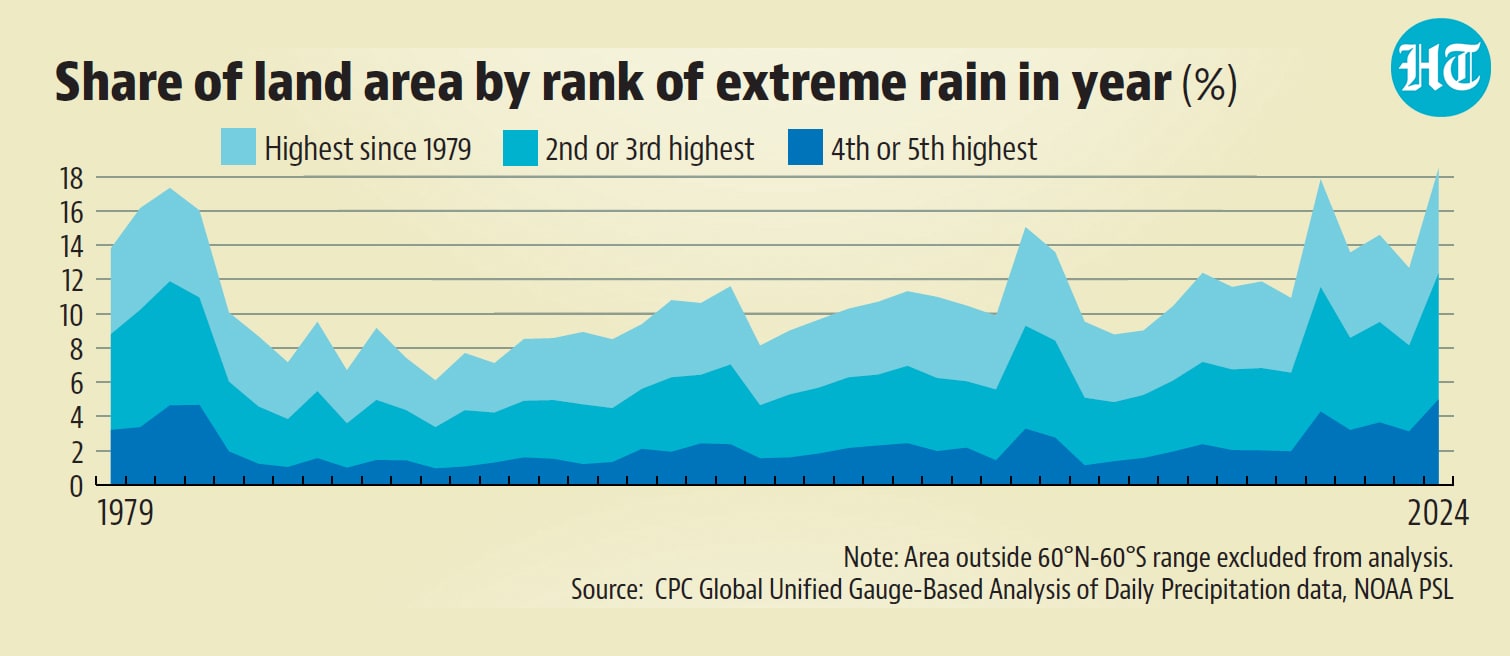
- Area coverage of record-breaking extreme rain also highest in 2024To be sure, average extreme rain reaching a record value may not always mean that a large part of the world was affected by it. The average can reach a record value even with a few places breaking previous records with a very large margin instead of multiple places breaking previous records with a relatively smaller margin. 2024’s case is more like the latter scenario. 18.49% of inhabited land received extreme rain in 2024 ranked among the top five for those places since 1979, 12.36% received extreme rain ranked among the top three, and, 4.99% of land received extreme rain ranked highest for those places since 1979. This level of geographical spread of extreme rainfall is the highest ever in 2024 for all three categories described above.
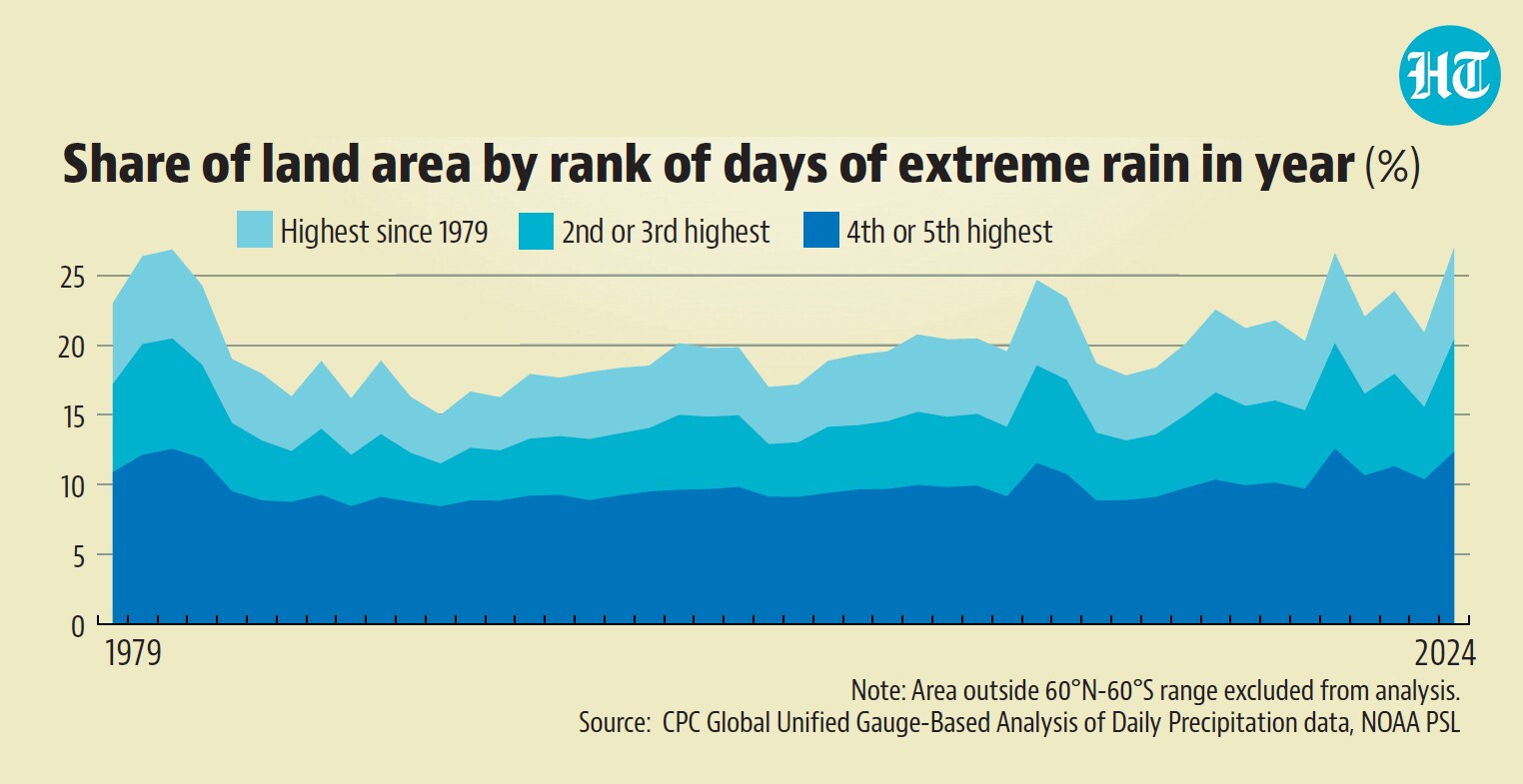
- Area covered by record-breaking extreme days is biggerOne can look at extreme rainfall in another way as well. The amount of extreme rain is not the only way disastrous rainfall events are tracked. One can also look at the number of extreme rainfall days. This matters because more extreme rainfall days can lead to larger number of days with flooding or crop losses. The number of days of extreme rain was ranked in the top five for 27% of inhabited land and in the top three for 20.4% of inhabited land. This number was the highest for 12.4% of inhabited land. To be sure, while the 27% figure is the highest since 1979, the 20.4% figure is the second highest, and the 12.4% figure is only the third highest, with the top two numbers for the latter being recorded in 2020 and 1981.


Unlock a world of Benefits with HT! From insightful newsletters to real-time news alerts and a personalized news feed – it's all here, just a click away! -Login Now!


