
 E-Paper



Number Theory: What does suspension of US aid mean for Ukraine?
.
Updated on: Mar 7, 2025, 09:43:44 IST

 Prefer HTon Google
Share via


Copy link

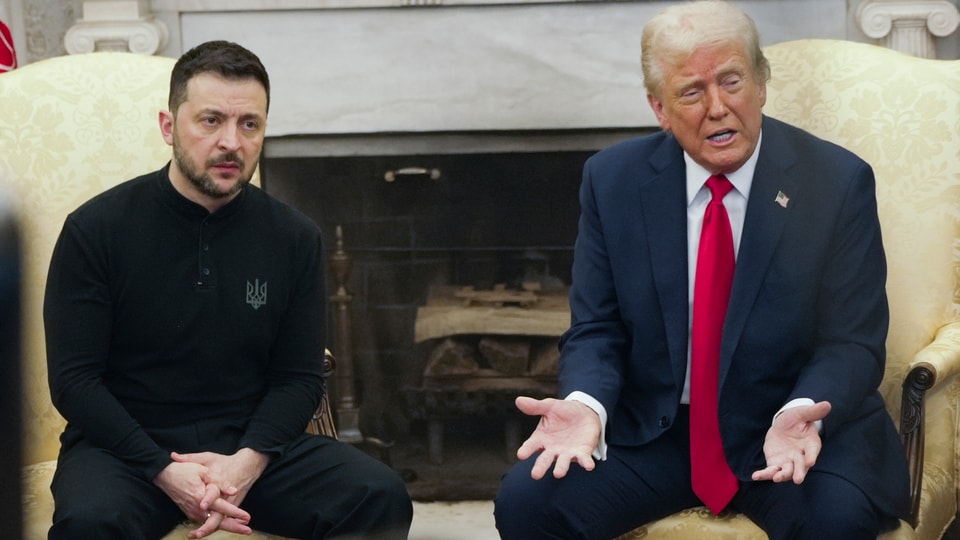
US President Donald Trump on Monday paused all military aid to Ukraine amid its war with Russia. While there is a possibility that the US and Ukraine could reach some sort of understanding through a minerals deal, Trump has stressed that Ukraine’s security is Europe’s responsibility, raising questions about future US involvement. How much aid has the US really provided to Ukraine? Has it exceeded Europe’s contributions? What are the potential impacts of this pause? The charts below explore this in detail.
What does suspension of US aid mean for Ukraine?
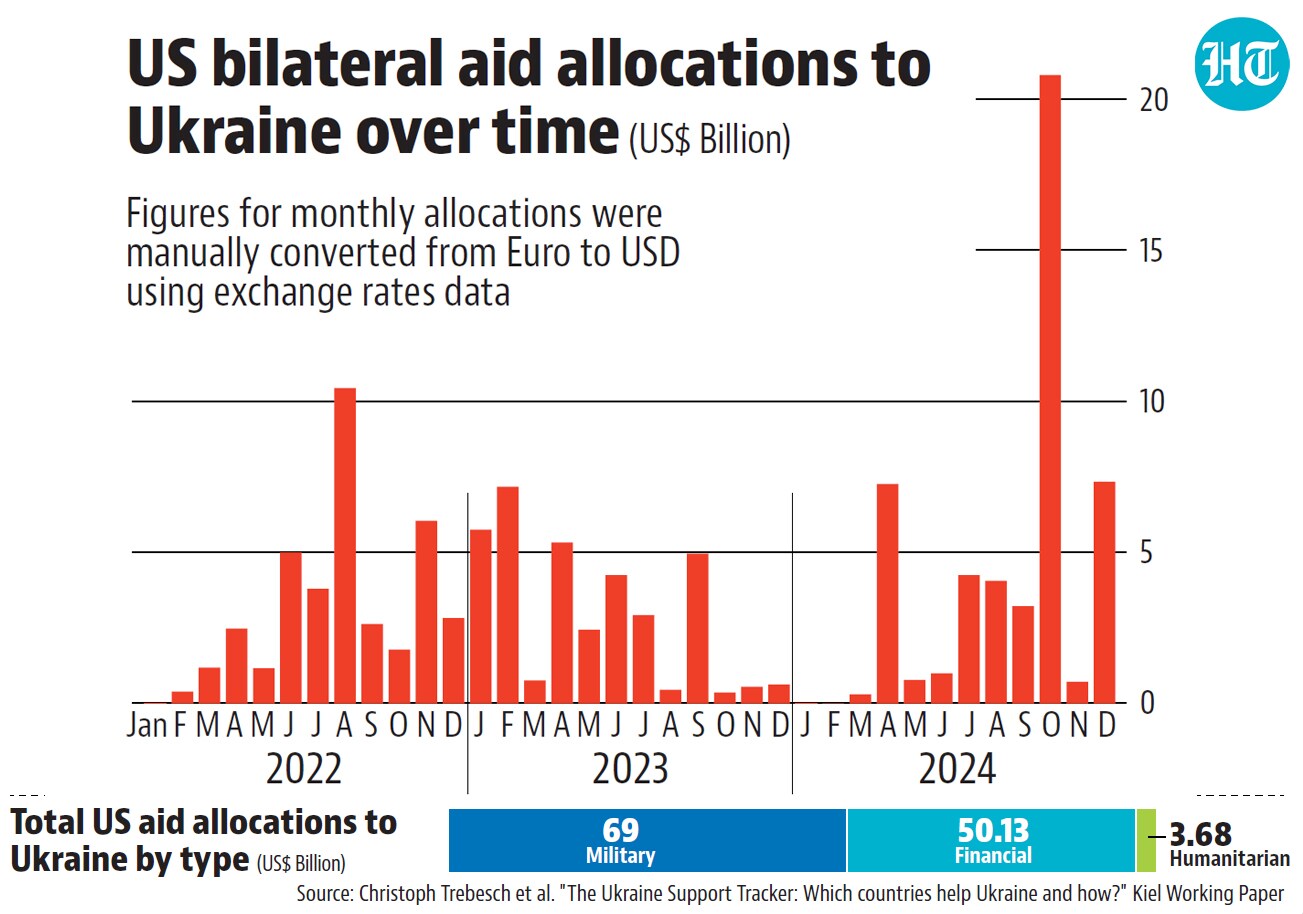
 How much aid has the US given to Ukraine so far?Estimates vary. Trump claims that the US has provided over $350 billion, but other sources report much lower figures. The US Department of Defense (DoD) estimates total US spending on Ukraine at $182.75 billion, using a broader definition that includes training US troops in Europe and replenishing defence stockpiles. The Kiel Institute’s Ukraine Support Tracker puts cumulative US bilateral aid as of December 2024 at $122.81 billion, including $69 billion in military aid, $50.13 billion in financial aid (loans, grants, credit guarantees, and swap lines), and $3.68 billion in humanitarian aid. Data shows a sharp rise in US aid in October 2024 before the elections and again in December, as the previous administration accelerated the aid pipeline before the inauguration of the Trump presidency. In contrast, aid nearly stopped in late 2023 and early 2024 as funds ran out while Congress debated the next package.
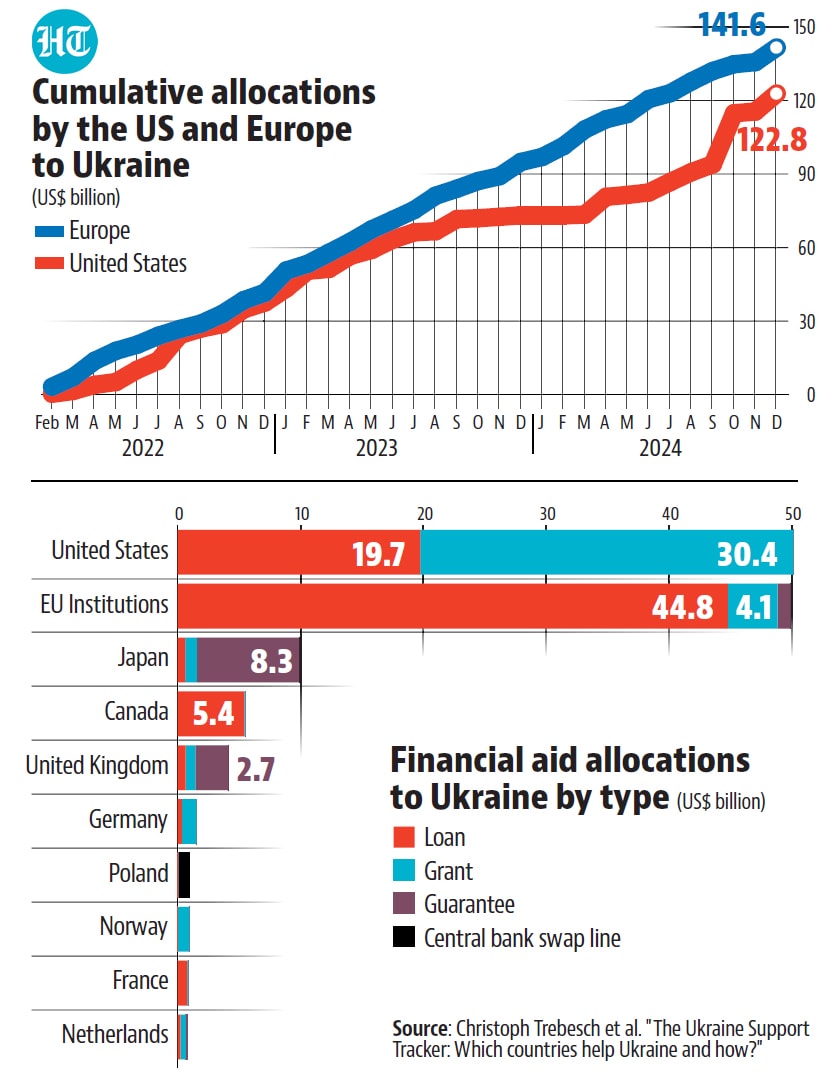
- Does Europe really contribute lesser than the US?Trump has made this claim repeatedly, but the numbers tell a different story. According to the Kiel Institute, European countries — EU members, UK, Iceland, Switzerland, and Norway — have provided $141.6 billion in aid to Ukraine since February 2022, exceeding the US total of $122.81 billion. A common criticism is that much of Europe’s financial aid comes as loans rather than grants. This is partly true — $44.8 billion of the EU’s $49.9 billion in financial aid consists of loans, with only $4.05 billion in grants. In contrast, the US has provided $30.4 billion in grants alone. However, the EU loans come with favourable terms, and in many cases, repayments will be covered by revenues from frozen Russian assets rather than by Ukraine itself. Estimates show that Ukraine could receive $48.42 billion in financial aid through such asset-backed loans in 2025.
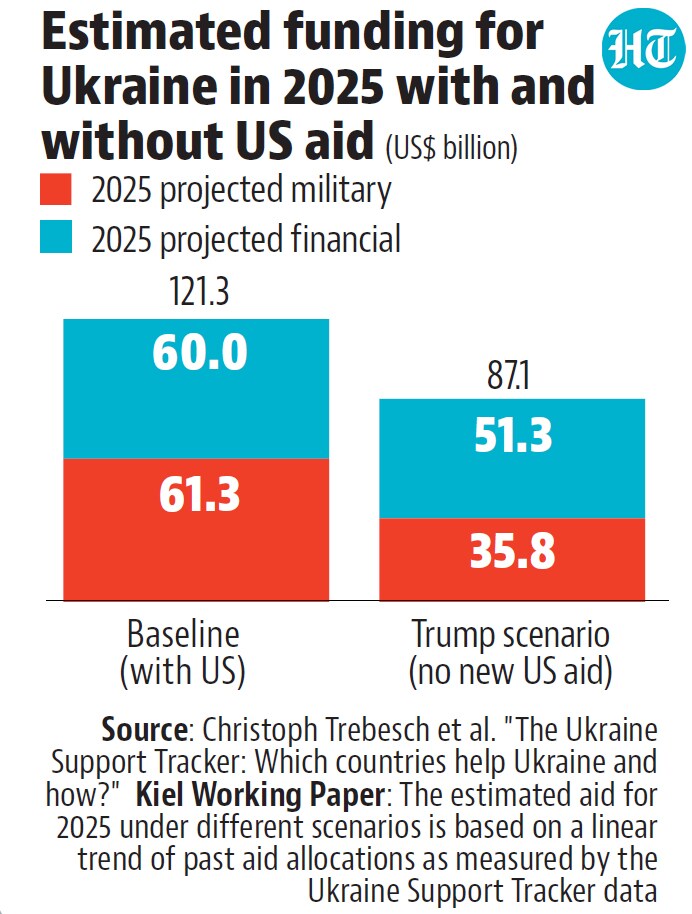
- Can Europe fill the gap?This isn’t the first time the US has withheld military aid. In summer of 2023, Republicans in Congress blocked then President Joe Biden’s largest assistance package, causing a funding freeze in late 2023 and early 2024. Ukraine managed to stretch its ammunition stocks with European support. As in 2024, the impact of cutting US aid may take months to be fully felt, especially in terms of ammunition and hardware. If pre-freeze aid levels continued, military aid in 2025 would reach $61 billion and financial aid $60 billion. Without new US packages, military aid could drop to $35.8 billion, and financial aid to $51.2 billion. While Europe has the financial capacity to compensate, there is a question mark over its ability to replace US military aid. “In 2024, US military support amounted to €20 billion (or $21.5bn) out of a total of €42 billion ($45.2bn). To replace the US, the EU would need to spend only an additional 0.12% of its GDP — a feasible amount. The bigger question is whether Europe could do this without access to the US military-industrial base,” said a report by Bruegel and the Kiel Institute last month.
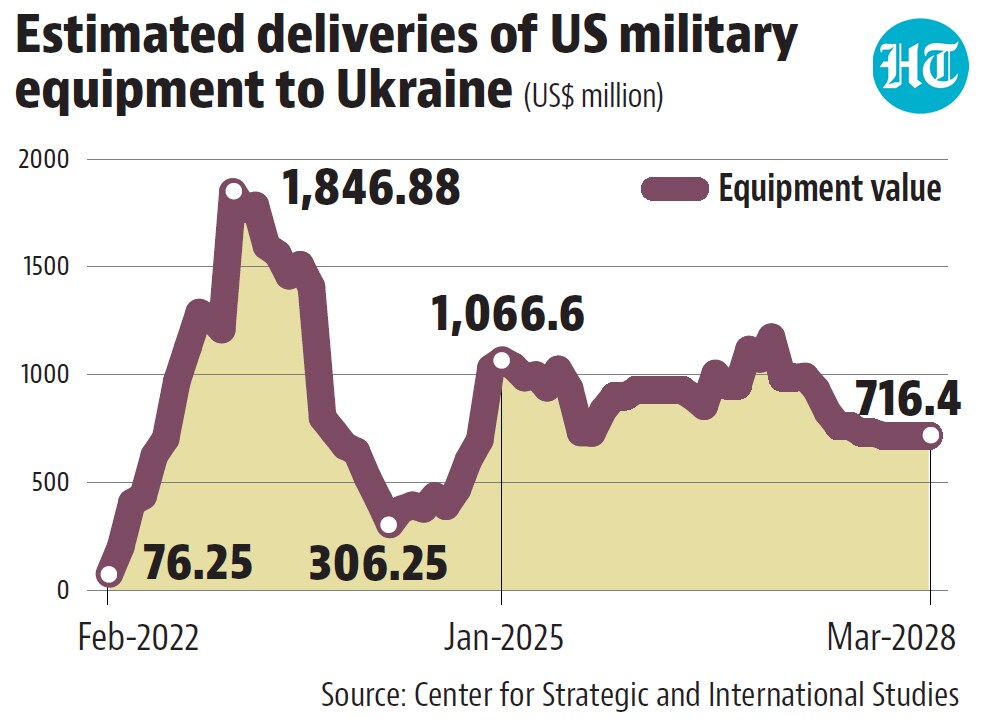
- Could Trump block military aid already in the pipeline?Military aid takes time to arrive, and much remains in the pipeline. Under existing commitments, US-supplied equipment will continue reaching Ukraine for years. The Ukraine Security Assistance Initiative by the DoD has particularly long delivery timelines. According to the Center for Strategic and International Studies, securing a contract takes about four months, manufacturing the first item around 24 months, and full delivery another 20 months due to production bottlenecks. While drawdown equipment is still being shipped, Trump could halt these deliveries, overriding previous commitments. Blocking shipments of newly produced weapons from contracts Ukraine signed using US funds would be more difficult, as they legally belong to Ukraine. However, his administration could attempt to redirect them to US forces, citing national security — an argument that, while a stretch, aligns with Trump’s past use of emergency powers for political objectives.


Unlock a world of Benefits with HT! From insightful newsletters to real-time news alerts and a personalized news feed – it's all here, just a click away! -Login Now!


