Thanks to the political churn Maharashtra has seen since the 2019 assembly elections, it is among the more complicated states to decipher in the 2024 contest. The BJP and the Shiv Sena fought the 2019 assembly elections together and won a majority. But the Shiv Sena walked out of the alliance in pursuit of the chief minister’s post and formed the government with the support of the Congress and the Nationalist Congress Party (NCP). This government lost power after a
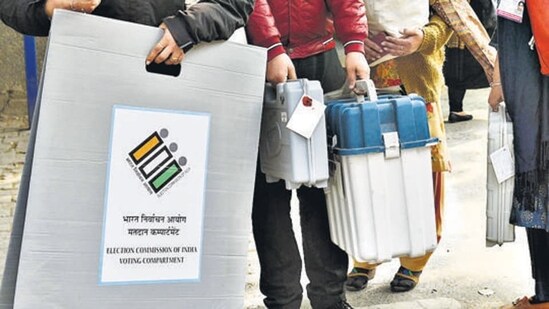
Representational image.
Why Maharashtra’s electoral math is complicated
BJP likely has the largest support base in Maharashtra, but its footprint varies regionally
The only election when the four major parties in the state contested an election on their own was the 2014 assembly election. The BJP ended up as the single largest party with vote share and seat share of 27.8% and 42.4% respectively. None of the other three parties came close the BJP on both these metrics. However, a region-wise break-up of the state shows that the BJP was not equally strong across the state. Its 2014 assembly election vote share varied from just 20.6% in Western Maharashtra to 35.3% in Vidarbha. The variation in the BJP’s seat shares – calculated on an assembly segment basis – was significantly larger.
And even with Congress and NCP coming together, BJP-Shiv Sena lost a significant number of seats in Vidarbha and western Maharashtra
A simple comparison of region-wise ACs won by the BJP-Shiv Sena and Congress-NCP show this clearly. While the joint tally of the BJP and Shiv Sena increased in the Konkan and Marathwada regions between the 2014 and 2019 assembly elections, their overall seat tally fell from 185 to 161 because of the large gains made by the Congress and NCP in the Vidarbha and western Maharashtra regions.
And things would have become much worse if the Congress-NCP alliance managed even a fraction of the Shiv Sena votes
HT has done a simple simulation on the basis of 2014 assembly election vote shares of the four major parties to reach this conclusion. The Congress-NCP alliance would have led in eight out of the 48 PCs in the state if the combined vote share of Congress-NCP is compared with that of the BJP and Shiv Sena. This number increases to 11, 15, 18, 23 or 26 if 10%, 20%, 30%, 40% or 50% of Shiv Sena’s vote went to the Congress-NCP alliance. It is this possibility which must have spooked the BJP into engineering a split in the Shiv Sena. For good measure, it followed up with another in the NCP.
What will the BJP gain even if it manages to capture a fraction of the Sena-NCP vote?
To simulate this scenario, HT assigned different fractions of the combined Sena-NCP vote in 2014 to the BJP. This shows that even if the BJP got 30% of their combined votes, the BJP alliance would win 22 PCs in the state. Moreover, 16 of these 22 PCs are among the 28 PCs the BJP is contesting in 2024. If the fractional shift is increased to 50%, the BJP alliance gets 35 seats, with 23 of these seats among the seats BJP is contesting in 2024. Since BJP won 23 PCs from Maharashtra in both 2014 and 2019 Lok Sabha, at least the losses for the BJP’s own tally are likely to be limited even if it is able to attract less than half of Sena-NCP voters to itself.
Abhishek Jha is Assistant Editor-Data at Hindustan Times. He uses statistical programming to generate newsworthy insights from large datasets. He is part of the team that produces Number Theory, a daily data story feature of the paper’s print edition. Since March 2024, he has been writing Weather Bee, a weekly column for the Hindustan Times website. He is a chemical engineer by training, who specialises in stories related to weather, climate, and the environment. Jha has been at HT since 2018, where he offers data-driven perspective and analysis on politics, environment, weather, climate, economy and society. His work includes data coverage of elections in India and abroad, including the 2019 and 2024 Lok Sabha elections; the disasters and extreme weather resulting from changing climate, such as floods, droughts, heat waves, cold waves, and dwindling snow cap in the Himalayas; the factors that drive poor air quality in northern India; the changing patterns of land use; the Covid-19 pandemic and its impact on labour market conditions; the changing pattern of consumer spending seen in the new consumer spending surveys; and social norms seen in the surveys such as the National Family Health Survey.
Roshan Kishore is the Data and Political Economy Editor at Hindustan Times. He heads the newsroom's data journalism team, which produces Number Theory, a daily data-driven feature for the print edition and the HT app. Number Theory uses data analysis and story-telling based on it to add value to the newsroom’s daily coverage by putting stories in a larger context on a range of issues, including politics, macroeconomy, markets, global affairs and climate. Under his leadership HT’s data journalism work has established itself as a niche product in Indian journalism and pushed the boundaries of marrying academic rigour with news sense and speed. Along with writing and editing data stories, he has also been writing a weekly political economy column called Terms of Trade for HT Premium. A trained economist with an MPhil degree from Jawaharlal Nehru University, Kishore has also been a visiting fellow at the Centre for Advanced Studies of India (CASI) at the University of Pennsylvania. Along with his journalistic work, his writings have also appeared in journals such as the Economic and Political Weekly and working papers for CASI and UNESCAP.
Unlock a world of Benefits with HT! From insightful newsletters to real-time news alerts and a personalized news feed – it's all here, just a click away! -Login Now!
Unlock a world of Benefits with HT! From insightful newsletters to real-time news alerts and a personalized news feed – it's all here, just a click away! -Login Now!
Home/Editors Pick/Number Theory: Why Maharashtra’s electoral math is complicated
{{^htLoading}}
Advertisement
{{/htLoading}}
SHARE THIS ARTICLE ON
{{#usCountry}}{{/usCountry}}
Notifications
Get breaking alerts directly from the newsroom
Notifications are on!You'll be notified when news breaks