E-Paper



Number Theory: Why Maharashtra’s electoral math is complicated
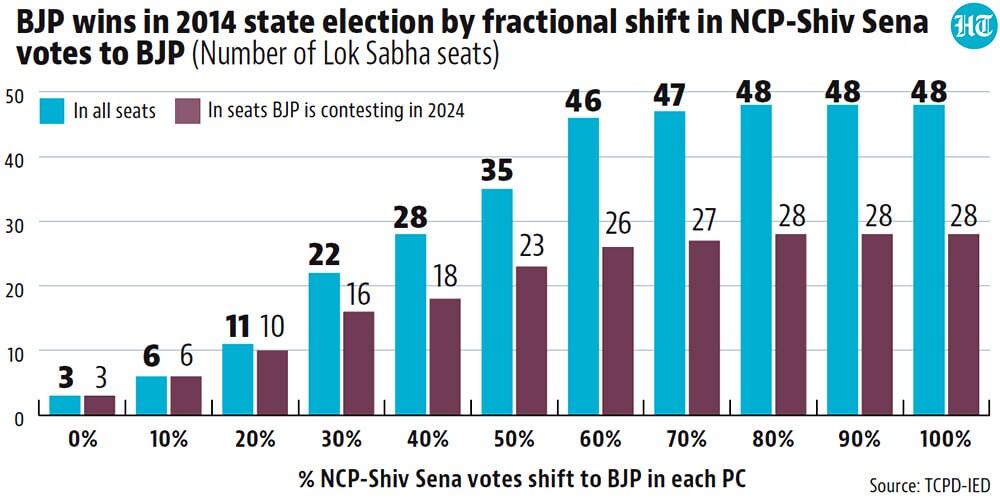
If the BJP got 30% of their combined votes, the BJP alliance would win 22 parliamentary constituencies in the state.

 Prefer HTon Google


Thanks to the political churn Maharashtra has seen since the 2019 assembly elections, it is among the more complicated states to decipher in the 2024 contest. The BJP and the Shiv Sena fought the 2019 assembly elections together and won a majority. But the Shiv Sena walked out of the alliance in pursuit of the chief minister’s post and formed the government with the support of the Congress and the Nationalist Congress Party (NCP). This government lost power after a split in the Shiv Sena in June 2022 with the larger group, officially recognized as the Shiv Sena, joining the BJP and forming the government. This alliance got a further boost after a split in the NCP, with the faction recognized as the NCP also joining. While the BJP has been able to form a government in the state along with its allies, the fact that no election has been held in the state before the Lok Sabha polls, has left the question of popular support for both the NCP and Shiv Sena groups unanswered. Here is why the BJP has decided to embrace this uncertainty in the elections.
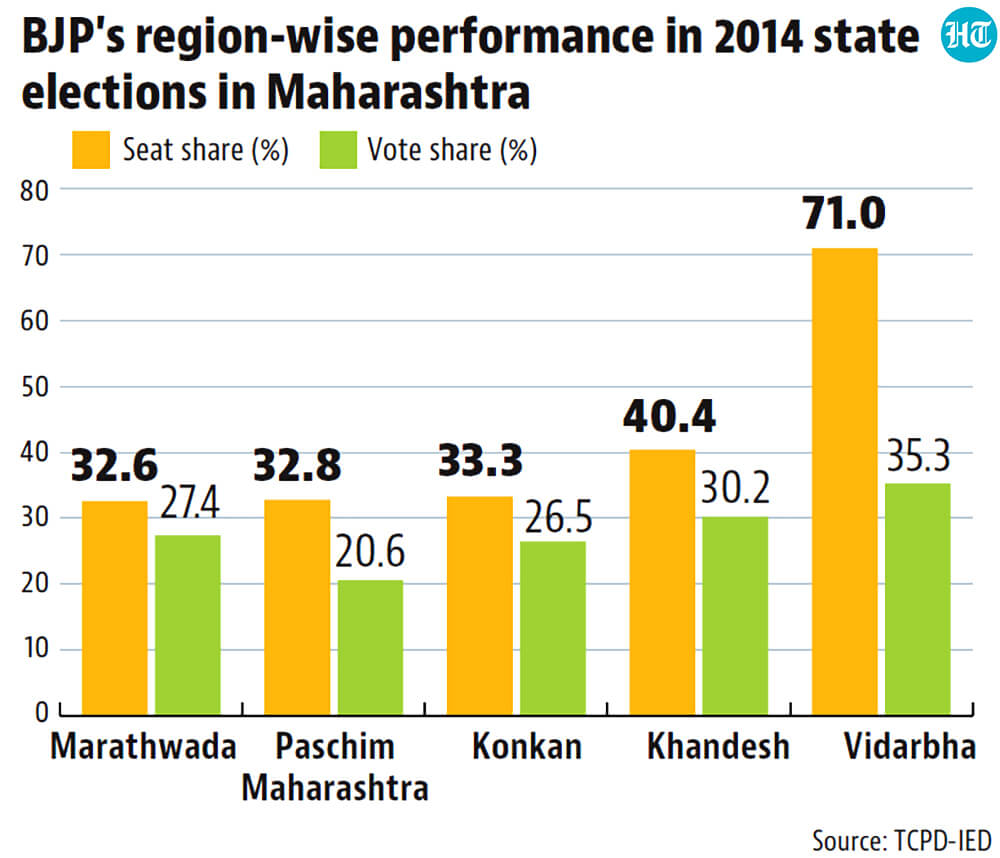
 BJP likely has the largest support base in Maharashtra, but its footprint varies regionallyThe only election when the four major parties in the state contested an election on their own was the 2014 assembly election. The BJP ended up as the single largest party with vote share and seat share of 27.8% and 42.4% respectively. None of the other three parties came close the BJP on both these metrics. However, a region-wise break-up of the state shows that the BJP was not equally strong across the state. Its 2014 assembly election vote share varied from just 20.6% in Western Maharashtra to 35.3% in Vidarbha. The variation in the BJP’s seat shares – calculated on an assembly segment basis – was significantly larger.
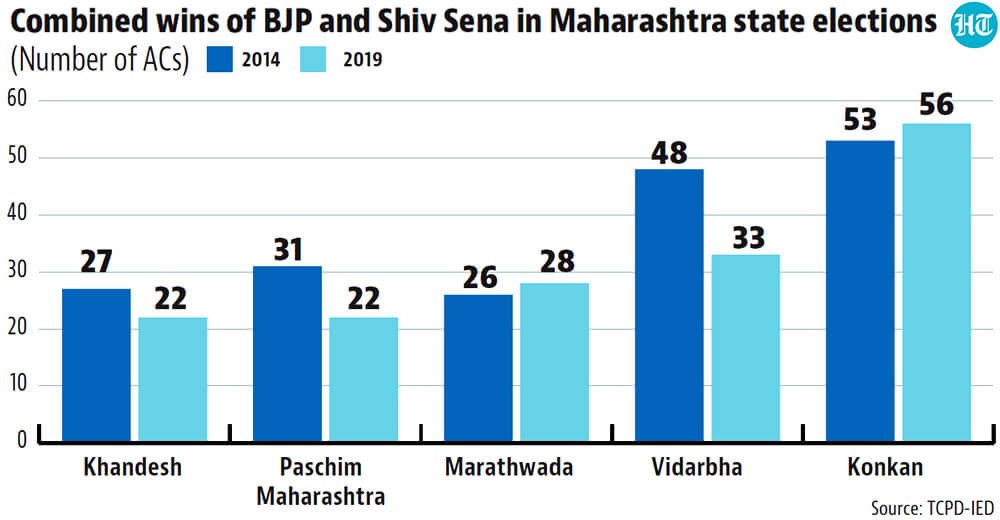
- And even with Congress and NCP coming together, BJP-Shiv Sena lost a significant number of seats in Vidarbha and western MaharashtraA simple comparison of region-wise ACs won by the BJP-Shiv Sena and Congress-NCP show this clearly. While the joint tally of the BJP and Shiv Sena increased in the Konkan and Marathwada regions between the 2014 and 2019 assembly elections, their overall seat tally fell from 185 to 161 because of the large gains made by the Congress and NCP in the Vidarbha and western Maharashtra regions.
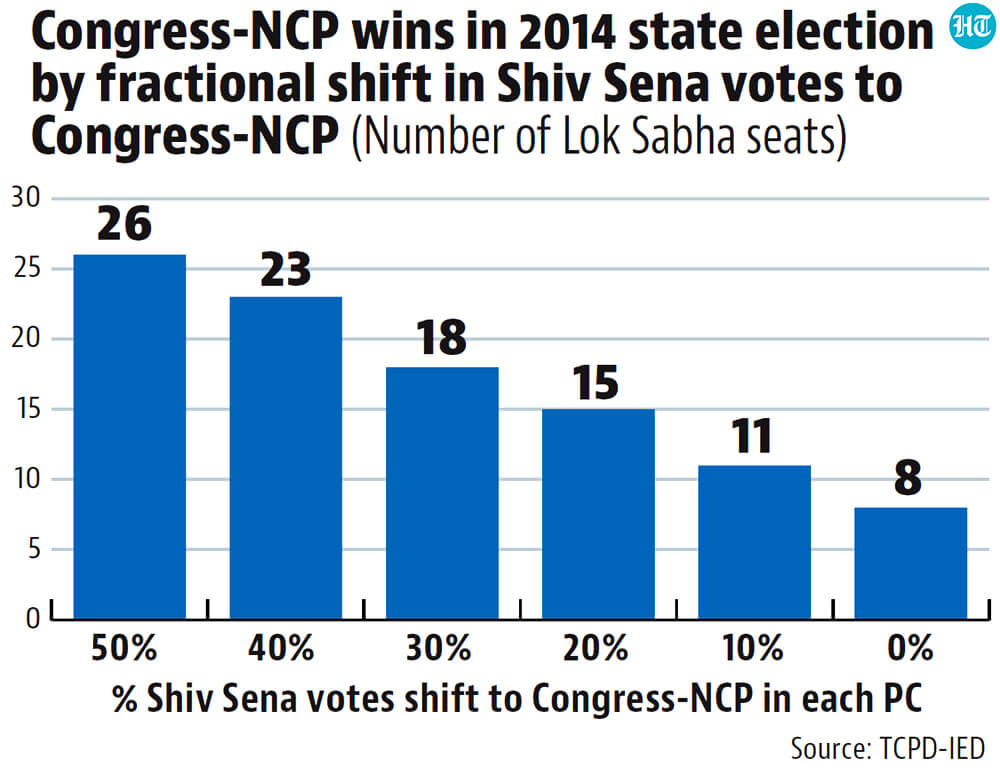
- And things would have become much worse if the Congress-NCP alliance managed even a fraction of the Shiv Sena votesHT has done a simple simulation on the basis of 2014 assembly election vote shares of the four major parties to reach this conclusion. The Congress-NCP alliance would have led in eight out of the 48 PCs in the state if the combined vote share of Congress-NCP is compared with that of the BJP and Shiv Sena. This number increases to 11, 15, 18, 23 or 26 if 10%, 20%, 30%, 40% or 50% of Shiv Sena’s vote went to the Congress-NCP alliance. It is this possibility which must have spooked the BJP into engineering a split in the Shiv Sena. For good measure, it followed up with another in the NCP.
- What will the BJP gain even if it manages to capture a fraction of the Sena-NCP vote?To simulate this scenario, HT assigned different fractions of the combined Sena-NCP vote in 2014 to the BJP. This shows that even if the BJP got 30% of their combined votes, the BJP alliance would win 22 PCs in the state. Moreover, 16 of these 22 PCs are among the 28 PCs the BJP is contesting in 2024. If the fractional shift is increased to 50%, the BJP alliance gets 35 seats, with 23 of these seats among the seats BJP is contesting in 2024. Since BJP won 23 PCs from Maharashtra in both 2014 and 2019 Lok Sabha, at least the losses for the BJP’s own tally are likely to be limited even if it is able to attract less than half of Sena-NCP voters to itself.