The carnival that the recent student protest became is now over. The government has conceded the most important demand of the protesters: Dharmendra Pradhan has been removed as the education minister. Now what? Conclusions galore. The most obvious are threefold.
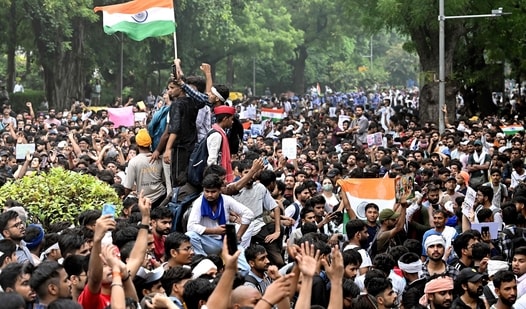
One, electoral victories for the government do not rule out large latent anger. The protests, unprecedented in terms of mass participation, followed the Bharatiya Janata Party's landslide and groundbreaking victories in multiple state elections, despite its partial setback in the 2024 national elections. Two, when an issue strikes a chord with the masses, mobilisation can transcend organisational barriers and surprise not just the government but also the Opposition. Simply speaking, this marks a bipartisan triumph—affecting both the government and the opposition—of extra-parliamentary over parliamentary politics. Three, mainstream politics, in the aftermath of this protest, will pivot towards the realm of the unknown from the obvious. The government will be scarred by the unexpected blow it has had to face and is bound to, even if subconsciously, imbibe an element of apprehensively second-guessing itself while taking key decisions. The Opposition will now like to believe that its partisan issues can draw larger popular support.
Readers will correctly note that all three points highlighted above are more subjective than objective in nature. The protests have introduced an X-factor in Indian politics which will make it more uncertain and inclined towards pre-empting things rather than seeing them as pre-ordained. This subjective factor is exactly what makes politics fascinating.
{{/usCountry}}Readers will correctly note that all three points highlighted above are more subjective than objective in nature. The protests have introduced an X-factor in Indian politics which will make it more uncertain and inclined towards pre-empting things rather than seeing them as pre-ordained. This subjective factor is exactly what makes politics fascinating.
{{/usCountry}}Subjectivities aside, are there some tangible takeaways from the protests? Can they make us wiser about Indian politics, not in terms of forthcoming electoral victories and defeats, but shifting fault lines, both in the present and the future? What follows is an attempt to flag some of these issues.
Class trumps identity once again
The Narendra Modi government agreeing to drop its education minister in the aftermath of an agitation is only the third instance of this 12-year-long government bowing down to a popular agitation. The first and second were when it agreed to roll back changes to the land acquisition law and the three farm laws early in its first and second tenures, respectively. In all three instances, the agitation was led by an economic interest-based group rather than an identity-based one; farmers in the first two and students in the latest one. There is good reason to assume that the class-based vanguardism of these protests also drew in sections of society which are not against the BJP on account of their identity and, in fact, could form the very core of its social support. This is yet another wake-up call for those who think identity, especially caste-based, can offer a bulwark when it comes to defeating the BJP.
Class-based victories at the barricades do not guarantee similar wins at the ballot box
Farmers’ protest is the biggest example to prove this point. Not only did the BJP not face any widespread headwinds among farmers – the largest occupational group in India – in the aftermath of the farmers’ protests, it even managed to retain power in Haryana and Uttar Pradesh, two places where the movement drew the most support along with the state of Punjab. In Uttar Pradesh, the BJP even managed to partner with the Rashtriya Lok Dal – the party with traditional support in the Jat peasantry and at the forefront of the farmers’ protests – after its 2022 victory in the assembly elections. This intuitive dissonance between popular protests and electoral results is best explained by Machiavellian bargains over sharing the spoils of political power with participants in such agitations, as well as with those who constitute a bigger fence-sitting silent majority. Identity can often be an effective arbiter in negotiating such deals to nullify class anger. This is what makes identity an extremely critical element in Indian politics.
The agitation-election dissonance does not make the latest protests insignificant
There is one area where the latest students’ protests mark a new chapter in Indian politics. They are the first instance of the youth agitating over a common anxiety – the failure of India’s education system to guarantee a better future for them. Only the really short-sighted will argue that the protesters who showed up were agitated over just the lack of propriety in conducting entrance examinations for medical colleges. Sure, police excesses acted as a catalyst, but something deeper was at work here. Numbers testify to the fact that India’s educated young population, the largest in the world, is failing to secure employment opportunities matching its aspirations. While battles around employment and employment-generating education have been fought on partisan lines in the past three and a half decades (read reservations), the latest agitation marks an instance where concern over the quality of the (education) pie trumped those over its distribution. This is not to say that the latter will cease to matter from here on, but it does mean that cynical or rightfully partisan ploys to tweak it might not be enough to divert attention from the former. This is unambiguously good news.
Government aside, this will also increase scrutiny on a parasitic class of capitalists in the country
Paper leaks are perhaps the most grotesque manifestation of the rise of what can only be described as a quasi-criminal educational industrial complex in India. This money-making behemoth thrives on a mix of aspiration and anxiety among students and their parents who are willing to spend beyond their means to do all it will take to boost their children's educational/employment prospects. There is good reason to believe that the vice transcends political affiliations in this country and is protected by political quid pro quo. Many local politicians and even elected representatives have business interests in education. India’s education regulators are mostly inefficient or complicit in allowing such a vested interest network to function. Some recent half-baked, ill-thought moves such as the formation of the National Testing Agency—where inefficiency seems to be the norm rather than the exception—might have boosted such irregularities. That the Modi government has set up an expert committee to look at the issue in detail might bring such issues into focus. Of course, attention does not guarantee action. Going after such vested interests will also entail cutting off an important political finance pipeline.
Are there larger takeaways from these four points?
Ethnic identities—be it religion or caste—are far from being at risk of losing salience in realpolitik in India. But they are also not immune to universal issues which matter beyond sectarian interests. This is more likely to be the case when the issue at hand manages to galvanise a class interest group which sees the government (rather than the market) as a direct adversary. Such expressions of anger—because they are rooted in protecting economic aspirations rather than managing economic pain—are unlikely to be controlled by populist palliatives that have come to denote the bipartisan modus vivendi to manage extra-ethnic political sentiment among the economically underprivileged in India.
This is exactly why these protests are good news for Indian democracy, and not just the Opposition. At their heart, they impart agency to the people at large and demand urgency from the powers that be to do justice to the aspirations of India’s demographic dividend. They have shown us that Indian politics will not just be the sum of doles and ethnic fissures. Whether this message gets amplified in larger politics in the country will depend on the established practitioners of politics. Honest implementation of its lessons will generate new enthusiasm and energy in politics. Self-suiting inferences will only fritter away the gains which could have accrued. It is early days to say which of these two tendencies will prevail.