The 2026 FIFA Men’s World Cup is now in its final week. It is also the most inclusive edition in the tournament’s history in terms of number of participating teams. But does greater inclusion also mean greater competitiveness? The data suggests otherwise. To be sure, national flags are only one part of football’s global story. Players are as mobile as the ball is in the field, representing countries different from where they were born or trained. This is what the
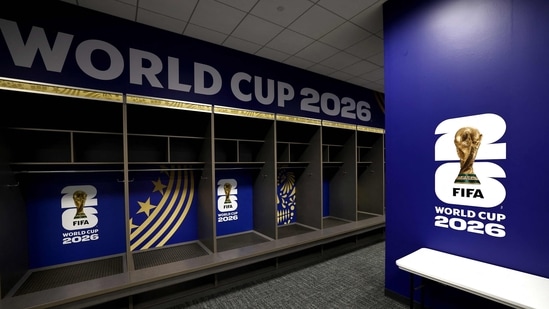
A locker room at the Dallas Stadium in Arlington. (AFP)
World Cup grows more inclusive, but old hierarchies hold
The gradual expansion of the World Cup
The FIFA World Cup began in 1930 with just 13 teams. It remained a relatively compact tournament for much of its early history. After settling at 16 participants in 1954, it stayed that size for nearly three decades. Expansion then came in stages. Spain 1982 increased the field to 24 teams, France 1998 to 32, and the 2026 edition to 48. What began as a relatively small gathering of footballing nations has become more inclusive event over the years. To be sure, some of the biggest countries such as India and China (whose only appearance ended in a group-stage exit in 2002) still don’t participate. Even so, the 2026 tournament marks a notable milestone: for the first time, the combined number of participating teams from African, Asian and Oceania exceeds that from Europe.
But what’s inclusive at kick-off isn’t so at full time
European teams accounted for only one-third of the 48 teams that qualified for the 2026 World Cup. Yet they make up six of the eight quarter-finalists and three of the four semi-finalists. Africa, despite sending a record 10 teams, saw only Morocco reach the quarter finals before being eliminated. Asia and North America had no quarter-finalists and Argentina is now South America’s lone remaining representative. Historically, this pattern has been remarkable consistent. Except for 1930 and 2010, Europe has supplied at least half of the quarter-finalists, or their equivalent, in every World Cup. In nine editions, they accounted for three-fourths or more of the last eight. In other words, the World Cup may now welcome more of the world at the starting whistle, but as the tournament progresses, the field continues to narrow to the same old names, who are mainly from Europe.
The safety net at group stage has its limits
Apart from the top two teams in each of the 12 groups, the eight best third-ranked teams also advanced to the knockout round of 32. A similar system was used in the 24-team World Cups of 1986, 1990 and 1994, when the best four of six third-placed teams reached the round of 16. The earlier experiment of promoting the best third-placed teams have, however, produced mixed results. Vast majority of the best third-placed qualifiers between 1986 and 1994 were eliminated in the Round of 16. But Belgium reached the semi-finals in 1986, while Argentina in 1990 and Italy in 1994 went all the way to the final. The 2026 cohort has been less convincing. Seven of the eight exited in the Round of 32 itself, with only Paraguay reaching the Round of 16 before getting eliminated.
Sreedev Krishnakumar is a data journalist who specialises in stories at the intersection of the economy, geopolitics, politics and finance. His work combines data analysis, reporting and visual storytelling to explain complex issues through evidence-based journalism, with a focus on making public data accessible and meaningful for readers. He joined the Data and Political Economy team at Hindustan Times in 2024 after working as a correspondent/data journalist at Moneycontrol, where he covered macroeconomics, markets, public finance and business. Over the course of his career, he has developed expertise in analysing large datasets, building interactive visualisations and using computational methods to uncover trends and patterns that inform public debate. Sreedev holds a Postgraduate Diploma in Integrated Multimedia Journalism from the Asian College of Journalism. His reporting interests include finance, economics, geopolitics, trade, technology and development.
Unlock a world of Benefits with HT! From insightful newsletters to real-time news alerts and a personalized news feed – it's all here, just a click away! -Login Now!
Unlock a world of Benefits with HT! From insightful newsletters to real-time news alerts and a personalized news feed – it's all here, just a click away! -Login Now!
Home/Editors Pick/World Cup grows more inclusive, but old hierarchies hold | Number Theory
{{^htLoading}}
Advertisement
{{/htLoading}}
SHARE THIS ARTICLE ON
{{#usCountry}}{{/usCountry}}
Notifications
Get breaking alerts directly from the newsroom
Notifications are on!You'll be notified when news breaks