Shifting workers out of agriculture is India’s biggest structural transformation challenge. Headline numbers suggest that it has made some progress on this front. Official employment data shows that agriculture’s employment share has fallen from 64.5% in 1993-94 to 46.1% in 2023-24. To be sure, agriculture’s employment share has been relatively flat in the last few years. What exactly are the dynamics of this change? An HT analysis of official employment statistics shows that a lot of the decline in employment
- Age-gap between agricultural and non-agricultural workers has increased after economic reformsHT has analysed unit-level data from official employment surveys to compare the average age of agricultural and non-agricultural workers in India over time. The two were similar at 33 years in 1993-94 but diverged significantly to 42 years and 36 years by 2018-19. The trend post 2018-19 has not changed much.
- There is a clear gender dimension to the increasing age-gap between agricultural and non-agricultural workersOnce again, the data shows it clearly. The average age of male agricultural and non-agricultural workers was 34 and 33 years in 1993-94. This number was largely the same for women: 32 years for both agricultural and non-agricultural workers. By 2023-24, the average age of male agricultural workers was 43 years compared to just 36 for male non-agricultural workers. For women agricultural and non-agricultural workers, the difference was smaller; 40 years and 37 years respectively. Is caste also a factor in the growing age-gap between agricultural and non-agricultural workers? All broad social groups have seen a growing gap between agricultural and non-agricultural workers, although this change is relatively smaller for Scheduled Tribes (STs).
- A more careful reading of rural data underlines the theory of younger men moving out of farmingIs it the case that elderly men are staying back in villages to work on farms while younger men in the family are seeking a living outside agriculture? An HT analysis of the latest Periodic Labour Force Survey (PLFS) data supports this theory. We classified rural households into four categories: those with just one male worker, those with more than one male worker but all employed in agriculture, those with more than one male worker but all employed outside agriculture, and those with more than one male worker but some in agriculture and some outside agriculture. In the fourth category, we checked the average age of members working in agriculture and outside it. This showed that 63% of fourth category households had agricultural workers older on average than their non-agricultural workers in 1993-94. This number increased to 82.5% in 2023-24.
- The richer a state’s villages, higher is the age difference between agricultural and non-agricultural workersA comparison of age-difference between agricultural and non-agricultural workers in the state with monthly per capita expenditure (MPCE) levels – MPCE is a better measure of individual incomes than per capita GSDP because the latter can involve business incomes too – shows this clearly. The higher a state’s rural MPCE, the higher is the age-gap between its agricultural and non-agricultural workers. The relationship holds for overall MPCEs too, but it is stronger for rural MPCEs.
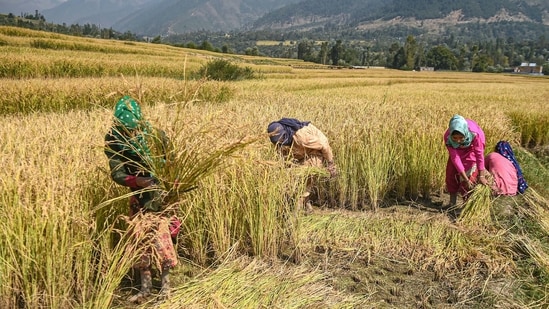
- What does all this mean?A lot of the fall in agricultural employment in India has been on account of younger male workers moving out of farms even as the women or elderly men in their households continue to work on the farms. (To be sure, women have also moved out of farm work in India, but that has generally led to women leaving the labour force entirely instead of moving to a different industry). Intuitively this makes perfect sense in India, as cities continue to receive young men looking for all kinds of blue-collar work. That this trend seems to have stagnated in the last four-five years – this is in line with the overall employment share of agriculture in the economy – raises the question whether this migration has reached its limits in India. On the other hand, we also ought to ask the question whether the out-migration of young men from agriculture poses headwinds to future productivity and income growth in our farms.
Roshan Kishore is the Data and Political Economy Editor at Hindustan Times. He heads the newsroom's data journalism team, which produces Number Theory, a daily data-driven feature for the print edition and the HT app. Number Theory uses data analysis and story-telling based on it to add value to the newsroom’s daily coverage by putting stories in a larger context on a range of issues, including politics, macroeconomy, markets, global affairs and climate. Under his leadership HT’s data journalism work has established itself as a niche product in Indian journalism and pushed the boundaries of marrying academic rigour with news sense and speed. Along with writing and editing data stories, he has also been writing a weekly political economy column called Terms of Trade for HT Premium. A trained economist with an MPhil degree from Jawaharlal Nehru University, Kishore has also been a visiting fellow at the Centre for Advanced Studies of India (CASI) at the University of Pennsylvania. Along with his journalistic work, his writings have also appeared in journals such as the Economic and Political Weekly and working papers for CASI and UNESCAP.
Abhishek Jha is Assistant Editor-Data at Hindustan Times. He uses statistical programming to generate newsworthy insights from large datasets. He is part of the team that produces Number Theory, a daily data story feature of the paper’s print edition. Since March 2024, he has been writing Weather Bee, a weekly column for the Hindustan Times website. He is a chemical engineer by training, who specialises in stories related to weather, climate, and the environment. Jha has been at HT since 2018, where he offers data-driven perspective and analysis on politics, environment, weather, climate, economy and society. His work includes data coverage of elections in India and abroad, including the 2019 and 2024 Lok Sabha elections; the disasters and extreme weather resulting from changing climate, such as floods, droughts, heat waves, cold waves, and dwindling snow cap in the Himalayas; the factors that drive poor air quality in northern India; the changing patterns of land use; the Covid-19 pandemic and its impact on labour market conditions; the changing pattern of consumer spending seen in the new consumer spending surveys; and social norms seen in the surveys such as the National Family Health Survey.