Grabbing a ₹1.4 crore annual package may have made headlines, but for a final-year B.Tech Computer Science student at Birla Institute of Technology (BIT) Mesra, the offer from LinkedIn was the result of years of disciplined preparation, consistent learning, and an unwavering focus on building real-world engineering skills.
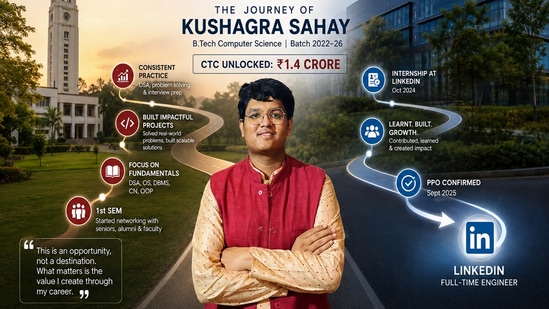
Kushagra Sahay, a B.Tech student of BIT Mesra, secured an internship with the company in October 2024. He converted it into a full-time Pre-Placement Offer (PPO) in September 2025—an achievement that places him among the highest campus recruiters this placement season.
In an exclusive conversation with HT Digital, Kushagra reflects on the journey that began with reaching out to seniors and alumni in his very first semester and evolved into a carefully planned roadmap of coding practice, strong computer science fundamentals, impactful projects, and resilience through setbacks. He also shares what LinkedIn's interviewers looked for beyond coding skills, why students should stop chasing DSA ratings, how AI is reshaping software engineering careers, and the five lessons every aspiring tech professional should remember while preparing for campus placements.
Read below.
1. What was your first reaction when you received the offer, and who was the first person you shared the news with?
{{/usCountry}}Read below.
1. What was your first reaction when you received the offer, and who was the first person you shared the news with?
{{/usCountry}}My parents were the first to know when the confirmation arrived because I was at home. The internship offer had arrived on October 29, 2024, and the PPO confirmation followed in the first week of September 2025. When I saw the offer, it took a while to sink in. It wasn't only the joy of getting into LinkedIn; it was years of preparation finally leading somewhere. My parents hugged me and were happy. Once things calmed down, they told me something I still carry with me: this is an opportunity, not a destination, and what matters is the value I create through my career. That kept me grounded even on my happiest day.
2. Looking back at your four years at BIT Mesra, what were the key milestones or decisions that played the biggest role in helping you achieve this placement?
Key milestones and decisions were: -
a. Networking with relevant alumni’s, seniors and faculties right from the first sem on LinkedIn, and reaching out to them with my set of questions without any hesitation, building meaningful connections is important if you are choosing this career path.
b. Not focusing on DSA contest ratings etc, keep practicing and improving, don’t chase ratings, focus on patterns and concepts, this was a key advice I got from my seniors.
c. Build unique projects or contribute to open-source projects, that are impactful to some set of people around you, think from an angle of solving a problem that exists and try to deliver a solution that scales well, think from all design perspectives and deliver the final solution, this will make your resume standout.
d. Focus on your CGPA, keep it decent enough, as that is a filter factor in On campus placements.
e. Staying consistent throughout the preparation, with a good planning and strategy.
Free AI course by Government of India: How to register for YUVA AI for ALL and get a certificate
3. Can you take us through your placement preparation strategy? How did you balance academics, coding practice, projects, internships, and interview preparation?
My preparation ran on consistency, not marathon study sessions. Each day I divided time across four areas: DSA practice, Computer Science fundamentals, project work, and interview preparation. Problem-solving took the largest share. Alongside it, I kept revising Operating Systems, DBMS, Computer Networks and Object-Oriented Programming, since interviewers tested these in depth. I also kept refining my projects because those conversations often go deeper than the coding rounds. And I practised explaining my thinking aloud; the correct code matters less if you cannot walk someone through it. Balancing all of this with examinations and deadlines was hard at times. What saved me was planning my week in advance and having friends with the same goals. We solved problems together, took mock interviews, reviewed each other's resumes and kept one another accountable. That shared discipline made the load feel lighter than it was.
4. What was the recruitment process at LinkedIn like? Could you share your interview experience, the kinds of questions you were asked, and what you think helped you stand out from other candidates?
The process had three stages: an online coding assessment, a Data Structures and Algorithms interview, and a managerial round covering projects, core subjects and behavioural discussion. The managerial round was the toughest because it demanded constant switching between technical depth and clear communication. What surprised me was how far the interviewers went into my projects. They wanted to know why I designed the system a particular way, how components interacted, how the database was structured and how it would scale. At one point, an interviewer opened my deployed project on his phone and asked questions while actually using it. Since I had personally designed and built those systems, I could defend every decision. I believe that's what set me apart. Anyone can list projects on a resume; being able to explain every engineering choice behind them is a different matter.
British Council shares 5 things students should know about UK IBC's in India
5. Which technical skills, programming languages, projects, or internships do you believe had the greatest impact on your selection? Are there any resources or platforms you would recommend to students?
Three things carried the most weight. Problem-solving through DSA got me through the coding rounds. Fundamentals in Operating Systems, DBMS and Computer Networks held up during technical discussions. And communication, the ability to explain decisions and trade-offs, mattered in every round. My internship at LinkedIn itself was significant; it gave me direct exposure to their engineering culture before the final offer. Java was my entry point into programming back in Class 6, and that early grounding shaped how I approach code even now. On projects, I'd say build things people actually use. Software running in production, with real users, teaches you about deployment, scalability and maintenance in ways tutorials cannot. As for specific platforms and resources, for Data Structures and Algorithms, I used Abdul Bari and Striver TUF videos on youtube for conceptual preparation, and LeetCode, InterviewBit platforms for practicing questions and giving contests. For Operating System, DBMS, Computer Networks etc. fundamental subjects, I kept preparing notes when they were taught during the semesters, and gradually levelled them up, from multiple sources like youtube videos, GFG, InterviewBit, and standard books prescribed in our semester courses. For learning skills like web development, agentic orchestration etc, I watched youtube videos of Hitesh Choudhary, Piyush Garg, freecodecamp, and standard udemy courses, and used to do the practical tasks along with them, which helped learn a lot.
6. Every success story comes with its share of setbacks. Did you face any rejections, failures, or moments of self-doubt during your preparation? How did you overcome them?
Yes, and I think it's important to be open about this. During internship season, the hiring market was challenging. I made it to the final rounds at Google but was unable to convert, which was frustrating and made me question myself. Rather than stopping there, I changed my approach: stayed open to more opportunities, kept preparing, and eventually secured another internship offer, which eased the pressure. The LinkedIn opportunity came after that. Those rejections taught me resilience. Sometimes timing simply doesn't favour you, and preparation alone doesn't guarantee an outcome on a given day. What you can control is being ready when the next door opens. I'd also credit my friends here; when self-doubt crept in, having people around me who shared the same struggles and refused to let each other quit made all the difference.
7. The tech industry is evolving rapidly with the rise of AI and automation. What skills do you think engineering students should focus on today to remain competitive for top global roles?
AI has changed how we learn more than what we need to know. Students today can grasp concepts faster, debug more efficiently and explore new technologies far quicker than earlier batches could. But AI should remain a learning partner, not a substitute for thinking. Companies still test whether you can solve problems independently, whether your fundamentals hold, and whether your engineering judgment is sound. None of that has been automated away. That said, students should actively build AI capability into their skill set: agentic systems, agent orchestration, prompt engineering, AI evaluation, and multistep AI workflows. Learn tools like Claude Code and Copilot and use them to add AI-based features to your own projects. The engineers who combine strong fundamentals with the ability to use AI well will have a real advantage over those who have only one of the two.
8. Many students dream of landing high-paying jobs at leading technology companies but often don't know where to begin. Based on your experience, what are the top five pieces of advice you would give to aspiring software engineers preparing for campus placements?
First, build your foundation before chasing every new technology. Programming fundamentals and core subjects come first; breadth can wait. Second, seek mentorship early. Guidance from seniors and professors saved me months of trial and error, and it's freely available if you ask. Third, choose your peer group carefully. Surround yourself with people who are curious and hardworking; growing together beats competing. Fourth, don't over-invest in one dimension of preparation. Students often pour everything into a single area and neglect the rest. Know what matters when, and keep some room for hobbies and friendships, because that balance sustains you through a long preparation cycle. Fifth, chase excellence, not the package. The offer makes headlines; the willingness to keep learning defines the career. Put in the work sincerely and leave the results to the Almighty.