More than 1.2 million students appeared for the Central Board of Secondary Education class 12 examinations this year. Hansika Shukla and Karishma Arora emerged as the national toppers, scoring 499 out of 500. Both were the students of humanities. In the city, Aakriti Kiran, a student of humanities from Amity International School in Sector 46, was the district topper, scoring 99.2% and 496 marks out of 500.
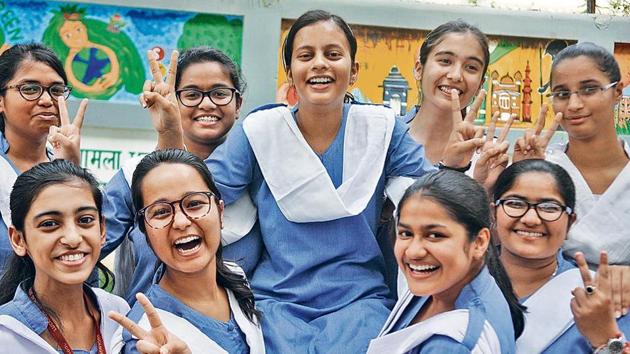
In many other city schools too, toppers have been from humanities. Until even a decade back, arts or humanities as the nomenclature goes now, was perceived by many as the educational stream of the last resort — one that most parents discouraged their children from taking up. But in the last few years students have seen the societal attitudes change.
Yukti Yadav, aged 18, a student of humanities, who is the topper in Blue Bells School in Sector 10 with 98.4%, said, “A lot of people, except my parents, discouraged me from taking up humanities after class-10. But I knew I wanted to study humanities. It keeps you connected to the world you are living in and does not put you in an academic cocoon.” School principals and educationists said that the past few years have seen more students take up humanities, owing to better career opportunities, a genuine interest on the part of students, and the overall availability of better infrastructure for humanities at the higher secondary level.
{{/usCountry}}Yukti Yadav, aged 18, a student of humanities, who is the topper in Blue Bells School in Sector 10 with 98.4%, said, “A lot of people, except my parents, discouraged me from taking up humanities after class-10. But I knew I wanted to study humanities. It keeps you connected to the world you are living in and does not put you in an academic cocoon.” School principals and educationists said that the past few years have seen more students take up humanities, owing to better career opportunities, a genuine interest on the part of students, and the overall availability of better infrastructure for humanities at the higher secondary level.
{{/usCountry}}Shiv Nadar School, Gurugram, has two toppers, one of whom is from humanities. Monica Sagar, Principal, said that the marking system in humanities earlier made it very difficult to score. “The revised system of marking emphasises on keywords. Examiners are asked to give marks if the necessary keywords are present in an answer. This keyword-oriented marking system allows even humanities students to score as high as science or commerce students. A 99 in history or psychology was unheard of even ten years back. But it is extremely plausible now.”
As the number of students opting for humanities increases, schools too have come up with better infrastructure for those who want to pursue humanities at the senior secondary level.
Amity International School began its humanities stream just five years back. Kusum Kapoor, a teacher of history at the school, says that ever since that time, the school have had a slew of toppers from humanities. She said, “Students who opt for humanities often display a greater amount of focus and emotional intelligence towards their subjects.”
But even as the number of students opting for humanities increases, graduation and post-graduation facilities for humanities students remain limited and mostly concentrated in urban pockets.
Nikita Audichya, associate professor of political science in Delhi University, said, “While it is great that more students are opting for humanities at the higher secondary level, it is still an extremely urban, niche and metropolitan phenomenon that has not percolated down to tier-2 and tier- 3 cities. Humanities options in Rajasthan or Gujarat universities won’t be the same they are in Delhi University.”
Audichya attributes this phenomenon to the disparity meted out to arts colleges. She said, “It is ironic that colleges offering liberal arts still receive much less funding than engineering and science colleges in the country.”
Kanika Ahuja, associate professor with Department of Psychology, Lady Shri Ram College, too voiced similar sentiments. Nonetheless, she acknowledged that humanities today offer better professional opportunities now than it used to do before. She said, “For the last two years, our Economics students have been hired at packages of ₹35 lakh. While this is a rarity, there is no denying that students of humanities today have a greater number of career options.”
Ahuja also attributed the increase in humanities students to the rule instituted by Delhi University 10 years back. The rule states that if you change your stream for your graduation program, there will be a deduction of 2% from your cumulative percentage at the class-12 examinations. She said, “This has made kids more focused. You cannot toy around with science in class-12 and then take up psychology or political science Honours for your graduation. How will you make it to a premier college if you straight away lose 2%?”
Even as the number of humanities students increase, a worrying trend is the persistent feminisation of the stream. Audichya states that during her lectures in different Delhi University colleges, the number of girls in the class is always over 70%, while Yukti Yadav said that there was only one boy in a class of ten in humanities in the 12th grade. He too left the school in the middle of the year.
Despite these palpable challenges, boys too are challenging the gender gap. Parth Lakhani, an Amity International School student who has scored 98.5% in humanities and a 100 in psychology, comes from a family of engineers. He, however, did not face any resistance from his family when he opted for humanities. He said, “How can education be masculine or feminine? It’s archaic and regressive. I could score high because I loved my subjects. I have seen boys suffer by taking up science and commerce, as their skills and aptitude may lie in humanities. I am sure, if I was forced to take up science or commerce, I would not do half as good as I did.”
Even while new careers open up, and students see waves of change, CBSE asserts that there never was, in fact, any demarcation. A CBSE official on condition of anonymity said, “The fact is that the only mandatory subject for students in CBSE is English. Apart from that, a child is welcome to choose any four subjects he or she wants.”
Anita Karwal, CBSE Board chairman, in her letter addressing the students of classes 10 and 12 earlier in February this year, wrote that although the subjects children take up are important, but what matters the most is “a life and learning filled with curiosity, care, creativity and meaning.” She added, “Studies, irrespective of anything, should lead to the holistic development of children and impart them with life skills that will help them face the world.”