New Delhi: The Centre, on Thursday, launched the country’s first-ever integrated curriculum framework for children between the ages of 3 and 8, emphasising creative ways of teaching, limited use of textbooks, use of mother-tongue in classrooms, and assessment through observation and analysing creativity.
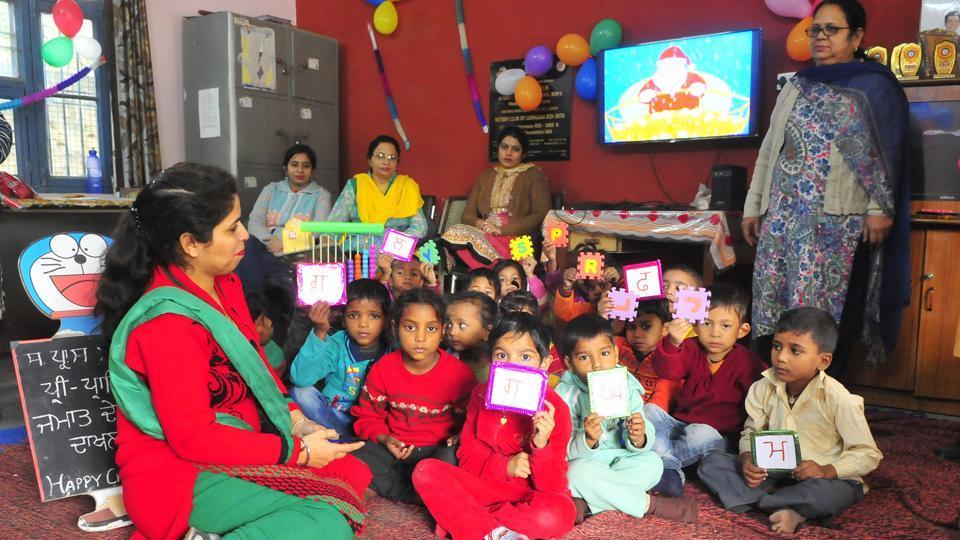
The “National Curriculum Framework (NCF) for the foundation stage” will be the basis for all pedagogy adopted by schools, pre-schools and anganwadis for children studying between nursery and Class 2 in institutional setups. It will be
New Delhi: The Centre, on Thursday, launched the country’s first-ever integrated curriculum framework for children between the ages of 3 and 8, emphasising creative ways of teaching, limited use of textbooks, use of mother-tongue in classrooms, and assessment through observation and analysing creativity.
The “National Curriculum Framework (NCF) for the foundation stage” will be the basis for all pedagogy adopted by schools, pre-schools and anganwadis for children studying between nursery and Class 2 in institutional setups. It will be followed by NCF editions for higher classes, as well as teacher and adult education, over the next few months in line with the National Education Policy (NEP) 2020.
While launching the NCF, Union education minister Dharmendra Pradhan said textbooks and learning material for the foundational stage will be prepared by the National Council of Educational Research and Training (NCERT) based on this framework by coming “Basant Panchami” ie January 2023.
HT explains how education at the foundation level, ie from preschool to class 2, is set to change once the NCF is implemented.
Why a separate curriculum framework for younger children?
On Thursday, terming the NCF for foundation level as the “most challenging” and “most responsible” task, Pradhan said, “Researches have shown that over 85% of an individual’s brain development occurs by the age of 6-8 years. Therefore, it is very important what children at this young age be taught and how they are being taught.”
According to the document released by the ministry, the framework is important for the development of education in a country where vast numbers of school-going children routinely fail to pass learning outcome tests at age-appropriate complexity levels.
The document acknowledges that currently “there is a learning crisis in India”, as children are enrolled in primary school but are failing to attain basic skills such as foundational literacy and numeracy. “During 2020-21, of the 19,344,199 students admitted in Grade 1, only 50.9% had pre-school experience. Of these, 24.7% had preschool experience in the same school, 7.9% in another school and 18.3% in an anganwadi/ ECCE centre, respectively,” it states.
How will young children learn at schools under the new NCF?
The NCF said that for ages three to six, there should not be any prescribed textbooks for the children, and instead recommended simple worksheets for curricular goals and pedagogical needs.
“In the first three years of the foundational stage, for ages three to six, there should not be any prescribed textbooks for the children… children in this age group should not be burdened with textbooks. While textbooks might be inappropriate for children of ages 3 to 6, activity books can guide teachers to sequence activities and learning experiences,” the document said.
It prescribed story-based, project-based, theme-based, and electric approaches for teaching children in the foundation stage. “Stories are a particularly good medium for learning about social relationships, ethical choices, for understanding and experiencing emotions, and becoming aware of life skills. While listening to stories, children learn new words, thus, expanding their vocabulary and learning sentence structure and problem-solving skills,” the NCF recommended.
Besides, it recommends that children can be taught using toys, art, and craft, music, outdoor plays, field trips, spending time with nature, and conversations.
When will textbooks be introduced to kids? What will the textbooks be like?
The NCF prescribed that textbooks can be introduced to students at the age of six to eight at a foundational level. However, it also cautioned that the textbooks for this stage should not only contain content for classroom instruction but also act as workbooks to give opportunities for children to work on their own and also as a record of their work.
“Utmost care needs to be taken to ensure that the content and activities in the classroom are not limited only to what the textbook contains. Particularly for language and literacy development, a wide variety of sources of text, including good children’s literature, needs to be brought into the classroom. Teachers should supplement the textbook with worksheets where necessary and appropriate,” the document said, recommending digital and audio-visual material references.
The framework stated that regional variations need to find adequate representation in textbooks. Balanced gender and community representation through the use of stories, characters, and pictures, must be ensured, books need to be attractive and should grab the attention of young children. They should have a balance between visual material and text should be tilted towards visual materials.
“In the Indian context, it is important to maintain diversity and inclusion as an important principle in the choice of content for textbooks. Even within states, there are regional variations and these need to find adequate representation in textbooks. Balanced gender and community representation (e.g., through the use of stories, characters, pictures) must be ensured,” the document stated.
Besides, special care should be taken to avoid the promotion of stereotypes in textbooks such as “owls and snakes as evil, or dark-skinned people as scary, or the mother always handling the kitchen”, the document highlighted.
Mother tongue as the medium of instruction
While emphasising that all languages must be welcomed and celebrated in the classroom, NCF said that children should be encouraged to express themselves, interact, and learn through their “home languages” or mother tongues during the foundational stage.
“The mother tongue or home language is more than just a mode of communication for the child, but also relates closely with the child’s personal, social, and cultural identity. Rejecting this rich experience through the imposition of a new language as the medium of instruction is neither fair to children nor desirable at the early stage of their education..,” the document said.
It states that the use of unfamiliar language at the foundational stage can “reverse the entire learning process”. It recommends that English can be one of the second languages taught at the foundational level.
How will mathematics be taught at the foundation level?
Learning mathematical skills must follow the simple to the complex path, the NCF states. It means that in the initial years, children learn mathematical vocabulary (matching, sorting, pairing, ordering, pattern, classification, one-to-one correspondence) and mathematical concepts related to numbers, shapes, space, and measures. These skills gradually move to more complex and higher skills (for example, quantity, shapes and space, and measurement) at later ages.
“In the mathematics teaching-learning process, those mathematical skills which are more focused on applying mathematical skills in a real-life situation to understand, solve, reason, communicate, and make decisions need emphasis,” the framework recommends.
The framework highlights that there is a need to develop a positive attitude towards learning mathematics in the early years. “The system needs to generate awareness of the strong affective responses mathematics as a subject can generate, and the pivotal role a strong foundation in early mathematics can play in pruning the negative image the subject has for many. Children should learn to enjoy mathematics,” it stated.
Incorporating “ethical and moral awareness” into the curriculum
The NCF emphasised incorporating “ethical and moral awareness and reasoning” in the curriculum through direct methods such as classroom activities, discussions, and readings; and indirect methods such as literature that addresses ethical and moral principles and “inculcates values such as patriotism, sacrifice, non-violence, truth, honesty, peace, righteous conduct, forgiveness, tolerance, empathy, helpfulness, courtesy, cleanliness, equality, and fraternity.”
It prescribed that children should be allowed to read and learn from the original stories of the Panchatantra, Jataka, Hitopadesh, and other fables and inspiring tales from the Indian tradition. Besides, it also suggested that stories from the lives of great Indian heroes of history are also an excellent way to inspire and introduce core values in children.
How will children be evaluated at the foundational level?
The NCF recommends two broad methods of assessment that are appropriate for the Foundational Stage — observations of the child and analysing artefacts that the child has produced as part of their learning experience. It recommends against tests and examinations.
“Assessment should not contribute to any additional burden for the child. Assessment tools and processes should be designed such that they are a natural extension of the learning experience for the child. Explicit tests and examinations are completely inappropriate assessment tools for this stage,” it stated.
How will the NCF be implemented? Will it be mandatory for states?
Based on the recommendations of the NCF, the NCERT will design books and study materials for the foundational level. The states and the union territories will also revise their state NCFs based on this document. This means the states will design their textbooks and pedagogies based on the recommendation of the national framework. However, it won’t be mandatory for the states to adopt everything mentioned in the document.
What do experts say?
Educationist Meeta Sengupta said the “systematic and well-researched” NCF for the foundational stage is a valuable addition to educational policy literature. “It is significant not just for its guidance for the future, but more for its careful construction of layered ideas that build the structures of what will be taught in the classroom. The whole ecosystem approach is commendable, as is the attempt to explain and even illustrate how this is delivered by teachers. This draft, however, will benefit hugely with inputs from practitioners on the frameworks — on additional approaches, or even meanings of the broad goals in their context,” she said.
Calling it a progressive document, Ameeta Wattal, an educationist, said that intensive training at the grassroots level will be required to implement it successfully. “To introduce toy-based, game-based learning and experimental pedagogies, consistent training of teachers will be required for several years across the country and it should not be limited to the urban pockets. This can be done with the help of corporate CSR activities as well,” she said
Jyoti Arora, principal of Mount Abu School in Delhi, said that the practices prescribed in the NCF for the foundation stage were long awaited. “We need to adopt modern pedagogies to make children future ready. However, to implement the NCF we will require adequate support from the government in expanding our infrastructure and resources,” she said.
One Subscription.
Get 360° coverage—from daily headlines
to 100 year archives.
Archives
HT App & Website