For the better part of a decade, executive education in India was framed as a binary. You either went fully online, trading the classroom for convenience, or you carved out two years for a full-time residential MBA. Somewhere around 2021, a third option got dismissed as a compromise: neither fully digital nor fully in-person, just a patchwork of both. That framing was wrong, and the data from the last eighteen months makes the case plainly.
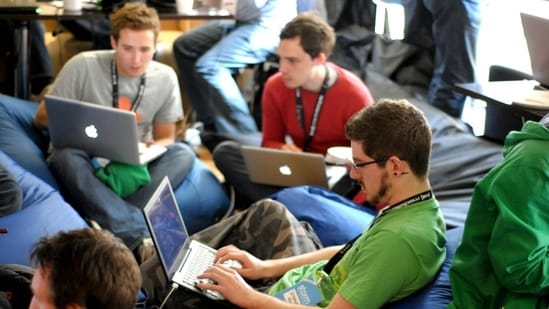
Globally, preferences are actually swinging back toward in-person learning. GMAC's 2025 Prospective Students Survey found close to three in four candidates worldwide now prefer full-time, in-person programmes, the strongest pull toward the classroom since before the pandemic. On the surface, that looks like bad news for anything digital. But the shift is concentrated almost entirely among candidates in their twenties, choosing their first postgraduate degree over a full-time job offer. Working professionals past thirty are moving differently. They are not returning to full-time in-person study. They are gravitating toward formats that combine part-time flexibility with real, scheduled human contact, which is precisely what a well-built hybrid programme delivers.
Engineering the Future: How technology is changing the way India builds and grows
That distinction matters enormously for how Indian institutions and employers should be thinking about executive education right now. The credential question has shifted.
{{/usCountry}}That distinction matters enormously for how Indian institutions and employers should be thinking about executive education right now. The credential question has shifted.
{{/usCountry}}Five years ago, the primary question a prospective student asked was whether an online degree would be treated the same as a regular one by employers. That question hasn't disappeared, but it has been answered well enough, for accredited programmes at least, that it is no longer the deciding factor. UGC-DEB recognition, NAAC accreditation, and NIRF rankings have become table stakes rather than differentiators.
What has replaced it is a harder question: does the format build something a senior professional cannot get from a laptop alone? For someone three years into their career, the answer might reasonably be no, since the content matters more than the room it's delivered in. For a director or VP with ten or fifteen years of experience, the answer changes, because a large part of what they are paying for isn't the curriculum. It's the peer cohort, the case discussions that only work with a room full of people who have run P&Ls, and the informal learning a chat window cannot replicate.
From Corporate Jobs to Classrooms: Why professionals are choosing teaching
This is why formats like the IIM Nagpur Blended MBA for Working Professionals and IIM Mumbai’s Blended Post Graduate Programme in Management (MBA-BPGP), which pairs online delivery with mandatory campus immersions, who want an IIM credential without giving up their jobs, but who also recognise that a purely asynchronous degree strips out the part of an MBA that senior executives actually value most.
Why 'hybrid' cannot mean 'online with an occasional Zoom call'
There's a genuine risk in how the word hybrid gets used in marketing material across the sector, mine included. Too often it is applied loosely to any programme with a live session bolted onto pre-recorded content. That is not what senior professionals are responding to.
The hybrid models gaining real traction have two non-negotiable features. First, in-person components that are structurally embedded rather than optional add-ons, whether that's residential weeks, modular weekend blocks, or campus immersions tied to specific milestones. Second, cohort design that deliberately groups people at a similar career stage, so the peer learning is dense rather than diffuse. Strip out either of those, and you are left with an online programme wearing a hybrid label, a distinction employers and candidates alike are getting sharper at spotting.
Can classrooms keep up with a job market changing in months?
What this means for institutions and for India's talent pipeline
According to Technavio, India’s online education market is projected to grow by USD 7.4 billion (Source). That is not a slow evolution; it is a structural rewiring of how mid-career learning happens in this country. But growth of that scale tends to invite a flattening of quality, where format gets marketed as substance.
The institutions that will earn trust with senior professionals over the next few years are the ones willing to say plainly what a fully online format is good for, and what it is not. Flexibility and accessibility are real, valuable outcomes for early and mid-career learners. But for a professional at the point where the degree is meant to compress a decade of leadership exposure into eighteen months, the room still matters. Not because digital delivery is inferior in some abstract sense, but because leadership judgment is built through friction with other people making real decisions, not through content consumption alone.
The middle ground isn't winning because it's a compromise between two extremes. It's winning because, for this specific audience, it was never actually a compromise. It was the format the outcome demanded all along.
(This article is written by Ranjita Raman, CEO, Jaro Education)