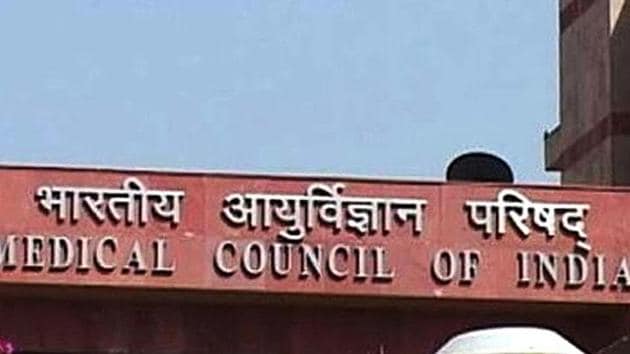
Government allows medical colleges in states, UT capitals to be built as high-rises
The Medical Council of India has made amendments to the Establishment of Medical College Regulations, 1999, lowering the minimum land requirement for construction of medical colleges in all state and UT capitals.
Taking into account the increasing shortage of land in urban areas, the Union health ministry has allowed medical colleges in state capitals to be built as high-rises, provided it complies with local regulations.
In 2012, the MCI had relaxed the norms for urban cities with a population of 25 lakh or more. (PTI File Photo)
{{^htLoading}} {{/htLoading}}
The Medical Council of India (MCI) has made amendments to the Establishment of Medical College Regulations, 1999, lowering the minimum land requirement for construction of medical colleges in all state and UT capitals. The total built-up area requirement has been brought down to 10 acres from 20 acres.
In 2012, the MCI had relaxed the norms for urban cities with a population of 25 lakh or more.
The 12 cities in the category were Delhi, Jaipur, Kanpur, Lucknow, Kolkata, Ahmedabad, Surat, Greater Mumbai, Pune, Hyderabad, Bengaluru and Chennai. “Norms have also now been relaxed for capitals where land is an issue. As population is growing, there is scarcity of land, along with the need for more medical colleges. We have to look for effective solutions,” said Dr Reena Nayyar, secretary, MCI.
{{^htLoading}} {{/htLoading}}
{{^usCountry}}
The minimum requirement for building a medical college in the select cities is the Floor Area Ratio/Floor Space Index. It is the ratio of the total area of a building to the area of the plot on which it is built. The MCI had notified the amended regulations on July 3.
{{/usCountry}}
{{#usCountry}}
The minimum requirement for building a medical college in the select cities is the Floor Area Ratio/Floor Space Index. It is the ratio of the total area of a building to the area of the plot on which it is built. The MCI had notified the amended regulations on July 3.
{{/usCountry}}
A health ministry official said, “Last year, we made only FAR the requirement for building a medical college. These colleges can expand vertically, provided they follow local regulations.”
Rhythma Kaul is the national health editor of the Hindustan Times. She has been reporting on public health, medicine, and medical research, with a particular focus on how government decisions and health system reforms shape people’s lives. Rhythma has over 25 years of journalistic experience. She joined Hindustan Times in 2008, and has since covered everything from pandemics and infectious diseases to cutting‑edge medical research and climate‑related health challenges. Her stories routinely track the work of the Ministry of Health and Family Welfare, department of pharmaceuticals, and key national health programmes, making complex medical science and policy accessible to a wide audience. One of her prominent news breaks has been the 2012 Baby Falak case: A two-year-old brutally battered baby girl was admitted to AIIMS-Delhi with severe head injuries, multiple fractures, human bite marks, and burns. The police investigation revealed this to be a case of multi-state human-trafficking racket. She was profiled by The Wall Street Journal for breaking this story. Rhythma holds a Master’s degree from Jawaharlal Nehru University, Delhi. Prior to Hindustan Times, she worked with the India Today Group. Rhythma can be contacted at rhythma.kaul@hindustantimes.com. Her X handle is @RamblingBrook.
Stay informed with the latest updates on Education News also check CBSE Class 10 Result and Find tips to help you succeed in your academic journey and career planning on Hindustan Times.
Stay informed with the latest updates on Education News also check CBSE Class 10 Result and Find tips to help you succeed in your academic journey and career planning on Hindustan Times.