
 E-Paper



How many people are already being killed by climate change?
Heat-related deaths now make up more than 3% of mortalities in 26 countries, mostly in Africa and the Middle East.


 Prefer HTon Google


PRESIDENT DONALD TRUMP recently declared, “I (WE!) just won the War on the Climate Change Hoax.” According to his social-media post, “Bill Gates has finally admitted that he was completely WRONG on the issue.” Not quite. On October 28th Mr Gates, a billionaire philanthropist, had indeed published a somewhat surprising missive. He pushed back against the common argument that global warming beyond certain thresholds—particularly the 1.5°C and 2°C targets set in the Paris agreement of 2015—will be cataclysmic. He argued that, although climate change remains a grave problem, there is now too much attention on emissions and temperature, and too little on reducing suffering in other ways, such as improving health. (He blamed Mr Trump’s cuts to foreign aid for worsening that neglect.)

Yet it is also increasingly clear how closely the problems of climate change and health are intertwined. Since 2016 an annual Lancet Countdown report,produced by an international group of academic medical institutions, the World Health Organisation and several other UN agencies, has assessed scientific research on the relationship. This year’s, published on October 29th, contained some startling statistics. It found, for example, that the rate of heat-related deaths had increased by 23% between the 1990s and 2010s, even after accounting for population growth. The authors estimated that between 2012 and 2021 heat killed an average of 546,000 people a year, a similar toll to that of malaria. Between 2020 and 2024 people across the world were exposed to an average of 19 “life-threatening heatwave days” each year—more than 80% of which would not have occurred without climate change.
Heat-related deaths now make up more than 3% of mortalities in 26 countries, mostly in Africa and the Middle East. In Equatorial Guinea, 7.4% of deaths are blamed on high temperatures—the highest in the world. The United Arab Emirates has the rich world’s highest rate, at 6.7%.
Deaths from heat are still about a tenth of those caused by cold, which are declining as the world warms. Overall, temperature-related deaths are falling, but most modelling suggests that they will eventually rise.
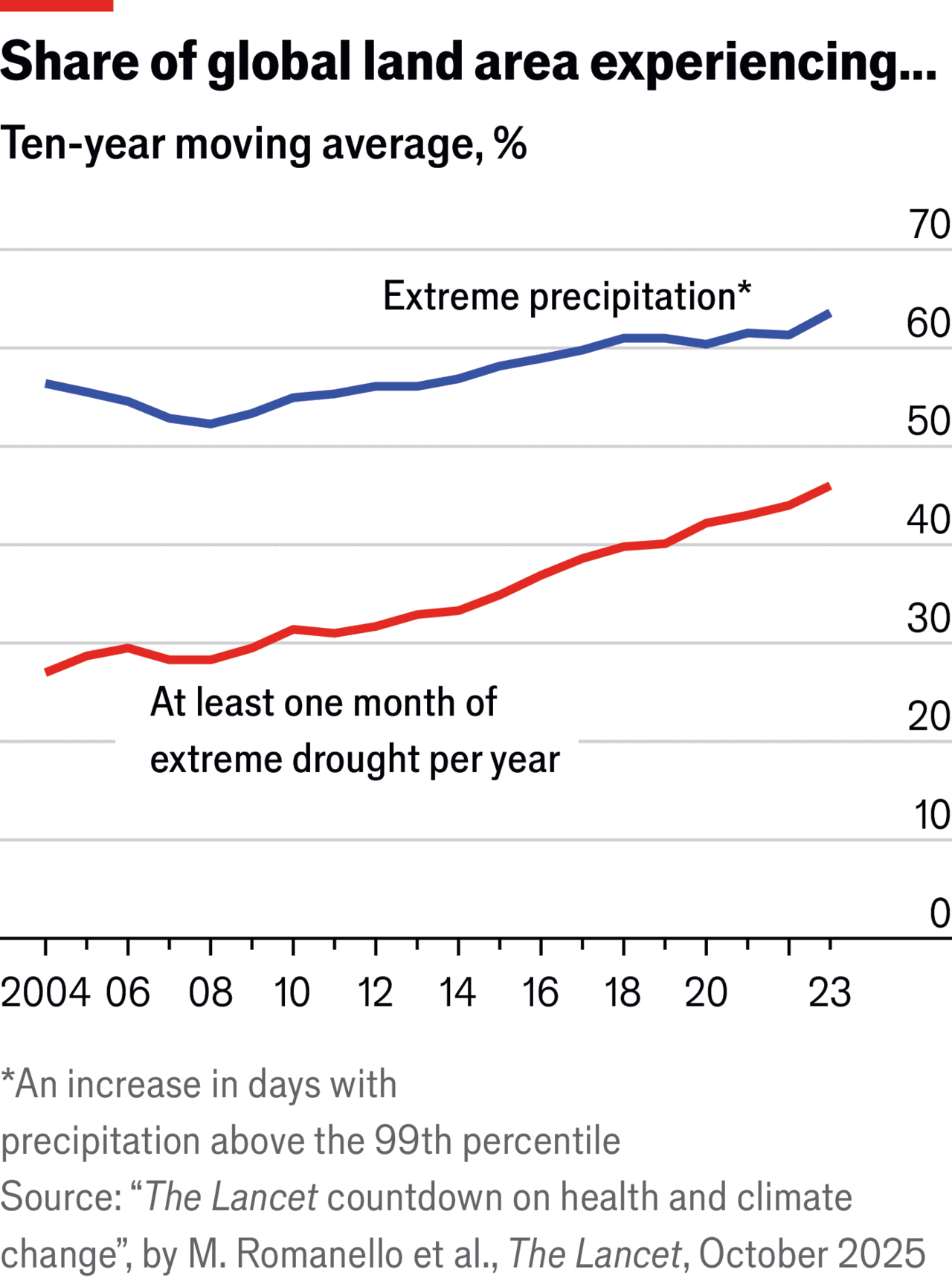
Climate change brings other health hazards, too. By changing how much moisture the atmosphere can hold, higher temperatures alter precipitation patterns, making both extreme drought and downpours more common. Last year more than 60% of the world’s land area experienced at least one month of severe drought. In the past decade, 64% of it has been pelted by more extreme rainfall than in 1961-90. Both are bad for health, by worsening sanitation and food and water security.
Hotter and altered weather patterns have also made wildfires more frequent and more extreme in large parts of the world. Beyond the obvious danger of flames, people in surrounding areas are exposed to smoke laden with pollutants. Particles of 2.5 microns or smaller (PM2.5) can pass through the lungs and into the bloodstream, causing or worsening respiratory and cardiovascular conditions and increasing the risks of certain cancers. In 2024 some 154,000 deaths were thought to be caused by exposure to PM2.5 from fires, a 36% increase from the average for 2003-12. In the past two decades, the mortality from PM2.5 has increased in 92% of countries. Between 2003 and 2024 America and China had the world’s highest death tolls from wildfire smoke, with annual averages of roughly 15,000 and 10,000, respectively. In China the number has decreased since 2003; in America it has increased by around 460.
All this is also altering the spread of infectious diseases. The survival of mosquitoes, in particular, is dependent on temperature, humidity and rainfall. The warmer and wetter it is, the faster they can breed, mature and bite. Between 1951-60 and 2015-24 the potential for the Aedes albopictus mosquito to transmit dengue—of which there were more than 14m cases globally in 2024, an all-time high—increased by almost 50%. The transmission potential of the Aedes aegypti mosquito, which carries Zika as well as dengue, rose by more than a tenth over the same period. The risk of contracting leishmaniasis, a potentially fatal disease transmitted by sand flies, rose by almost 30%.
Predictably, climate sceptics such as Mr Trump seized on Mr Gates’s comments as proof that the climate is a lesser concern for human wellbeing. In fact mounting evidence suggests the opposite: trying to protect people’s health is an increasingly important aspect of dealing with global warming.


