A decentralised approach involving every citizen would be needed to save the country’s rivers from pollution, experts said at Hindustan Times Environment Conclave, while adding that the Public Trust Doctrine may be used against civic bodies and industries to stop them from polluting rivers and water bodies.
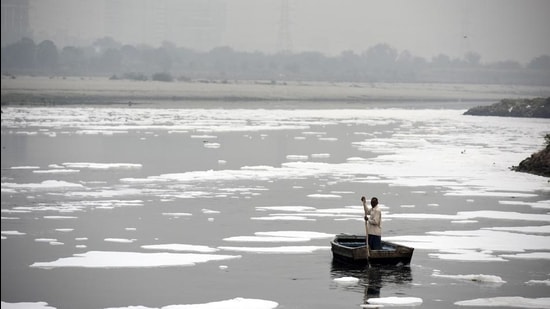
“The way we tried to treat our rivers, there was something wrong in it. We need to take a decentralised approach. It should be a people’s movement. Each and every state and district in the river’s catchment area and every citizen should be involved in this movement,” said Kalyan Rudra, a Kolkata-based expert on rivers and water bodies and chairman of the West Bengal Pollution Control Board.
“We think that rivers are one common pool resource to pollute. In our Constitution water resources are held in public trust. We have to use the Public Trust Doctrine to apply stringent provisions against permitting municipal bodies or industries from polluting rivers,” said Arunabha Ghosh, CEO of Council on Energy, Environment and Water.
Also Read: HT Environment Conclave: Govt to train village women to test water quality
{{/usCountry}}Also Read: HT Environment Conclave: Govt to train village women to test water quality
{{/usCountry}}Ghosh also said that climate change was compounding the problem of river pollution because rising temperature was impacting the melting of glaciers in the Himalayas and the flow of water in many perennial rivers was likely to get reduced.
“Our river management has to factor in the broader climate risks. There are enough agricultural practices and community-based social capital in the country, traditional knowledge, and modern technology that can be brought together with the right incentive structure,” said Ghosh.
The experts also said that it was not just the rising temperature but change in rainfall pattern and delayed monsoon that were taking a toll on the rivers’ heath as less water was infiltrating the ground, resulting in huge runoff. Delayed monsoon was forcing farmers to exploit groundwater resources more, they said.
“India consumes more groundwater than USA and China combined do. While on one hand we are depleting our groundwater and drilling deep into our aquifers, on the other hand we are putting in pesticides and fertilisers. It is a double whammy for groundwater,” Ghosh added.
Depleting groundwater would have a negative impact on the effluent seepage or base flow towards rivers which, in turn, would again impact the rivers.
“Since the groundwater is getting depleted, the base flow (to rivers) is getting affected. In some areas like Prayagraj, we can just walk across the river in February. Thanks to the water that is being brought in by some rivers from Nepal like Kosi and Gandak, the Ganga is rejuvenated,” said Rudra.
They also said that whenever a river is intercepted, people only talk about the flowing water and not about the sediment it carries, the energy and the biodiversity.
“In 1980s, the river Ganga at Farakka in West Bengal carried 800 million tonnes of sediment-load. Now it carries only 170 million tonnes. The hilsa fish earlier used to swim up to Varanasi. Now they are trapped before Farakka,” said Rudra, who blamed back-to-back dams in the upper levels of Ganga for its rising pollution.
Both Rudra and Ghosh concurred that ecological flow of a river is not an arithmetic equation which allows us to divert a certain percentage of the river water. Instead, they said, the river is a hydrological entity and its hydrological cycle should not be stopped or hindered.
“Humans are not the exclusive custodian of the river and each species has their right. We are living in an ecosystem where everything is connected,” Rudra added.
Ghosh said there can be enough water for rivers without impacting agriculture. “Our study has shown that 25% of irrigation water can be saved for growing paddy without any fall in production,” he said.