Belem: A fire broke out at the UN Climate Meeting (COP30) Blue Zone, the primary venue for official negotiations, the Leaders’ Summit, and national pavilions, on Thursday, bringing talks to an abrupt halt and triggering panic among participants.
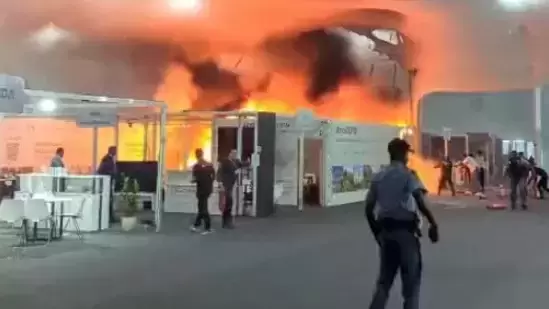
At least 13 persons were treated at the site for “smoke inhalation”following the fire, an official said.
Talks resumed in the zone around 9 pm. Delegates started heading back to the venue after a safety clearance was issued.
Among leading diplomats and officials present at the Blue Zone on Thursday were UN secretary general, Antonio Guterress, ministers from most countries including EU, India, China, Brazil among others. Negotiators, media, and some observers were also present at the venue when the fire broke out.
“Earlier today, a fire broke out in the Blue Zone of the COP30 venue in Belém. The fire department and UN security officers responded swiftly, and the fire was controlled in approximately six minutes. People were evacuated safely. Thirteen individuals were treated on site for smoke inhalation. Their condition is being monitored, and appropriate medical support has been provided,” the Presidency said on Thursday evening.
State of the summit
The fire incident took place on the penultimate day of COP30, when the Brazil Presidency was expecting to bring the talks to a close. On Wednesday, President Luiz Inácio Lula da Silva took charge of the talks at COP30, holding several informal meetings with various parties and party blocs. Negotiators were up all night trying to find common ground on the texts of the Belem package. But at the end of the day President Lula seemed to suggest that there was no consensus on critical matters.
{{/usCountry}}The fire incident took place on the penultimate day of COP30, when the Brazil Presidency was expecting to bring the talks to a close. On Wednesday, President Luiz Inácio Lula da Silva took charge of the talks at COP30, holding several informal meetings with various parties and party blocs. Negotiators were up all night trying to find common ground on the texts of the Belem package. But at the end of the day President Lula seemed to suggest that there was no consensus on critical matters.
{{/usCountry}}“Everyone must understand their responsibility. That is why we introduced the Roadmap. We must show society that we are serious—without imposing anything on anyone, without setting deadlines. Each country has the sovereignty to determine what it can do within its timeframe and capacities, but we must show seriousness. We must reduce greenhouse gas emissions,” Lula emphasised. The Roadmap is a Brazilian proposal at COP30 that sets out action plans and concrete targets for reducing the global use of fossil fuels.
Lula addressed the challenge of bringing the Conference to a city that does not usually host major international events. “It was very important for us to show the Amazon as it truly is, and to embed it in the minds of people around the world,” he explained. “ I am certain that people now know that there is not only the city of Bethlehem where Jesus was born, but also Belém do Pará—the Belém of the Brazilian people, a people extraordinarily warm, welcoming, and generous, with whom you have certainly engaged,” he added.
Salient features of the summit
COP30 stood out from previous conferences due to its broad participation across different sectors of society. For the first time in the history of the COPs, 3,500 Indigenous participants took part, according to the Presidency.
Most importantly, Lula made it clear that Brazil will not impose or force a decision. “We will be able to build understanding, because at a COP nothing is imposed. Everything must be achieved through consensus; everything must be thoroughly discussed. And we respect the political, ideological, territorial, and cultural sovereignty of every country. We do not seek to impose anything. We seek only to say: it is possible. And if it is possible, let us build it together. For this reason, I am satisfied,” he had said.
Unfinished business
It is not clear if the Presidency will pursue a cover text. “There is no pressure from the COP30 Presidency. They understand that decisions have to be based on national circumstances and sovereignty respected,” said a developing country delegate.
An European Union (EU) official, who asked not to be named, said on Thursday that “there is a minority but hardline couple of countries that walked out because they want the lowest possible bar on mitigation. The European team is here, stays here and will work with everyone for an outcome, both on mitigation and adaptation finance.”
HT reported on Friday that countries could not agree on 1. A nationally determined roadmap on fossil fuel phaseout 2. Article 9.1–a legal obligation requiring developed countries to provide financial resources to developing countries for climate mitigation and adaptation efforts 3. A way to address the disproportionate impacts of unilateral trade measures on developing countries among others. These have divided the developing and developed country blocs. While the Like Minded Developing Countries which includes India and China will not accept any prescriptive text on developing a fossil fuel phaseout roadmap; EU and other rich nations will not accept any further talks on article 9.1.
“Every country has a right to grow. National circumstances and common but differentiated responsibilities are the corner stones of Paris Agreement. Those have to be followed,” said a member of the India delegation, adding that all parties have shown that they support multilateralism.
While these remained open and talks continued, some observers said at least texts on which there is complete agreement would also symbolise progress from Belem.
What the UN chief said
“Over the past days, I have met with world leaders, ministers, negotiators, Indigenous Peoples, civil society, and young people from every region.One thing is clear: We are down to the wire, and the world is watching Belém. Communities on the frontlines are watching too – counting flooded homes, failed harvests, lost livelihoods…And asking: how much more must we suffer? They have heard enough excuses,” said Antonio Guterress, UN Secretary general on Thursday.
“Today’s incident at the COP30 venue was unfortunate. We stand with Brazil. This is a time to show solidarity. We request everyone to follow instructions from authorities. Safety is top priority. Our work is unfinished. We hope all delegates will come together with the determination and commitment to successfully conclude the work of COP30,” COP30 Special envoys said–Adnan Amin; Arunabha Ghosh; Jonathan Pershing; Laurence Tubiana and Patricia Espinosa in a statement.
On article 6 (carbon markets) texts which were uploaded on Thursday, experts said there were not enough safeguards, “Belém’s updated Article 6 text moves toward a carbon market deal with zero protections for Indigenous rights or territories. Without FPIC or safeguards, land-based offsets risk fuelling land grabs and junk climate claims, not real emissions cuts. Advancing this at the Amazon COP would be indefensible,” said Tom Picken, Rainforest Action Network in a statement.