E-Paper



‘India is in the process of ratifying High Seas Treaty’: Jitendra Singh at UNOC
The Treaty is a legally binding instrument for the conservation and sustainable use of marine biological diversity in areas beyond national jurisdiction.

 Prefer HTon Google


India is in the process of ratifying the Biodiversity Beyond National Jurisdiction (BBNJ) Agreement, or the High Seas Treaty, Union minister of state for earth sciences Jitendra Singh said at the Third United Nations Ocean Conference (UNOC3) on Tuesday.
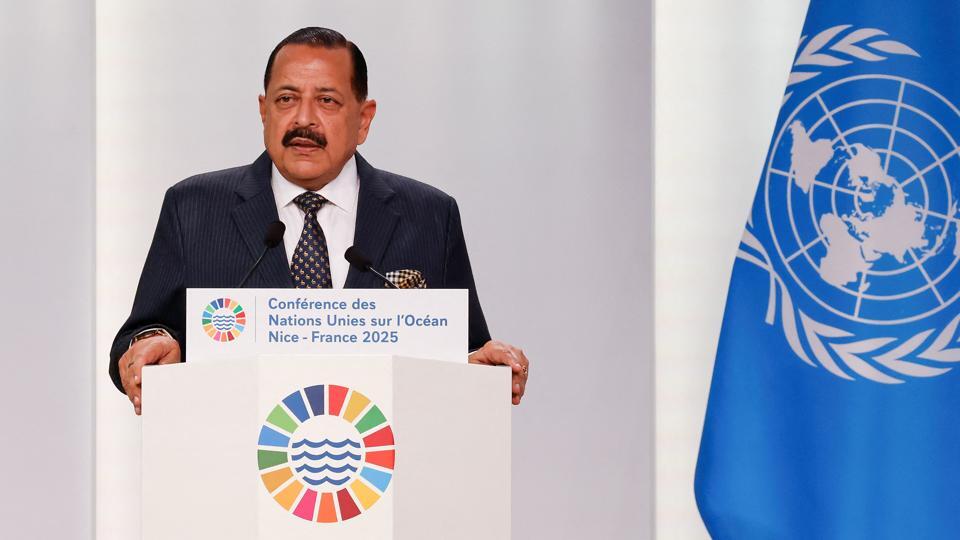
“India has signed the BBNJ Agreement and is currently in the process of ratification. This step underscores our commitment to conserving marine biodiversity in areas beyond national jurisdiction,” the minister said at the event in France’s Nice.
The BBNJ is a legally binding instrument for the conservation and sustainable use of marine biological diversity in areas beyond national jurisdiction.
During the conference, India also proposed six strategic initiatives to conserve oceans, such as: 1. advancing marine research and science-based solutions for ocean policy and governance; 2. expanding marine protected areas and supporting the BBNJ Agreement to preserve marine ecosystems; 3. reducing marine pollution through effective wastewater management and the adoption of circular economy principles; 4. enhancing coastal resilience by integrating ocean-based climate solutions to mitigate the impacts of climate change; 5. promoting environmentally friendly ocean renewable energy sources and empowering communities by incorporating indigenous knowledge; and 6. integrating coastal communities into policy frameworks, ensuring inclusive and equitable ocean governance.
“India is honoured to address the Third United Nations Ocean Conference. With a coastline of 11,098km, over 1,300 islands, and more than 2.1 million square km of Exclusive Economic Zone (EEZ), India boasts of a rich maritime heritage and the ocean is indeed our lifeline,” Singh said, adding that recognising the importance of SDG-14, India has initiated several new initiatives, including the Deep Ocean Mission, a pilot project of Blue Economy.
This mission aims to understand and map the biodiversity within our EEZs, develop and implement marine spatial planning, protect and conserve our oceans, and develop technology for ocean exploration and observation. Additionally, it supports climate change studies and more.
“Marine pollution, particularly from plastic, remains a global challenge. Our efforts align with Ocean Action Panel 4, which focuses on preventing marine pollution from land-based sources. We have undertaken numerous awareness campaigns along the coast ‘Swachh Sagar, Surakshit Sagar’ — ‘A clean and safe sea’. This campaign aims to reduce the impact of marine debris on coastal biodiversity and inspires the community to adopt eco-friendly habits and become marine conservation advocates by engaging citizens across all age groups,” Singh added.
India also extended support to the ‘Nice Ocean Action Plan’, which prioritises actionable outcomes, innovative financing, and inclusive partnerships to achieve SDG-14.
Singh said that India is ready to collaborate with all stakeholders, including governments, civil society, the private sector, and indigenous communities, to build a sustainable, resilient, and equitable ocean future.
The UNOC is the most ambitious environmental conference after the 2015 Paris Climate Conference, which led to the Paris Agreement, French officials said in a briefing last week.
“Ten years after COP21 and the Paris Agreement, the UNOC-3 represents a historic opportunity to establish a binding global framework, and the Nice Agreement will constitute a real international pact for the conservation and sustainable use of the ocean,” officials said.
“First, we want to advocate for the successful conclusion of multilateral processes related to the ocean, in terms of governance and BBNJ agreements. The high seas treaty cannot be a failure. If we do not seize the opportunity of UNOC-3, we risk wasting precious years for the sustainable management of the ocean. We are still far from having all the signatories to ratify BBNJ throughout the world, but if we manage to get to 60 at the end of the year, that’s achievable,” the officials said.
India also participated in the Space for Ocean Alliance (S4O) event hosted by Centre National d’Études Spatiales (CNES), France, on the sidelines of UNOC3. The alliance aims to leverage space tech and data for oceans. With ISRO’s ocean monitoring expertise, India is set to lead in IOR (Indian Ocean Region) and shape global ocean indicators, said M Ravichandran, secretary, ministry of earth sciences.