Heera and Panna, two tiger brothers living in the buffer zone of Panna tiger reserve, have revealed a relatively unknown aspect of feline behaviour --- brotherhood, said a forest department official, adding that they have not attacked even a single human habitat.
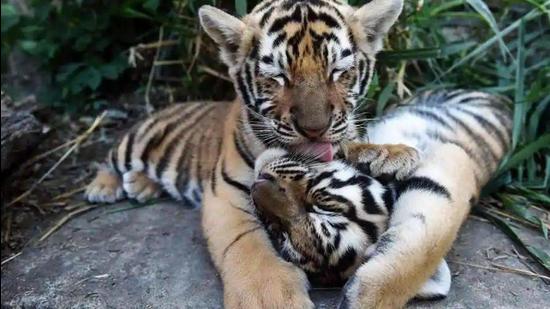
Heera and Panna got separated from their mother nine months ago and have made buffer zone their home since them.
“There has not been a day they have not been together since February when their mother left them. They don’t only roam together but they also follow the same daily routine. These harmless cubs are favourite of villagers of Akola buffer area too, who have named them Heera and Panna,” said UK Sharma, field director Panna Tiger Reserve.
This behaviour came to light during a joint study of the Madhya Pradesh forest department and Dehradun based Wildlife Institute of India (WII), a government of India enterprise.
The WII officials and state forest officials are studying the behaviour of 14 tigers, living outside the forest core zone in an area of 15,000 sq km, known as Panna landscape. Four tigers are moving in the core-buffer boundary, four are in buffer area and six tigers are in the landscape i.e., without any report of the man and animal conflict. The study is being done by fitting radio collars to these tigers.
“The tigers were born in November 2020 in the Akola buffer area of Panna Tiger Reserve. With the efforts of field officers and locals, the area has been developed into a good tiger habitat. In December 2020, we decided to radio collar the brothers for the research project,” said Sanjeev Gupta, a veterinary doctor at Panna.
{{/usCountry}}“The tigers were born in November 2020 in the Akola buffer area of Panna Tiger Reserve. With the efforts of field officers and locals, the area has been developed into a good tiger habitat. In December 2020, we decided to radio collar the brothers for the research project,” said Sanjeev Gupta, a veterinary doctor at Panna.
{{/usCountry}}“To fit a radio collar was not an easy task as they used to roam together always. Tiger P234-31 was successfully collared in January this year. We tried to radio collar the other tiger (P234-32) but failed as brothers could not be separated from each other. It was then decided not to make more effort to radio collar P234-32,” he added.
Radio collaring of P234-31 opened the floodgates of information regarding not only his movement but also their behaviour.
“From sharing prey to spending time together on the road are some of the instances which amazed us a lot. One of their popular daily routines was to reach the edge of the state highway in the late evening at around 7:30 PM and stay there for a few hours,” the research paper published about their behaviour said.
The local villagers said the tigers may have killed cattle but have never attacked them.
“There are villages at the periphery and the buffer is used by villagers for their bona fide needs. There is movement of people and tiger in the area. The brothers have killed cattle but have not attacked villagers. We know that we will get compensation for our cattle so we never think of hurting the tigers,” said Lakhan Ahirwar, a resident of Akola Village.
However, the forest department expects to move the brothers to a different location.
“These two brothers will now be moved to the Panna Landscape, as there is no possible territory for them in PTR, which has too many tigers and cubs. Now, it will be interesting to study their behaviour in a new area,” said K Ramesh, a senior scientist with WII, who has worked in several tiger reserves in the country. On why this research project has been undertaken, Ramesh said it will generate data regarding movement, behaviour, outer limits and final destinations of tigers.
“Panna Tiger Reserve (PTR), which is known for tiger reintroduction after extinction of tigers two decades ago, is coming up with many new revelations regarding behaviour of tigers. There is hardly any case of man animal conflict reported from the forest. Last year, Panna Tiger Reserve was declared a global biosphere by UNESCO,” said Alok Kumar, principal chief conservator of forest.
Earlier in July, a tiger, which brought up four cubs after they lost their mother, was studied by a forest official.