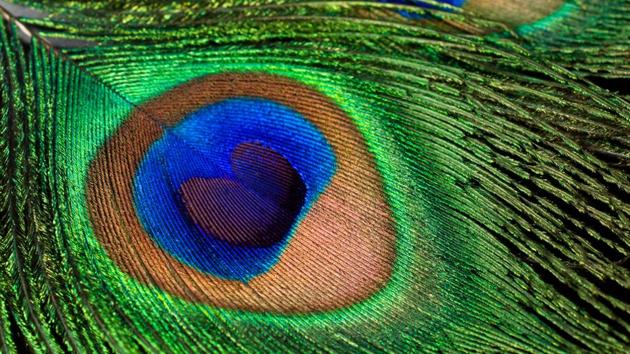
Inspired by the dazzling multi-coloured peacock feathers, researchers have developed a new and non-polluting method to colour textiles without the use of traditional dyes that enter streams and rivers, causing environmental pollution.
“Fast fashion” might be cheap, but its high environmental cost from dyes polluting the water near factories has been well documented. Dyes and pigments are chemical colours that produce their visual effect by selectively absorbing and reflecting specific wavelengths of visible light.
Structural or physical colours – such as those of opals, peacock feathers and butterfly wings – result from light-modifying micro- and nanostructures.
To help stem the tide of dyes from entering streams and rivers, researchers at Dalian University of Technology in China have developed a non-polluting method to colour textiles using 3D colloidal crystals.
Researchers wanted to find a way to colour voile textiles with structural colours without creating a stream of waste. They developed a simple, two-step process for transferring 3D colloidal crystals, a structural colour material, to voile fabrics.
{{/usCountry}}Researchers wanted to find a way to colour voile textiles with structural colours without creating a stream of waste. They developed a simple, two-step process for transferring 3D colloidal crystals, a structural colour material, to voile fabrics.
{{/usCountry}}Their “dye” included polystyrene nanoparticles for colour, polyacrylate for mechanical stability, carbon black to enhance colour saturation and water. Testing showed the method could produce the full spectrum of colours, which remained bright even after washing. In addition, the researchers said that the technique did not produce contaminants that could pollute nearby water.
The study appears in the journal ACS Applied Materials and Interfaces.
Follow @htlifeandstyle for more.
Catch your daily dose of Fashion, Taylor Swift, Health, Festivals, Travel, Relationship, Recipe and all the other Latest Lifestyle News on Hindustan Times Website and APPs.
Catch your daily dose of Fashion, Taylor Swift, Health, Festivals, Travel, Relationship, Recipe and all the other Latest Lifestyle News on Hindustan Times Website and APPs.