The definition of an SUV in India has changed over time. What once stood for ruggedness and durability is now also associated with technology, comfort, and convenience. This shift reflects a broader change in buyer expectations—from basic, purpose-driven vehicles to more feature-oriented mobility solutions.
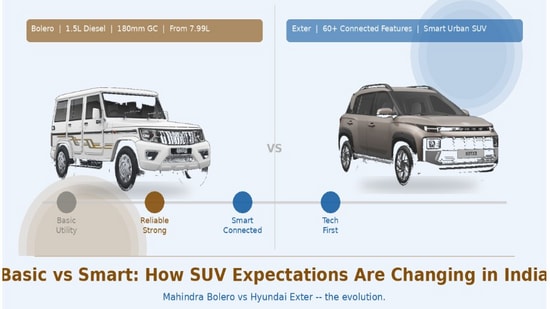
Models like the Mahindra Bolero and Hyundai Exter represent these two ends of the spectrum.
The era of basic, purpose-driven SUVs
SUVs in India originally gained popularity for their toughness and reliability.
Vehicles like the Mahindra Bolero were built with a clear focus:
- Strong construction
- Ability to handle rough roads
- Long-term durability
The Bolero’s frame-based body and high-strength construction, described as “built like a fortress,” highlight its focus on rugged dependability.
Such vehicles were designed for:
- Rural and semi-urban usage
- Heavy-duty daily operations
- Minimal maintenance and long-term ownership
In this context, simplicity was not a limitation—it was a strength.
The rise of smart, urban SUVs
As urbanisation increased and buyer preferences evolved, SUVs began to change.
Modern vehicles like the Hyundai Exter are designed to offer:
- Updated technology
- Everyday comfort
- Enhanced convenience
The Exter focuses on turning “everyday drives into memorable experiences,” combining practicality with modern features.
{{/usCountry}}The Exter focuses on turning “everyday drives into memorable experiences,” combining practicality with modern features.
{{/usCountry}}It offers:
- Touchscreen infotainment systems and connected features
- Wireless smartphone connectivity
- Features like sunroof, digital cluster, and voice commands
This marks a shift from purely functional vehicles to experience-oriented cars.
Changing buyer expectations
Today’s buyers expect more from their cars.
Earlier priorities included:
- Durability
- Reliability
- Low maintenance
Now, buyers also look for:
- Comfort and convenience
- Technology and connectivity
- Design and overall experience
This shift has redefined what an SUV is expected to deliver.
Simplicity vs technology
The contrast between basic and smart SUVs is most visible in their approach to technology.
Bolero’s approach:
- Essential features for functionality
- Focus on mechanical reliability
- Minimal dependence on electronics
Exter’s approach:
- Advanced infotainment and connectivity
- More than 60 connected car features
- Digital interfaces and smart controls
While one prioritises simplicity, the other focuses on enhancing the user experience.
Usage patterns define preferences
The difference in expectations is largely driven by how cars are used.
Utility-focused usage:
- Rough roads and challenging conditions
- Long hours of operation
- Need for durability over comfort
Urban usage:
- Daily commutes in traffic
- Short-distance drives
- Need for convenience and ease of use
This explains why both types of SUVs continue to exist.
Comfort and interior experience
Interior design reflects this shift as well.
The Bolero offers:
- Functional interiors
- Durable materials
- Practical seating layouts
The Exter focuses on:
- Dual-tone interiors and improved aesthetics
- Spacious cabin with a 391-litre boot
- Features like automatic climate control and rear AC vents
This shows how comfort has become a differentiating factor.
Safety: evolving expectations
Safety expectations have also evolved.
The Bolero focuses on:
- Structural strength
- Safety systems like ABS and airbags
The Exter adds:
- 6 airbags as standard
- Electronic stability control (ESC)
- Advanced safety features and monitoring systems
This highlights how safety has moved from basic protection to advanced assistance.
Can basic and smart coexist?
Despite the shift towards smart features, basic SUVs remain relevant.
They are preferred by buyers who:
- Need reliability in tough conditions
- Value simplicity and ease of maintenance
- Prioritise long-term durability over features
At the same time, smart SUVs attract buyers who:
- Want a comfortable daily driving experience
- Prefer connected and feature-rich cars
- Value convenience and technology
This coexistence reflects the diversity of the Indian market.
The role of digital platforms
With multiple options available, platforms like ACKO Drive help buyers:
- Compare basic and feature-rich SUVs
- Understand ownership costs
- Evaluate real-world usability
This enables more informed and practical decisions.
Final thoughts
SUV expectations in India are no longer limited to ruggedness.
They now include:
- Technology
- Comfort
- Design
- Overall experience
Vehicles like the Mahindra Bolero and Hyundai Exter show how the market has evolved from basic utility to smart mobility.
However, the shift is not about replacing one with the other—it’s about expanding choices.
Because in today’s market, the “right” SUV is not defined by how many features it has or how tough it is—it’s defined by how well it fits the buyer’s needs.
Note to the Reader: This article is part of Hindustan Times' promotional consumer connect initiative and is independently created by the brand. Hindustan Times assumes no editorial responsibility for the content.