Uttarakhand chief minister Pushkar Singh Dhami on Thursday participated in a five-day religious and social event organised at Jeevandeep Ashram in Roorkee, where he inaugurated new facilities and announced that a key road junction in the city would be renamed Shaheed Chowk.
Addressing saints, religious leaders and devotees at the ashram, Dhami said that institutions led by the saint community function as “living pilgrimages” that guide society towards what he described as the right path. He paid tributes to the late Padma Bhushan awardee Swami Satyamitranand Giri and offered respects to Jagadguru Mahamandaleshwar Swami Yatindranand Giri and other seers present on the occasion.
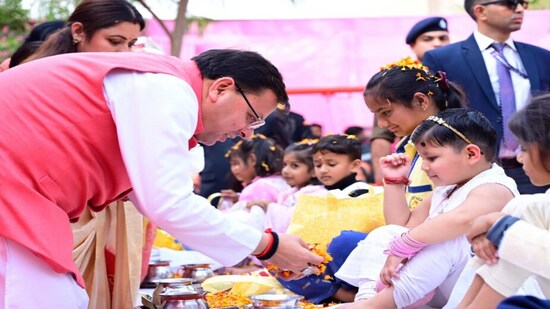
The chief minister said the five-day event organised by Jeevan Deep Seva Nyas featured a Shat Chandi Mahayagya, discourses on Bhaktamal, worship of 1,100 girls, distribution of study material and the mass marriage of girls. According to him, such activities combine religious observance with social outreach and convey a message of service.
Dhami inaugurated the Swami Satyamitranand Giri auditorium, the Shri Siddhbali Hanuman gate and a newly developed Shaheed Chowk at the ashram campus. He added that the intersection of Main Marg and Sunahara Marg in Roorkee would be officially named Shaheed Chowk in honour of martyrs, and said the square was intended to serve as a reminder of their sacrifice for future generations.
The chief minister described Swami Satyamitranand Giri as a religious leader who, in his view, devoted his life to the service of the nation, religion and humanity. He said that drawing inspiration from the late seer, Jeevan Deep Seva Nyas is active in areas such as education, healthcare, value-based learning, women’s empowerment and cow protection.
{{/usCountry}}The chief minister described Swami Satyamitranand Giri as a religious leader who, in his view, devoted his life to the service of the nation, religion and humanity. He said that drawing inspiration from the late seer, Jeevan Deep Seva Nyas is active in areas such as education, healthcare, value-based learning, women’s empowerment and cow protection.
{{/usCountry}}Linking the event to broader cultural developments, Dhami said India’s “Sanatan culture” had gained greater international visibility under Prime Minister Narendra Modi’s leadership. He cited projects such as the construction of the Ram temple in Ayodhya, redevelopment of Badrinath and Kedarnath shrines, and corridor projects at Kashi Vishwanath and Ujjain’s Mahakal temple as examples of initiatives aimed at religious infrastructure and pilgrimage facilities.
Dhami reiterated the state government’s stated objective of positioning Uttarakhand as a “spiritual capital” for visitors from India and abroad. He referred to works under way in the Kedarkhand and Manaskhand temple areas, the proposed redevelopment of Yamuna pilgrimage sites, the Haridwar–Rishikesh corridor, the Sharda corridor project and the establishment of a Centre for Hindu Studies at Doon University.
The chief minister also used the platform to highlight a series of legal and administrative measures taken by his government. He said that an anti-conversion law and a stringent law to deal with riots had been enforced in the state. Dhami added that action had been taken against what he termed “land jihad”, “love jihad” and “thook jihad”, and claimed that more than 9,000 acres of government land had been freed from encroachment.
He further said that the state had implemented a Uniform Civil Code (UCC) to establish, in his words, a common legal framework for all citizens. For the youth, he pointed to an anti-cheating law aimed at curbing irregularities in recruitment examinations, stating that this had paved the way for over 26,000 young people to secure government jobs.
Referring to religious education institutions, Dhami said that more than 250 unauthorised madrasas had been sealed for alleged violations, and that a new law had been passed under which the madrasa board would be dissolved. According to him, non-compliant madrasas would automatically cease to function from 1 July 2026. He also mentioned “Operation Kalnemi”, under which, he said, action had been taken against individuals accused of maligning Sanatan Dharma.
Dhami reiterated that his government was working with what he called a “non-negotiable resolve” to make Uttarakhand one of the leading states in the country, and expressed confidence that support from religious leaders and citizens would help the state achieve this goal.
Speaking at the event, the chief minister’s wife Geeta Dhami said it was a privilege to participate in the five-day programme at Jeevandeep Ashram. She noted that the ashram was hosting the worship and community meal for 1,100 girls and the mass wedding of six brides, and extended her best wishes for their future.
During the programme, the chief minister worshipped 11 girls, presented them with gifts and honorariums, and extended greetings and blessings to the six couples whose marriages were solemnised at the venue.
The event was attended by seers associated with various akharas and religious bodies, as well as public representatives and senior district and police officials from the region.