The EMI you can comfortably manage each month is not only dependent on the salary credited to your account. Two people earning the same amount may have very different financial commitments, depending on their existing loans, household expenses, and other regular obligations.
Therefore, if you are considering a personal loan, it helps to first understand your overall eligibility and then work out how the repayment would fit into your monthly budget. A personal loan EMI calculator can help you compare different loan amounts, interest rates, and tenures before you make a decision. This article looks at what people with different income levels should consider when planning an EMI.
How Much EMI Can Different Salary Levels Realistically Support?
Before deciding how much of your salary can go towards an EMI, it is important to check whether you meet the lender’s eligibility requirements. Salary is an important consideration, but it does not determine personal loan eligibility on its own.
Lenders may consider several factors when assessing an application, including:
- Your age and whether it falls within the lender’s specified range.
- Your monthly income and its stability.
- Your employment type, work experience, and continuity of employment.
- Your credit score and repayment history.
- The proportion of your income already committed towards existing loan obligations, often assessed through the debt-to-income ratio or a similar measure.
Lenders may consider several factors when assessing an application, including:
- Your age and whether it falls within the lender’s specified range.
- Your monthly income and its stability.
- Your employment type, work experience, and continuity of employment.
- Your credit score and repayment history.
- The proportion of your income already committed towards existing loan obligations, often assessed through the debt-to-income ratio or a similar measure.
Once you have an indication of your eligibility, you can consider how much EMI your monthly income can realistically support. A higher salary may provide greater room for repayments, but income should not be viewed in isolation. Someone earning Rs. 50,000 with substantial existing EMIs, for example, may have less room in their monthly budget than another person earning the same salary with no existing debt.
The aim should therefore be to consider both lender-specific eligibility factors and your own monthly financial commitments before settling on a loan amount or EMI.
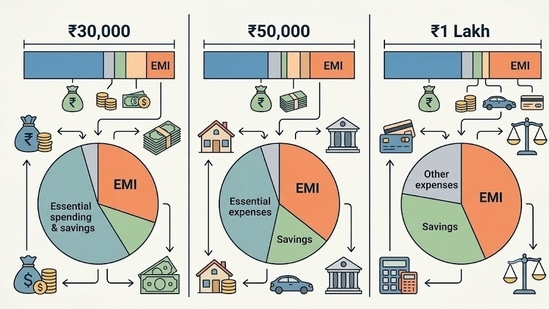
Sample EMI Scenarios for ₹30,000, ₹50,000 and ₹1 Lakh Salaries
Well-known lenders such as SMFG India Credit provide an online personal loan eligibility calculator that can give borrowers an indication of the maximum loan amount they may qualify for, along with the corresponding EMI. The estimate is based on inputs such as net monthly income, existing financial obligations, expected interest rate, and the preferred repayment tenure.
To understand how this can work across different income levels, consider the following examples. They assume an interest rate of 12% per annum and a repayment tenure of 60 months.
Monthly Salary | Existing Monthly EMIs | Indicative Loan Amount | Potential Monthly EMI |
| Rs. 30,000 | NIL | Rs. 6,06,893 | Rs. 13,500 |
| Rs. 50,000 | Rs. 5,000 | Rs. 7,86,713 | Rs. 17,500 |
| Rs. 1 lakh | Rs. 20,000 | Rs. 13,48,651 | Rs. 30,000 |
These examples also show why salary should not be considered in isolation. Although monthly income increases across the three scenarios, existing debt commitments also influence the estimated loan amount and EMI.
Disclaimer: The figures above are illustrative examples. Actual eligibility, loan amount, interest rate, and EMI may vary depending on several factors, including the lender’s terms at the time of the loan application.
How to Use a Personal Loan EMI Calculator for Budget Planning
Once you have an idea of your eligibility, you can use a personal loan EMI calculator to narrow down the loan amount and tenure that work with your monthly budget. Remember that you do not have to apply for the maximum amount indicated by an eligibility calculator. Consider your existing expenses, savings goals, and any significant future expenses you can reasonably anticipate before deciding how much to borrow.
For example, suppose you take a Rs. 10 lakhs personal loan at an interest rate of 12% per annum. Here is how changing the tenure affects repayment:
Tenure | Approx. Monthly EMI | Approx. Total Interest Payable |
| 60 months | Rs. 22,244 | Rs. 3,34,667 |
| 36 months | Rs. 33,214 | Rs. 1,95,715 |
The 60-month tenure results in a lower monthly EMI, leaving more room in the monthly budget, but increases the total interest paid over the loan period. With 36 months, the EMI is higher, while the overall interest cost is lower. Comparing such scenarios can help you balance immediate repayment comfort with your savings goals and longer-term financial plans.
How Do Existing EMIs and Monthly Expenses Affect Your Repayment Capacity?
Your salary may remain the same, but the amount available for a new EMI changes considerably once existing commitments are taken into account. Lenders consider current debt obligations while assessing a loan application, but your own calculation should also include expenses that may not form part of the lender’s assessment.
Before deciding on an EMI, account for regular outgoings such as:
- Existing home, vehicle, education, or other loan EMIs.
- Credit card repayments and other recurring debt commitments.
- Rent, utilities, groceries, insurance premiums, and household expenses.
- Regular contributions towards savings, investments, and an emergency fund.
- Upcoming expenses that you can reasonably anticipate, such as education costs, relocation, or major family commitments.
Looking at what remains after regular commitments provides a more practical basis for choosing an EMI than relying on salary alone.
What to Check Before Choosing a Personal Loan Amount and Tenure
Once you know your eligibility and have compared different EMI scenarios, consider the loan amount and tenure together rather than making either decision separately. Borrowing more than you need can increase both the monthly commitment and overall interest cost, while choosing a very short tenure simply to reduce total interest payable may put unnecessary pressure on your monthly budget.
Before finalising your choice, consider:
- Your actual borrowing requirement: Aim for the amount you genuinely need rather than the maximum amount you may be eligible to borrow.
- Monthly repayment: Check whether the EMI leaves sufficient room for regular expenses, existing financial commitments, and savings.
- Total interest costs: Compare how much interest you would pay across different tenures, not just the difference in monthly EMI.
- Future commitments: Consider foreseeable changes, such as higher household expenses or other planned financial obligations.
- Associated fees and charges: Along with the applicable interest rate, also check the processing fee, prepayment or foreclosure conditions, late payment charges, and other relevant expenses. These also affect the overall cost of borrowing.
Conclusion: Choose an EMI That Leaves Room for Essential Expenses
Your salary and the amount you may be eligible to borrow should not be the only consideration when choosing a personal loan. Your EMI also needs to fit alongside essential expenses, existing commitments, savings goals, and foreseeable financial needs. Using a personal loan EMI calculator to compare different loan amounts and tenures can help you understand the trade-off between monthly repayments and total interest costs. Ultimately, choosing an EMI with sufficient room in your monthly budget can make repayments easier to manage throughout the loan tenure.
*T&C apply. Loan eligibility, loan terms, and loan disbursement processes are subject to SMFG India Credit’s policy at the time of loan application.