Residents received pleasant relief from the rising heat when unexpected rain lashed the city on Sunday night. The showers, which began a little before 9pm, were accompanied by dust storm and broke a two-week dry spell in the city.
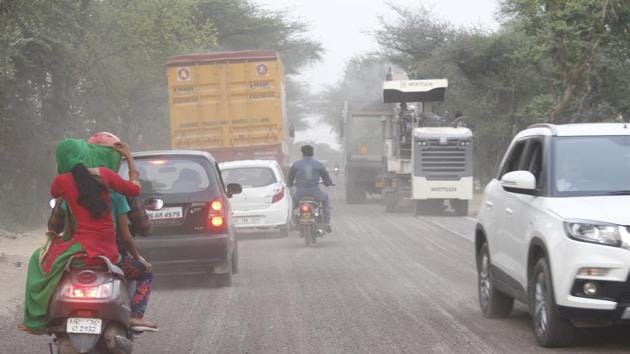
Gurugram’s air quality, which hit ‘very poor’ level for the first time in seven weeks on late Sunday evening, is expected to improve on Monday, thanks to the unexpected showers, officials of India Meteorological Department (IMD) said.
Around 7.30pm on Sunday, dust storm, accompanied by wind of speed 10-15kmph began blowing through the city, reducing visibility and causing particulate matter levels to shoot up.
Gurugram scored 305 on the Central Pollution Control Board’s Air Quality Index (AQI) bulletin at 8pm on Sunday, that falls into the ‘very poor’ category. According to the official data, PM2.5 levels reached above 500ug/m3, more than five times the safe limit.
The IMD officials have warned of a dust storm on Monday as well, with high-speed winds in the order of 13kmph and partly cloudy skies due to presence of dust.
After a month of improved air quality in March, pollution levels in the city have been on the rise in April. Experts said this was due to higher temperatures and wind velocity, leading to more re-suspension of dust and particulate matter. “As we have transitioned into April, we have seen temperatures steadily increasing. This has both positive and negative effects on pollution levels,”?said Guneet Singh, founder of a city-based non-profit body, which tracks air quality.
{{/usCountry}}After a month of improved air quality in March, pollution levels in the city have been on the rise in April. Experts said this was due to higher temperatures and wind velocity, leading to more re-suspension of dust and particulate matter. “As we have transitioned into April, we have seen temperatures steadily increasing. This has both positive and negative effects on pollution levels,”?said Guneet Singh, founder of a city-based non-profit body, which tracks air quality.
{{/usCountry}}On one hand, higher temperatures facilitate the vertical movement of air that carries particulate matter to greater mixing heights. On the other hand, higher temperatures also lead to loss of atmospheric moisture and an increase in wind speeds. “As a result, a lot of road dust and crustal material gets swept away into the air — what is known as re-suspension of particulate matter — and adversely impacts air quality,” Singh explained.
Over the past week, maximum daytime temperatures in the city have increased from an average of about 37 degrees Celsius to 39 degrees Celsius, and minimum temperatures have shot up from about 18 degrees Celsius to 25 degrees Celsius.
Another reason for the prevailing spike in AQI , experts said, is the increased usage of diesel generator sets due to increased power cuts during the summer, as well as usage of air conditioners and refrigerators. “This time of the year, diesel gensets come back into swing, emitting polluting gases and particles into the atmosphere,” said Dipankar Saha, former head of the CPCB’s air quality lab in Delhi.
Stay updated with all the Breaking News and Latest News from Mumbai. Click here for comprehensive coverage of top Cities including Bengaluru, Delhi, Hyderabad, and more across India along with Stay informed on the latest happenings in World News.
Stay updated with all the Breaking News and Latest News from Mumbai. Click here for comprehensive coverage of top Cities including Bengaluru, Delhi, Hyderabad, and more across India along with Stay informed on the latest happenings in World News.