baoli or the stepwell is an important architectural typology of the traditional Indian water architecture and is found in abundance in the arid and semi-arid zones of north-western India, with Haryana being one of them. Among the scattered remains of this built heritage in the Gurugram district, there are some very interesting and significant baolis in terms of their architectural forms. The particular plan form of a baoli reflects its function and evolution. As such, it is relevant to record the form and function of the historic baolis that still exist in Gurugram, primarily the three prominent ones, namely the Ali Ghosh Khan ki Baoli in Farrukhnagar, under the protection of the Archaeological Survey of India(ASI); the controversial Badshahpur Baoli, which was in the news for last two years because of the risk of it being demolished due to road expansion, and the Akhara Baoli in Badhshahpur, which was part of a functional akhara on the same road, few kilometres from the Badhshapur Baoli.
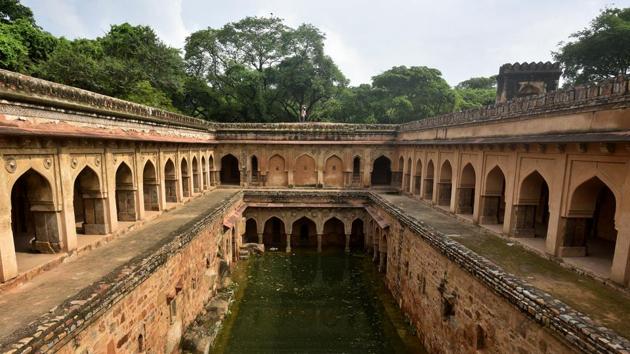
Though no longer a part of Gurugram, it is also interesting to note the presence of Palam Baoli (near Palam in Delhi), where an inscription from the reign of Muhammad Tuglaq (1328 CE) mentions the name as “Hariyana” and another inscription, dating back to the time of Balban (1280 CE), too provides its variant name, “Hariyanaka” (Source: Haryana District Gazetteer).
The traditional subterranean water bodies in this region are of two broad types — the stepwell and the stepped pond. A stepped pond was usually built near a temple while the stepped well was located on travel routes or the outskirts of towns constructed by nobles, queens, rich traders and philanthropists of the community to provide drinking water to the passers-by. Also, the stepped well or baoli is always connected to a well hence it is the best source of groundwater for drinking purpose. The process of constructing the baoli was associated with piety and a local expert, with indigenous knowledge, was requiredto strike a particular spot on the ground and find water to initiate the process of building a baoli.
Constructed with local materials, such as stone, the baolis in Gurugram have interesting architectural styles with a melange of Islamic pointed arches and cusped even segmental arches at places, reflecting a blend of Rajput-Jat-Mughal styles dating back to 18th-20th centuries.
{{/usCountry}}Constructed with local materials, such as stone, the baolis in Gurugram have interesting architectural styles with a melange of Islamic pointed arches and cusped even segmental arches at places, reflecting a blend of Rajput-Jat-Mughal styles dating back to 18th-20th centuries.
{{/usCountry}}The form of the baoli could be square, rectangular or sometimes even octagonal in plan, although the latter was rare.
Farrukhnagar in Gurugram has an octagonal well, which has to be approached across a low bridge to accommodate a local road, allowing the visitor to initially observe it from above rather than from the ground level. It was built by a local chief, Ghaus Ali Shah, who served Farrukhsiyar in the 18th century. The baoli can be approached by a series of steps from south-west of the Jhajjar Gate, passing under the gate. It was used as a water tank catering for Sheesh Mahal and may have been used as a bathing space for women, as it shows evidence of a hidden passage at both ends. The baoli is approximately 6.5-metre deep with an arched verandah on all sides overlooking the inner core of the baoli with a well wall for pulley on one side. The lower level has a small central circular well surrounded by 21 colonnades. There are eight sides with seven bays, while three of the enclosing sides give way to tiered steps surrounding the well head. The eighth side has a tall pier with a raised platform, allowing the drawing of water from the well from a stone gantry. The building is constructed of then lakhori bricks and Jhajjar stone and plastered in lime. A few remnants of coloured bands at parapet level can also be observed. The octagonal construction and general proportions of the building are balanced and the well is in good shape with some conservation works undertaken by the ASI. This national monument is truly a grand baoli in the Gurugram area that stands as a testimony to the subterranean water structures in the region.
The other two baolis in Badhshapur area are of a later period, much smaller in scale and fall under the standard shapes of a square plan (with three side steps ) and rectangular with single steps to move down into the baoli. As the only few examples of this water architecture typology, it’s important to conserve them today.
Stay updated with all the Breaking News and Latest News from Mumbai. Click here for comprehensive coverage of top Cities including Bengaluru, Delhi, Hyderabad, and more across India along with Stay informed on the latest happenings in World News.
Stay updated with all the Breaking News and Latest News from Mumbai. Click here for comprehensive coverage of top Cities including Bengaluru, Delhi, Hyderabad, and more across India along with Stay informed on the latest happenings in World News.