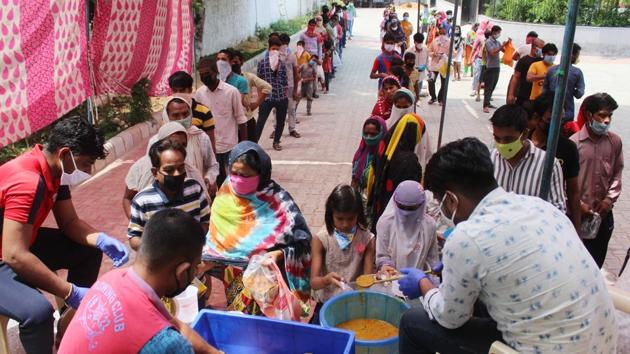
As the clock strikes 2pm, a crowd starts gathering near a tent in a slum cluster in Saraswati Kunj, Sector 53. People, mostly migrant workers, rendered unemployed due to the nationwide lockdown, call out to their children and rush from their shanties, lining up to collect a meal of pooris and sabzi. Adults take their plates—four pooris with sabzi—while children are given two pooris each. A woman pleads for a second helping but is rebuked by the relief volunteer handing out food at the bhandara. For a majority of slum residents, this is perhaps the only meal they will eat this day.
Almost a week ago, about a kilometre from here, a migrant from Bihar who worked as a painter had killed himself as he was unable to feed his family of seven. A few hours before his death, he had sold his mobile phone for ₹2,500 to purchase some ration and a portable fan. Struggling to find work, he had hanged himself in his shanty.
To many others living in slum clusters across the city, the ongoing national lockdown has dealt a severe blow. Most people are going through food distress that has been exacerbated by the drying up of wages. Hindustan Times visited three areas across the city—Saraswati Kunj in Sector 53, Nathupur near DLF phase 3 and Chakkarpur near MG Road— where the migrant population from Bihar, Madhya Pradesh and West Bengal is staying and found that most people were surviving on the bare minimum. While some residents say that they have not received any food or ration from the administration since the lockdown started, others are surviving on one meal a day served by volunteers from the village or NGOs.
Saraswati Kunj clusters
{{/usCountry}}Saraswati Kunj clusters
{{/usCountry}}Tabrej Alam, a labourer from Bihar’s Supaul district, has been surviving on one meal a day distributed by volunteers in Saraswati Kunj, where he lives. Alam says that he, like many others in the cluster, have not received any help from the government. “When the lockdown started, we could no longer work and earn. We spent whatever little ₹100-200 that we had on food in the initial days. Once our savings dried up, we could no longer sustain ourselves. Since then, we have been surviving on the food (pooris) that we are served once a day,” Alam says.
He says that most workers living in the slums are migrants from various districts of Bihar, such as Supaul, Siwan, Araria and Purnia. They are stuck due to the lockdown restrictions and lack of transport. According to him, people cannot even go to vegetable shops within a kilometre.
The closest food disbursal point for the residents of Saraswati Kunj is the Community Centre in Sector 56. Jarul Shaikh from West Bengal’s Nadia district, who lives in one of the clusters in Saraswati Kunj, says that on multiple occasions, he and others have been turned away from the district administration’s food disbursal facility in Sector 56 after waiting in the queue for hours. “One time, we waited for two hours in the queue. Before our turn could come, the distributors announced that there was no more rice and asked us to come back after two days. When we returned after two days, we waited for two hours and again had to return empty-handed,” Shaikh, who stopped going to the facility after being turned away repeatedly, and has been surviving on meals that good Samaritans provide occasionally, says.
Some metres away from Shaikh’s cluster, a group of five people sit on the ground and talk among themselves. The shortage of food figures prominently in the conversation with most of the group expressing its disdain over the dysfunctional system. “We don’t get any food here. It has been over a month now but no tangible help has been provided to us. People come to enquire about the food but it never reaches us,” Vinod Kumar says.
Shamshida Khatoon, from Bihar’s Supaul district, adds that the quantity of food that is distributed is insufficient and hardly enough to satiate a day’s hunger. “Children are given two pooris while adults receive four. If one tries and takes more, food is snatched from them and given to others. People fight to get some food before it is taken,” Khatoon says, adding that she has not received any dry ration till date.
Nathupur
At Nathupur village, around 4pm, scores of people throng a table where packets of daal and rice are being distributed by a volunteer. A woman requests for a second helping for her child, but is harshly asked to return as she has already collected her meal.
Binoy Sarkar from West Bengal’s North 24 Parganas, says that chances of survival look bleak if the lockdown is extended again. “We will not survive if the lockdown is extended. There is no assistance from the government. We are living at the mercy of citizens who distribute packets of khichdi once a day,” Sarkar says. He adds that a school headmaster had distributed ration (5 kg flour, 1-litre oil, and 1 kg potato) to each of them in the first week of the lockdown, but with the supplies running low, survival has become a challenge.
Hassan Vishwas, another resident at the same shelter, says that he had no food or money and was worried about the days ahead. “My wife used to work as a domestic help but was asked not to come. Both of us don’t have any work now. A school headmaster has been helping us with a one-time meal of khichdi,” says Vishwas. He says that he was hoping that someone from his home state might have written to the administration here for help. “We had heard this on TV, but so far, no help has reached us,” he added.
Chakkarpur
Residents of Chakkarpur say that ration delivery has been minimal and inconsistent. Rubina (who goes by her first name) from West Bengal’s Malda district, says that she has received ration twice in 25 days—it has not been enough. “They keep noting down our names on various lists but ration doesn’t reach us. Last week, when they came to distribute ration, the crowd became difficult to control and food was over in a matter of minutes,” Rubina says. She adds that on two occasions, cooked food packets distributed by individuals had turned stale because of the weather. “Food turns bad in this weather. Dry ration could help us but it is hardly distributed,” she says, adding that she has borrowed money from relatives to purchase ration for a few days.
Hamida, another woman, says that for migrants like her, there seems to be no light at the end of the tunnel. “We are poor labourers. Neither can we go back to our villages nor can we work here. Along with our children, we are surviving on one meal a day, for which we have to beg. The government has not helped us in any way. We roam within a periphery of half a kilometre, surviving on water,” she says.
Government response
Varinder Singh Kundu, the additional chief secretary of Haryana and CEO, Gurugram Metropolitan Development Authority, says that the administration is coordinating the efforts of large groups working towards alleviating hunger among the needy. “In all distribution centres, meals are provided twice a day and there is a constant effort to match the requirements with the supply. We try to send an adequate supply to all centres,” Kundu says.
As per a list shared by the district administration on April 10 there are 69 relief centres in the district where food is being provided. These include the MCG’s community centres and government schools. The nodal officer for food distribution in the city, Vivek Kalia, says that 35 teams have been formed to handle food distribution across the city, adding that the government is working in tandem with private organisations/initiatives such as Gurgaon Nagrik Ekta Manch and Janta Rasoi, who are handling certain areas, and the administration is avoiding duplication in the same areas. “Besides government officials, each ward has volunteers involved in food distribution. We are sourcing around 1.2 lakh meals a day from 15 private firms and individuals,” Kalia says.
He adds that while it is easier to identify slum clusters, it is crucial to identify lower-income families living in various colonies, who are hesitant to seek help. “These are unprecedented times and we have to fight as one collective unit. Residents should also help us in reaching those in distress,” Kalia says.
Kundu says that some NGOs have exhausted their resources and the government is supplying ration to these NGOs to cook and distribute among the poor. He says that the administration is cognizant of the fact that people need to be taken care of till the lockdown is lifted, and it is working on implementing a system that works in the long run. “We are making the effort of covering the maximum number of people possible through distribution centres. Besides that, we are also responding to requests that we receive on the helpline or via social media channels. In a city with such a large workforce scattered in different areas, 100% coverage is not easy,” Kundu says.
He adds that the government is working towards distributing dry ration to families through PDS shops and other points against their Aadhar cards. “There will be a record of the families that receive monthly ration through this system and we will be able to avoid duplication. The survey began on Sunday, and once we have the details, we will be able to issue dry ration tokens. People will be able to collect ration against the tokens,” Kundu says.
Stay updated with all the Breaking News and Latest News from Mumbai. Click here for comprehensive coverage of top Cities including Bengaluru, Delhi, Hyderabad, and more across India along with Stay informed on the latest happenings in World News.
Stay updated with all the Breaking News and Latest News from Mumbai. Click here for comprehensive coverage of top Cities including Bengaluru, Delhi, Hyderabad, and more across India along with Stay informed on the latest happenings in World News.