A Nihang order’s blue-robed sevadar allegedly attacked Shiromani Akali Dal (SAD) chief Sukhbir Singh Badal with a kirpan at a Nanded gurdwara in Maharashtra on Thursday — the second attempt on his life in under two years, and one that reopened a decade-old rupture between the Badal family and sections of the Sikh Panth.
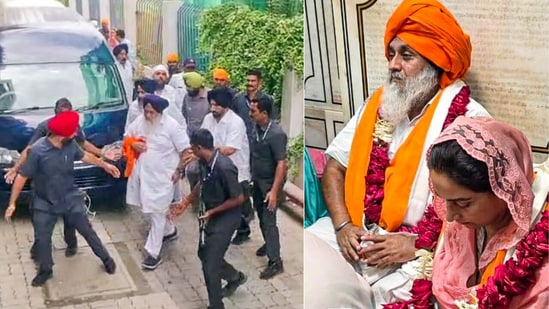
Jaspal Singh, a 64-year-old Pune-based lawyer who had served as a sevadar at Gurdwara Mata Sahib Devan Ji Mugat for nearly two years, struck Badal around 1.50pm, shortly after the SAD chief completed darshan.
Badal suffered a stab wound to his right forearm with a vertical fracture. He was operated on at Nanded's Yashosai Hospital and was expected to be discharged on Friday.
Nanded police said Singh had repeatedly claimed he acted on “an order from waheguru”, though he first told officers he was angry over Punjab’s drugs problem. Police said they had found no gang or criminal history linked to him so far.
The attack drew swift condemnation across the political spectrum, and from the Akal Takht and the Shiromani Gurdwara Parbandhak Committee (SGPC). Jathedar Giani Kuldip Singh Gargaj said "a person who commits such an act cannot be a Sikh", and SGPC chief Harjinder Singh Dhami called the attack “a direct insult to the honour and sanctity of the Guru's house”. AAP leader Baltej Pannu, condemning the attack too, noted that resentment over unresolved 2015 sacrilege cases remained “alive in the minds of Sikhs even today”.
Who are the Nihangs?
{{/usCountry}}The attack drew swift condemnation across the political spectrum, and from the Akal Takht and the Shiromani Gurdwara Parbandhak Committee (SGPC). Jathedar Giani Kuldip Singh Gargaj said "a person who commits such an act cannot be a Sikh", and SGPC chief Harjinder Singh Dhami called the attack “a direct insult to the honour and sanctity of the Guru's house”. AAP leader Baltej Pannu, condemning the attack too, noted that resentment over unresolved 2015 sacrilege cases remained “alive in the minds of Sikhs even today”.
Who are the Nihangs?
{{/usCountry}}The Nihangs are a Sikh warrior order distinguished by blue robes, traditional weapons and martial discipline.
The SGPC describes the word’s meaning as “alligator” — supreme in water, as the lion is supreme among forest animals — and, in Sikh usage, a synonym for “Akali”, or a staunch Sikh.
The tradition traces to Guru Gobind Singh, who is said to have dressed one of his sons in blue battle attire, fixing the colour as the order’s visual marker ever since.
Nihangs and Akalis remained largely indistinguishable until the mid-19th century, after which separate Nihang groups developed their own structures while retaining customary weapons and military-style formations. The Nanded gurdwara where Thursday's attack took place is run by one such group — a splinter of the Shiromani Panth Akali Budha Dal, a Nihang organisation.
A legacy under contest
The Shiromani Akali Dal has been entwined in a prolonged debate over who speaks for the Akali and Panthic legacy — and what that legacy demands of the SAD today.
Much of it goes back to the SAD-BJP government’s 2007-17 tenure in Punjab.
The 2007 Dera Sacha Sauda controversy, in which Dera chief Gurmeet Ram Rahim Singh was accused of imitating Guru Gobind Singh’s attire, triggered protests that the Akal Takht briefly tried to defuse in September 2015 by pardoning him. The pardon was withdrawn within weeks after fierce opposition from the community. Days later, the discovery of torn pages of the Guru Granth Sahib – the Sikh scripture – followed by police firing on protesters in Faridkot hardened public anger.
Critics have long accused the then SAD-BJP government of mishandling the response and failing to bring those responsible for the “sacrilege” to justice.
Those controversies are widely credited with the SAD’s collapse in the 2017 Punjab election, where the party fell from ruling the government to 15 seats in the state’s 117 assembly seats. The slide has continued since. SAD won just three seats in 2022, and it currently has a single MLA and MP each.
In December 2024, the Akal Takht also declared Badal “tankhaiya” — guilty of religious misconduct and ordered him and other former ministers to perform religious penance. Badal was shot at while performing sewa at the Golden Temple in Amritsar days later, and escaped unharmed, the first of the two attacks now.
The SAD’s own post-2022 review acknowledged the party’s unpopularity. A 13-member panel that toured Punjab produced a 20-page report with 42 recommendations, including seeking forgiveness from the Akal Takht and the Panth, keeping distance from deras, reconnecting with ragis, granthis and pathis, and pursuing “Panthic unity”, among other measures — an implicit admission that rebuilding the party meant rebuilding trust with the religious community first.
The performance of SAD allowed other rivals to claim they were the Akalis who could truly represent the Sikh community.
Formations such as SAD (Punar Surjit) and Akali Dal (Waris Punjab De) have positioned themselves as the “true” custodians of the Akali legacy. At a rally in Moonak last month, SAD (Punar Surjit) chief Giani Harpreet Singh directly challenged Badal’s claim to represent Akali ideology.
The BJP question, again
Complicating the SAD’s attempted course correction is fresh speculation over a return to its old alliance with the BJP.
Badal met Prime Minister Narendra Modi in New Delhi on August 7 for a meeting that neither side has explained. Aides described it as an informal meeting, but it revived talk of the two parties coming together again ahead of Punjab assembly election due early next year. SAD had quit the BJP-led National Democratic Alliance in the Centre in 2020 as Punjab and Haryana farmers agitated against the now-withdrawn agriculture laws.
Both the parties, though, have publicly ruled out a tie-up earlier.