Delhi Police closed off the approaches to Jantar Mantar with barricades on Saturday, ahead of a protest called by the Cockroach Janta Party against Chief Election Commissioner Gyanesh Kumar.
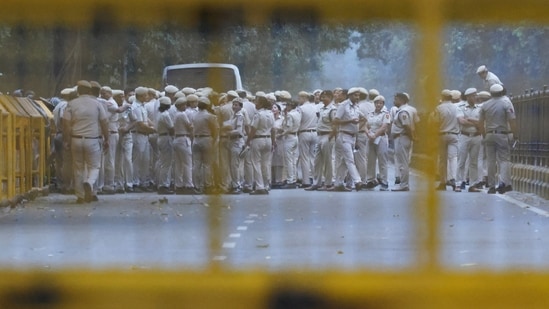
At the Tolstoy Marg-Sansad Marg intersection, at least two layers of barricades stopped people and vehicles heading towards the site. The carriageway leading to the Ashoka Road roundabout was shut at Connaught Place's Outer Circle, with traffic diverted to the opposite side of the road.
CJP protests: Follow live updates
A senior officer said barricades had been put up at 37 identified points from where protesters could potentially enter, and police set up pickets on the borders between central and New Delhi districts and at connecting points with the south, southeast and southwest districts.
The Delhi Police Act, 1978, which Parliament passed to regulate policing in the Union territory, gives the force specific powers over the city's roads. One provision lets the police commissioner close a street or public place to the public. Another lets him authorise barriers to stop and check vehicles. A third lets him make standing rules on traffic and on closing streets.
A breakdown of the provisions:
The force and the law
{{/usCountry}}A breakdown of the provisions:
The force and the law
{{/usCountry}}The Act took effect from July 1, 1978, and set up a single police force for all of Delhi. The force is headed by a commissioner of police appointed by the Administrator.
The Administrator is the official through whom the President governs a Union territory under Article 239 of the Constitution, and in Delhi the Constitution designates this official as the Lieutenant Governor.
Most of the powers are granted to the commissioner. Deputy, additional deputy and assistant commissioners of police can exercise them on the commissioner's orders.
The Act's definition of a street is broad. It covers highways, bridges, roads, lanes, footways, squares, alleys and passages open to the public, whether or not they are through-routes.
Also read: Abhijeet Dipke, Saurav Das and Ashutosh Ranka detained on landing at Delhi airport for CJP's stir
Closing off a street
Section 36(1) allows the commissioner to temporarily reserve any street or other public place for a public purpose by issuing a public notice. Once an area is reserved, he can bar people from entering it except on conditions he lays down.
The provision sets three conditions. The reservation has to be temporary, it has to serve a public purpose, and it has to be announced through a public notice.
Barriers to check vehicles
Section 36(2) is the provision in the Act that mentions barriers. It allows the commissioner, whenever he considers it necessary, to authorise police officers to erect barriers on any street "for the purpose of stopping temporarily vehicles driven on such street", according to the Act. The stop has a stated aim, which is to check that no law has been broken in respect of the vehicle, or by its driver or the person in charge of it.
The same section allows the commissioner to issue orders on how such barriers are to be used.
The definition of a vehicle is wide too. The Act counts carriages, carts, vans, trucks, handcarts, bicycles, tricycles, rickshaws and motor vehicles as vehicles, and the definition also takes in vessels and aeroplanes.
Also read: YouTuber Dhruv Rathee detained in Gurugram ahead of CJP's Jantar Mantar protest
Standing rules on traffic and closures
Beyond these case-by-case powers, Section 28 allows the commissioner to make regulations by notification in the Official Gazette. These can regulate traffic of all kinds on streets and in public places, including how people walk, cycle, ride or drive, to prevent danger, obstruction or inconvenience to the public.
Regulations can also set the conditions under which vehicles may stand in the street. Under clause (t) of the same section, they can provide for closing particular streets or places temporarily where danger arises from dilapidated buildings or any other cause.
These traffic regulations are subject to the Administrator's control, and regulations under the section's other clauses, including the one on closing streets, need the Administrator’s sanction in advance.
The Act also requires these regulations to be published in advance. Once made, they must be made known in the affected locality by posting copies at prominent spots nearby, by proclamation with the beat of a drum, or through advertisements in local newspapers in Hindi, Urdu and English, or at least two of these. The commissioner can also use any other means he considers suitable.
Still, there's an exception. The commissioner can skip advance publication if he is satisfied that circumstances require a regulation to take effect at once.
Also read: Contempt plea in SC over Delhi Metro, rail curbs; home secretary, Delhi Police chief named
At the barrier
The Act makes regulating traffic part of every officer's job. Each police officer has a duty to regulate and control traffic in the streets, to prevent obstructions there, and to prevent breaches of any rule or order that applies in or near the streets.
To enforce the Act, an officer can warn people who break a rule out of ignorance, and can order anyone acting against the Act or an order made under it to stop. Breaking a traffic regulation made under Section 28 is one of the offences for which police can arrest a person without a warrant.
Section 65 requires everyone to comply with reasonable directions given by a police officer in the course of duty under the Act. If a person resists or refuses, the officer can remove them and either take them before a Metropolitan Magistrate or, in trivial cases, release them once the situation that led to the removal has passed. In either case this has to happen within 24 hours.
These powers have conditions specified in the Act. A street can be reserved only temporarily, for a public purpose and by public notice. Vehicle barriers need the commissioner's authorisation and exist to check vehicles against the law, and standing rules on traffic and street closures must be notified in the Official Gazette, normally after advance publication.