
Parliament’s four-day sitting from November 30 is likely to take up delimitation, the redrawing of India’s electoral map that the government has tied to implementing women’s reservation in the Lok Sabha and state assemblies.
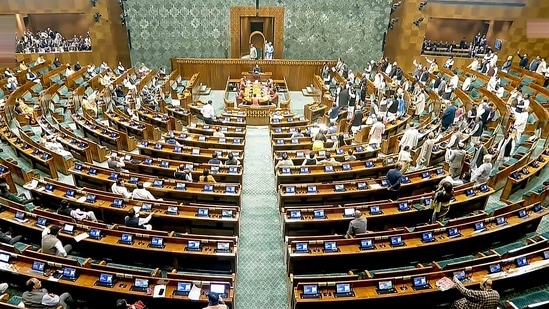
The Union Cabinet was to take up the delimitation-linked women’s quota bill on Friday, HT reported, though the text has not been made public.
A Constitution amendment bill on the same subject failed in the Lok Sabha in April, by 298 votes to 230. At the time, the government said the bills were needed to implement the quota by 2029. Ministers promised that no state would lose seats while Opposition parties argued that redrawing seats on the basis of the 2011 census would put the southern states at a disadvantage.
What is delimitation?
Delimitation decides how many Lok Sabha seats each state gets and how constituency boundaries are drawn within it. Article 82 of the Constitution provides for both to be readjusted after every Census.
{{/usCountry}}Delimitation decides how many Lok Sabha seats each state gets and how constituency boundaries are drawn within it. Article 82 of the Constitution provides for both to be readjusted after every Census.
{{/usCountry}}India has done this four times. In 1952, the first exercise fixed 494 Lok Sabha seats on the basis of the 1951 census. The total went up to 522 in 1963 and to 543 in 1973.
Since 1976, each state’s share of Lok Sabha seats has been based on the 1971 census. An amendment that year froze the shares until the first census after 2000, and a later amendment moved that date to the first census after 2026. The government's stated reason for the extension was to encourage states to continue with population control.
How did it get tied to women’s reservation?
In 2023, Parliament passed the Nari Shakti Vandan Adhiniyam with near-unanimity. It provides for reserving about one in three seats in the Lok Sabha and state assemblies for women.
Also read: NDA may be closer to majority on delimitation, women's quota after Opposition churn
The quota, however, comes into effect only after a delimitation based on the first Census conducted after the law came into force. Reservation would work through constituencies, so seats can be earmarked for women only once constituency boundaries are fixed. The reserved seats would also rotate between constituencies after each delimitation.
That Census is still under way. To avoid waiting for its results, the government’s April bills proposed using the latest Census data available when a delimitation commission is formed, in effect the 2011 count. The government had said this would enable implementing the quota in time for the 2029 general election.
What was in the April bills?
The government brought three bills to a special sitting on April 16.
The 131st Constitution Amendment Bill would have raised the cap on Lok Sabha seats from 550 to 850, with up to 815 members from the states and 35 from Union territories. The Delimitation Bill would have created a delimitation commission, headed by a sitting or retired Supreme Court judge, to readjust each state’s seats and redraw constituencies on the basis of the latest census.
Also read: ‘Delimitation makes MPs’ work easier’: Rebel TMC MP Kakoli Ghosh ahead of House sitting
The amendment needed two-thirds of members present and voting, while the other two needed a simple majority.
The dispute was over how the extra seats would be shared among states. If all 850 seats were allotted by population on the 2011 Census, the projection was that the share of southern states in Lok Sabha could drop.
The government tried to allay concerns and said every state’s seats would go up by the same proportion. Law minister Arjun Ram Meghwal said each state would get 50% more seats. “The total Lok Sabha seats would be 815, and 272 will be reserved for women," he said. Prime Minister Narendra Modi told the House there would be "no change in those ratios". Union home minister Amit Shah also read out figures to say that the share of five southern states’ would rise.
But the text of the three bills did not explicitly mention a fixed proportion or a freeze on each state’s share.
Also read: 20 TMC rebels, 22 DMK MPs and Lok Sabha numbers game: Decoding delimitation maths
The Opposition said it supported women’s reservation but not the delimitation bill, with its leaders alleging that the government’s promises were spoken in the House, not written into the bills.
The bill got 298 votes, 54 short of the 352 it needed that day. It was the first defeat of a government bill since the National Democratic Alliance came to power in 2014. The government withdrew the two linked bills soon after.
What has changed since?
Much has changed since April.
The Lok Sabha currently has 540 members and three vacancies. The government needs 360 votes to pass the amendment, and the Opposition needs 181 to block it.
HT reported on Friday that the Opposition could lose about 26 votes. Twenty of the Trinamool Congress’s 28 Lok Sabha MPs who broke away from the party say they will back the delimitation bill. Six of the nine Shiv Sena (UBT) MPs have joined the BJP-allied faction of the Shiv Sena. The Shiromani Akali Dal, which has one Lok Sabha MP, tied up with the BJP earlier this week for the coming Punjab elections and is likely to support the party.
Two parties that opposed the bill in April have signalled they could change their stand. The DMK, which has 22 Lok Sabha MPs, has indicated it might support the bill if the government gives written assurances of a proportional increase in Tamil Nadu’s seats. “If the wording of the bill has changed, we will certainly be open to supporting it,” a senior DMK leader said on Thursday.
Sharad Pawar’s Nationalist Congress Party, which has eight Lok Sabha MPs, says its support depends on the bill’s provisions. Supriya Sule, the party’s working president and MP from Baramati, listed a 50% increase in Lok Sabha seats across all states and adequate representation for opposition parties on the delimitation commission among its conditions.
If the Opposition loses another 30 or so votes, the government could be within striking distance of a two-thirds majority.
In the Rajya Sabha, it needs 163 votes and has 154.
Government leaders told HT that Shah has assured that no state will lose seats and that proportional representation will be maintained. The Congress has opposed the special sitting of Parliament. Its leader Jairam Ramesh said on X that the government was “hoping that it will get its super-tainted two-thirds majority to pass a Constitution amendment bill”.
ABOUT THE AUTHOR
HT Explainers Desk delivers in-depth explainers and analysis on the stories shaping India and the world, from SimplyPut, Hindustan Times’ dedicated explainer section. The desk unpacks the science, policy, geopolitics and market forces behind major news events, breaking down complex developments into clear, accessible reporting for readers who want more than the headline. Explainers draw on the expertise of the journalists covering the story and insight from leading subject experts, translating specialist detail into plain language without losing precision or nuance. Coverage spans national and global news — from health and science breakthroughs to trade, technology, cybersecurity, aviation, energy and public policy — going beyond what happened to explain how it works, why it matters and what to watch next. Written for readers who want context, and not just the headlines, HT Explainers Desk brings together original reporting, data and expert analysis to make sense of the news as it develops. It is part of Hindustan Times, India's leading source for news, in-depth analysis and explanatory journalism since 1924.