The Keralam government said on Tuesday it was drafting a law to regulate how the elderly are looked after in the state. This involves who may run an elderly care home, who is qualified to work in one, and what standards both must meet.
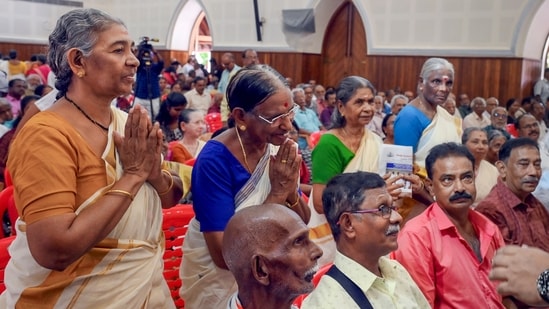
Chief minister VD Satheesan reviewed the draft Keralam State Elderly Persons (Care and Protection) Bill, 2026, along with a Policy for Elders, at a meeting in Thiruvananthapuram on Tuesday, and directed officials to complete the procedures at the earliest. He said afterwards that the government was committed to ensuring "statutory security, healthcare access, and a life of dignity" for senior citizens.
Neither the draft bill nor the policy has been published as yet. A look at what explains the state government's reasoning for such a law:
Why Keralam, and why now
The state's Elderly Budget for 2026-27 prints the Registrar General of India's population projections, which may be among the key reasons for such a law.
In absolute terms, the state's 60-plus population roughly doubles between 2011 and 2036, from 4.2 million to 8.4 million. When seen against the country, the proportion of elderly people Keralam had in 2011 is the proportion India reaches around 2030. By this account, the state is running about two decades ahead of the country.
Also Read: Proposed Keralam law aims to upskill elderly care-giving sector: CMO
{{/usCountry}}Also Read: Proposed Keralam law aims to upskill elderly care-giving sector: CMO
{{/usCountry}}In January, the Reserve Bank of India (RBI) devoted a chapter of its annual study of state budgets to demographic transition and classified every state by age structure. A state counts as "ageing" once 15% or more of its population is 60 or older — a threshold the RBI set at 60 rather than the international convention of 65, because that is where retirement and senior-citizen entitlements begin in India.
In 2016, not one Indian state qualified under this category. By 2026, Keralam and Tamil Nadu do. By 2036, more than half of India's states will, and none will remain in the youngest category. The RBI put Keralam "at the forefront" of that shift, and describes the state's position as advanced ageing.
The fiscal consequence follows too. Keralam’s working-age population would fall from 62% of the total in 2026 to 59.5% by 2036 — the only state projected to drop below the 60%-mark. That means fewer earners, more dependants, and a tax base that grows more slowly than the obligations the government has to fund.
The health factor
The case for an elderly care law may not be limited to age.
The Union health ministry's Longitudinal Ageing Study in India, which surveyed more than 31,000 people aged 60 and above in 2017-18, found that 52% of Keralam's elderly people were living with two or more chronic conditions at once — the highest figure of any state, against 23% nationally. More than half rated their health as poor, tied only with Tamil Nadu for worst self-assessment in the country.
The survey also found the reverse of what those numbers might suggest about neglect. Among Keralam's elderly diagnosed with high blood pressure, 91% were receiving treatment, a rate among the best anywhere in India. The state diagnoses illnesses and treats them.
Also Read: Keralam drafts bill to improve geriatric care
What it may now be looking for to build is the business of caring for people who will live for years with conditions that cannot be cured.
What we know about the draft Bill
According to the chief minister's office, the draft legislation would set standards and accountability for elderly care centres, assisted living facilities, day homes and home care agencies. It proposes a Keralam Geriatric Care Certification Framework under which caregivers would be trained, certified, subjected to background checks and entered on a state register.
It would also create state and district mechanisms for implementation, monitoring and grievance redressal, and carry provisions on the digital and financial security of older people.
Running through the policy would be the principle of ageing in place — helping people stay in their own homes and neighbourhoods for as long as they can, with quality care available when they cannot.
The government also wants to treat this as an economic opportunity rather than a burden, promoting what it calls a silver economy in care services, assistive technology and elderly-friendly products.
What already exists
Keralam is not starting from scratch.
The state runs 16 government old age homes. Another 680-odd are registered with the Orphanage Control Board. The Elderly Budget records 37,895 residents in 2024-25. Ninety-five 'Vayomithram' units take mobile clinics to elderly people, largely in urban areas. Sayamprabha day-care homes have operated in 82 local bodies since 2018. Local governments are required to set aside 5% of their development fund for elderly welfare and palliative care, and the social security pension is ₹2,000 a month. Separately, Kudumbashree, the state’s women's collective, has been training members as certified home carers under a programme called K4CARE.
A piece of the new architecture was also announced before Tuesday's statement.
The Elderly Budget, presented in January, contains a project called Retirement Homes: age-friendly housing in every district, on a fee-paying basis, "with government regulation and monitoring mechanisms" intended to give the state a basis for intervening in paid welfare institutions.
Has any other state done this?
Not in this format. But Himachal Pradesh legislated for elderly people with its Maintenance of Parents and Dependants Act of 2001, and the central Maintenance and Welfare of Parents and Senior Citizens Act, 2007 drew on it.
The central Act governs elder care law across India, and it works through maintenance tribunals, under which a parent who cannot support themselves can apply for an order requiring their children to pay. Its only clause on care infrastructure is permissive, i.e. a state government may establish at least one old age home per district.
Also Read: Time to prepare for an elderly population
States have added rules under that Act rather than laws of their own.
Tamil Nadu has likely gone furthest on care standards, fixing minimum requirements for old age homes run by voluntary organisations through two government orders in 2016. Keralam's Elderly Commission, created by statute in 2025 and the first such body in the country, can also summon witnesses and take evidence, but its findings go to the government as recommendations.
What other countries have done
Three broad approaches exist.
Japan chose to pay for care. Its Long-Term Care Insurance Act of 1997, in force since 2000, makes municipalities the insurers, requires everyone over 40 to contribute, and assesses each applicant for a certified level of need. The RBI's chapter referred to it, noting that Japan introduced long-term care insurance as its population aged.
Singapore chose to enforce family duty. Its Maintenance of Parents Act of 1995 lets a parent over 60 apply to a tribunal for support from their children, with conciliation attempted first. Its record is telling. Claims have fallen from an average of about 170 a year in 2008-10 to roughly 30 annually in recent years. In 2023, the law was amended, so that parents who abandoned or abused their children must get the tribunal's permission before claiming a maintenance amount.
The UK put the duty on the state. The Care Act 2014 requires local authorities to assess anyone who appears to need care, to assess unpaid carers separately, and to shape the local market of care providers — in what may be structurally the closest thing abroad to the law Keralam is proposing.
Above these, a treaty is now being drafted. In April 2025 the United Nations Human Rights Council established an intergovernmental working group to produce a legally binding instrument on the rights of older persons, chaired by Carlos Mario Foradori, Argentina's ambassador and a former vice-minister of foreign affairs. The working group met for the first time in July and meets again in late October, but a text is likely years away.
The UN Principles for Older Persons, adopted by the General Assembly in 1991, state that older persons should be able "to reside at home for as long as possible". Thirty-five years on, Keralam is trying to work out what that may mean.
What remains unanswered
The state government has described a system of standards and a workforce. But it has not said publicly how the care those would be paid for — whether through insurance, subsidy, or the household budgets of people who are already the most medically burdened elderly population in India. Nor has it explained how the draft Bill relates to the Retirement Homes scheme already on the books, or when the draft will go to the assembly.