In a report published on August 28, Binod Parajuli set out what the satellite pictures showed about the origins of the August 26 tragedy. A senior divisional hydrologist in the flood forecasting division of Nepal's Department of Hydrology and Meteorology, Parajuli told the Kathmandu Post that imagery shared by the Chinese side pointed to a combination of three things: an ice avalanche, permafrost movement and a rockslide.
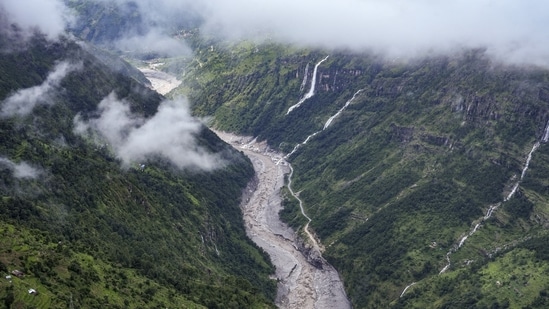
The avalanche began on Nepali territory, he said, then crossed the border into China as it came down, causing extensive damage on both sides.
Nepal has since told the world that the biggest greenhouse gas emitters should pay for what happened next. On August 26, a collapse of rock and ice near the Nepal-Tibet border sent a surge of water and debris down the Lhende Khola into the Bhotekoshi and Trishuli rivers. Nepal Police put the toll inside Nepal at 1,066 dead and about 4,606 missing as of Wednesday; casualties on the Chinese side are counted separately.
Foreign minister Shisir Khanal told Kantipur TV that China, the US and India had made outsized contributions to climate change while smaller countries paid the price. Nepal was shifting its diplomatic framework from aid to justice and compensation, he said, calling the issue one of legal and moral liability rather than charity.
Prime minister Balendra Shah put it more carefully, thanking China and India for sending technicians and flying aerial reconnaissance from the first day. "There is a global contribution behind climate change," Shah said. “And the responsibility to manage and minimise its effects also rests on the global community.”
{{/usCountry}}Prime minister Balendra Shah put it more carefully, thanking China and India for sending technicians and flying aerial reconnaissance from the first day. "There is a global contribution behind climate change," Shah said. “And the responsibility to manage and minimise its effects also rests on the global community.”
{{/usCountry}}Why the mountain has to be explained before anyone is billed
Scientists studying the collapse are not yet willing to say what caused it – understandably, since events of such intensity require bulletproof attribution. An assessment published by the Stimson Center, authored by senior fellow Austin Lord, said analysts suspect warming at high elevations destabilised the source area by weakening the glacier and the bedrock around it, while cautioning that the driver of this kind of disaster is climate change intersecting with other processes rather than climate change acting alone.
In the Himalayas, hazards are stacked on top of one another.
Glacier failures, monsoon-triggered collapses and earthquake all have combined routinely to unleash havoc in the same terrain. The 2015 Gorkha earthquake, for instance, triggered a catastrophic avalanche on the other side of this same mountain, in the Langtang valley. Whether seismic damage from eleven years ago left this particular slope weaker is a question that some are beginning to raise.
Rock and ice collapses are far harder to attribute than heatwaves or bursts of extreme rainfall, where attribution analyses are now possible within days of an event. Establishing that warming caused this particular mountainside to fail could take years of fieldwork and modelling. Any claim for compensation will likely hinge on that determination.
Also read: After Nepal floods, the Himalayan glaciers on India’s risk list — and the ones that aren’t
What Nepal has actually filed
Two things have gone out from Kathmandu, and they are aimed at different targets.
The first is a letter, co-signed by finance minister Swarnim Wagle and Geeta Chaudhary, the minister holding the forests and environment portfolio, sent this week to the co-chairs of the board of the Fund for responding to Loss and Damage. It asks the board to respond rapidly and directly under the fund's Governing Instrument, given what the ministers call the exceptional nature of the disaster.
The letter describes a fragile transboundary mountain river system with consequences reaching far beyond the flood zone, says the full scale of losses has yet to be established, and states that what is already known exceeds Nepal's capacity to respond.
The second is the political campaign: Khanal's interview naming US, India and China, Nepal's missions abroad lobbying for reconstruction funds, and reports that Shah will take the demand to the UN General Assembly.
Maheshwar Dhakal, a joint secretary at the forests ministry and Nepal's member on the fund's board, told the Kathmandu Post that the letter does not specify the scale of losses and that the decision rests with the board. "Almost all major donors and global development partners are members of the board, and Nepal's claims and potential risks are well-established, so the board must compensate us," he said.
Preliminary government estimates put the destruction at between $4 billion and $7 billion — a figure from Nepali officials' public accounting rather than from the letter, which as Dhakal notes puts no number on the losses.
While Dhakal used the word compensate, what the fund offers is grant finance. Compensation, in law, means payment for a wrong. The two have been kept deliberately apart since Paris, and the separation has been fought over at every UN climate conference since.
Also read: Trump shut down project to track natural disasters in Nepal a year before deadly floods came: Report
Aid and liability are not same in climate justice
Loss and damage is the term climate negotiators use for harm that adaptation cannot prevent — homes and lives lost in a flood, land taken by the sea, a glacier that will not come back. It entered the Paris Agreement as Article 8, after years of pressure from vulnerable countries, and it came with a condition attached.
When governments adopted the agreement in 2015, they simultaneously agreed a line stating that Article 8 provides no basis for any liability or compensation. Developed countries accepted the article only on that understanding, and the exclusion was written in to satisfy major polluters, the US foremost among them.
The Fund for responding to Loss and Damage, agreed at COP27 in 2022 and operationalised at COP28, takes money only from countries that choose to give it. The COP28 decision urges developed countries to keep providing support and encourages everyone else to contribute on a voluntary basis, and the fund's Governing Instrument lets it take money from a wide variety of sources. No country is assessed a share. Nobody is billed.
To recap: the Paris Agreement binds the states that ratified it. While the line ruling out liability is not in the treaty, it is part of paragraph 51 of the COP decision that adopted the treaty. Which means in terms of what countries – the developed, developing and least developed – have agreed is this: developed countries are urged to pay, everyone else is encouraged to, and nobody — however much they have emitted — can be held liable.
Small island states saw to that from the beginning. AOSIS members attached declarations when they signed the UNFCCC in 1992, stating they were not waiving any right to claim liability against states for the adverse effects of climate change and that nothing in the Convention could be read as overriding general international law. Several countries repeated the point when signing the Kyoto Protocol and again at Paris.
Separately, the climate treaties sort countries into lists drawn up under the 1992 Convention, and the duty to provide finance falls on the developed-country list. Neither China nor India is on it. Those lists record how countries were classified by development status in 1992, not a ranking of who has emitted most, and they follow the principle of common but differentiated responsibilities and respective capabilities that runs through global climate action more broadly.
The other route
On July 23, 2025, the International Court of Justice (ICJ) delivered a unanimous advisory opinion, from all fifteen judges, on what states owe each other over climate change. Where a state breaches its climate obligations, the court held, it must make full reparation — restitution, compensation, or satisfaction. Compensation could be owed for significant climate harm, the court said, if a sufficiently direct and certain causal link is shown between the wrongful acts of one or more states and the harm suffered.
Nepal was part of that proceeding. It co-sponsored the General Assembly resolution requesting the opinion, filed a written statement that the court admitted late on an exceptional basis in March 2024, and appeared at the Peace Palace in December 2024 — the first time in the court's history that Nepal had spoken before it. Nepali youth organisations contributed to that first written submission.
So Kathmandu has a documented record of pressing the state responsibility argument, and it is that argument that would apply to China and India.
A demand aimed at all three of the countries Khanal named cannot rest on the climate treaty finance obligation alone; the ICJ opinion, which grounds obligations in customary international law and human rights rather than the 1992 lists, applies more broadly, and it will be litigated the moment anyone tries to invoke it in a specific event such as August 26.
The fundamental difference is this. The Paris Agreement is a treaty that governments ratified through their own legislatures, and underneath it sits working machinery: the loss and damage fund has a board, a secretariat hosted by the Philippines, the World Bank as interim trustee, and an application process. An advisory opinion by the ICJ is the court's authoritative statement of what the law requires. It was not delivered in a case between two countries, it binds nobody directly, and it comes with no institution and no cheque.
Also read: 1,643 children, one warning: How a Nepal teacher pulled off a heroic rescue
What Nepal can realistically get
The loss and damage fund has never paid anyone anything. Its first funding window, open from December 2025 to June 2026, drew nearly 180 applications seeking roughly $2.8 billion against about a paltry $250 million that is available; the board released a further $100 million in July in response, then postponed its first project approvals to its December meeting.
Pledges stood at $822.06 million from 27 contributors as of May 13, according to the trustee's status of resources report to the board in May, but contribution agreements covered only $592 million, and $456.14 million had actually reached the trust fund.
The low end of Nepal's damage estimate is roughly nine times everything that has ever reached the fund's trust account.
But arguably, Nepal's case is not weak. Its request is exactly the kind of sudden, climate-linked disaster the fund was built for. And Nepal is still a least developed country — its graduation from that category, scheduled for November, has reportedly been put on hold after the government asked the UN for a delay — which places it in the group entitled to at least half the fund's start-up resources, alongside small island states.
Against that, Nepal is asking for something the board has not done before: an emergency decision outside the ordinary cycle, after the funding window has closed. December is when the board next sits, and the ministers have said December is too late.
And the largest historical emitter will not be in the room. The US pledged $17.5 million to the fund at COP28 and withdrew from its board in 2025.