
 E-Paper



The Himalayas need a cross-border disaster data ecosystems
This article is authored by Mahesh Ganguly, teaching assistant and research fellow, IIT Bombay and Amaan Siddiqui, independent researcher.

 Prefer HTon Google


The catastrophic flash floods that struck the Nepal–Tibet border on August 26 offer a stark reminder that nature does not recognise political boundaries in the way nation-states do. The Himalayan region is becoming increasingly fragile, with glacial instability, the climate crisis and cascading hazards intensifying across the region. Addressing such unpredictable natural phenomena makes a strong case for cross-border data ecosystems that bring together hazard monitoring, early warning and evacuation planning – enabling organisations across borders to reduce disaster risk, strengthen preparedness and improve resilience.
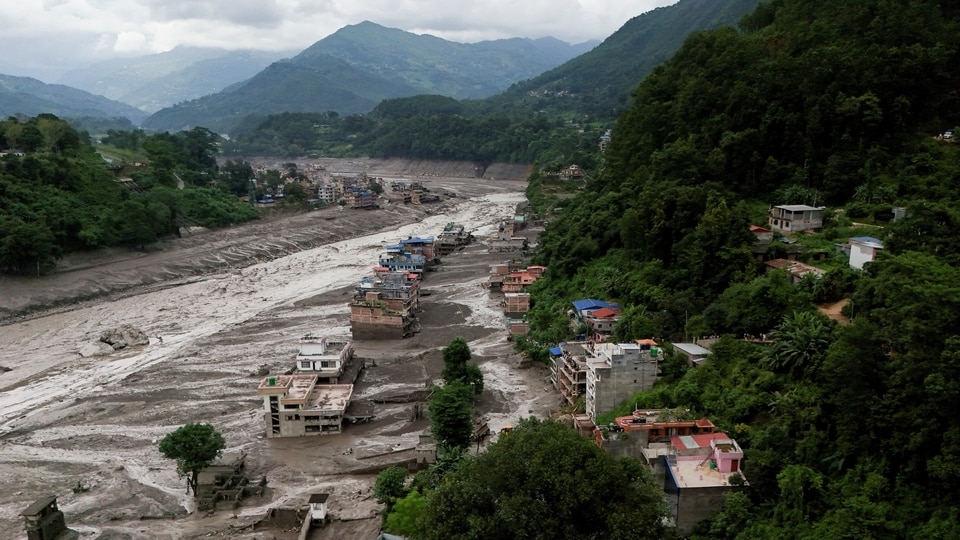
With the death toll reportedly surges to 1,050 and around 4,000 people still missing, the majority of them Indian nationals, the floods have devastated hydropower facilities, roads, bridges and settlements across Nepal and Tibet, including the strategically important Rasuwagadhi border checkpoint. Damage to the Gyirong port in the Tibet Autonomous Region of China, along with several power and communication networks, and the destruction of the Sino-Nepal Friendship Bridge have further disrupted a crucial trans-Himalayan link.
The fallout has also reached India, prompted authorities to remain on maximum alert and deployed large-scale rescue teams in northern districts of Uttar Pradesh and Bihar as floodwaters moved into downstream areas.
The cross-border nature of these risks is evident from past disasters. In 2016, a moraine-dammed glacial lake breach in Tibet sent a surge into Nepal’s Bhotekoshi–Sunkoshi basin, damaging the Upper Bhotekoshi hydropower project and Arniko Highway and causing more than $70 million in losses. The 2025 Rasuwa GLOF killed nine people, destroyed the Nepal–China Friendship Bridge, blocked a key road corridor and disrupted around 240 MW of hydropower. In 2008, the Kosi embankment breach in Nepal altered the river’s course and inundated large parts of Bihar, affecting 69 districts in Nepal.
Together, these events point to a shared disaster landscape linking China, Nepal and India, where hazards originating in one part of the region can send ripple effects across borders, escalating into humanitarian, infrastructure and economic crises elsewhere.
The SAARC’s Dhaka Declaration, adopted in 2005 in the aftermath of the 2004 tsunami, called for a “permanent regional response mechanism dedicated to disaster preparedness”, followed by the Comprehensive Framework on Disaster Management formulated in 2006. Yet the experience of successive disasters suggests that regional mechanisms have not fully translated into a continuous and effective flow of information across borders.
This challenge has re-surfaced in recent reporting on the latest floods, which has highlighted differing claims between Nepal and China over the timeliness of warning systems and access to glacier and water-level data. The issue, then, is not a lack of information, but whether it can be generated, shared and converted into timely action across institutional and national boundaries. That is where stronger cross-border data systems demand renewed attention.
A cross-border data ecosystem is a collaborative network through which organisations produce, share and use datasets and data services. In the Himalayan context, it could connect disaster-management authorities, scientific institutions, local administrations, humanitarian organisations and other stakeholders around data on glacial lakes, rainfall, river discharge, floods, landslides, infrastructure vulnerability, historical disaster records and real-time sensor observations. Rather than merely exchanging raw information, the objective would be to convert it into usable services such as maps, visualisations, risk assessments and early-warning outputs.
Such an approach could strengthen cross-border disaster preparedness in several ways. Inter-organisational networks and central data hubs can improve situational awareness, while shared protocols can create greater synergies around preparedness. It could facilitate cross-organisational information exchange, collaborative tracking of risks, understanding the population movements and more coordinated risk mitigation.
Organisations could develop task-orientated arrangements around specific risks such as glacial lake outburst floods, riverine floods and landslides. This would allow institutions to address different informational needs while gradually building interoperability and a common data culture. In the China–Nepal–India context, information generated upstream could then become actionable for organisations downstream before a hazard develops into a wider disaster.
However, significant challenges remain. Data quality, interoperability standards, privacy and security, governance structures and differences in institutional priorities can constrain information sharing. Building and sustaining such an ecosystem would also require diverse areas of expertise, including server administration, programming, data analysis, visualisation, safety protocols and other technical capabilities. Since one organisation may not possess all these capabilities, ecosystem expansion would be needed to incorporate new experts and companies, including actors who may have limited familiarity with the realities of cross-border disaster-risk reduction.
The more difficult challenges, however, are organisational and political. Organisations may be reluctant to share data because of commercial sensitivities, institutional priorities or concerns over secrecy. In a politically sensitive region such as the Himalayas, different political, economic and cultural contexts can further shape institutional priorities and generate divergent interests, even around the shared objective of disaster-risk reduction.
A functional cross-border data ecosystem requires more than technological infrastructure. It needs clear governance arrangements, agreed data-sharing protocols, interoperable standards and sustained institutional cooperation. The goal should be to build a connected regional data architecture that enables organisations across borders to generate, share and access timely, reliable and actionable information while maintaining appropriate safeguards for sensitive data.
The latest disaster underscores the need to rethink disaster preparedness in the Himalayas. As the region functions as one interconnected geological and hydrological system, disaster preparedness must increasingly reflect this reality. Additionally, there is an urgent need to set aside the broader geopolitical complexities where possible, and build feasible cooperation around the shared objective of reducing disaster risk.
The region needs an integrated cross-border disaster data architecture that enables relevant organisations to access continuous, reliable and actionable information before, during and after a disaster. The focus should be on making critical disaster information available across borders when it matters most.
(The views expressed are personal)
This article is authored by Mahesh Ganguly, teaching assistant and research fellow, IIT Bombay and Amaan Siddiqui, independent researcher.


