E-Paper



1,643 children, one warning: How a Nepal teacher pulled off a heroic rescue
The flash flood, triggered by a glacier collapse, tore through mountain river systems, killing over 700 people in Nepal and 16 in Tibet.

 Prefer HTon Google


When Rajendra Dawadi arrived at school to teach on Wednesday morning, little did he know he would soon be racing to save the lives of 1,643 children as a deadly flash flood tore through Nepal’s Trishuli Valley.
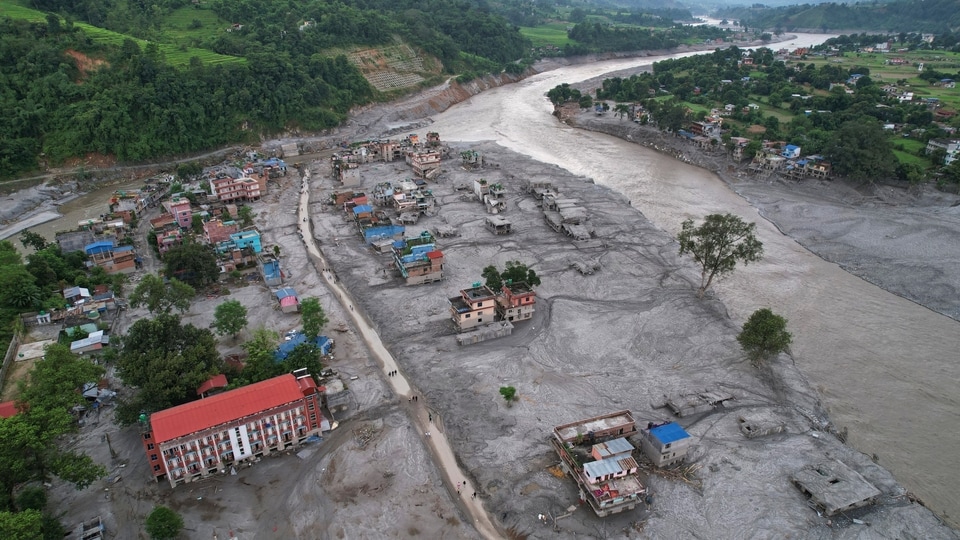
A 47-year-old teacher and principal of Tribhuvan Trishuli Secondary School in Nepal’s Trishuli Valley, received a warning at 9.20 am on Wednesday from a friend: “He said the village was gone: taken by the river. He told me to run,” The Times reported.
Deep Dive

Dawadi, had 1,643 children in and around the three-storey school in flood-hit Nuwakot that morning. The flash flood, triggered by a glacier collapse, tore through mountain river systems, killing over 700 people in Nepal and 16 in Tibet.
At first, Dawadi believed the school was out of danger. The three-storey concrete building was around 60 metres above the river and at the same level as the steel bridge connecting the village to the eastern bank, according to the report.
Then a parent rushed in to warn that the water level was rising rapidly.
Dawadi sounded the school bell and told the teachers to get the children out of their classrooms. He also called the school bus drivers and asked all but one to turn back. By then, he spotted the bus he had been unable to contact crossing the bridge.
By then, the children were beginning to realise they were in danger. One girl suffered a panic attack and was taken uphill on a motorbike. The others fled on foot, with Dawadi following behind, according to The Times.
The children eventually took shelter beneath a bodhi tree as the floodwaters swept away their school buildings.
Dawadi's quick thinking saved 1,643 children and all but one member of the teaching staff. Social history teacher Santos Pariyar, 32, was washed away after returning to his rented room beside the river to cook breakfast. The school's janitor, Sultan Lama, was also killed after returning to close the doors, the report further added.
Also Read: India sends 4th relief flight to flood-hit Nepal; 108 Indian nationals rescued, 275 still missing
Death toll, missing rise
Figures from Nepal and Chinese authorities in charge of Tibet put the total number of missing at just over 3,000, with 750 bodies recovered.
Nepal says there are 2,498 people, including hundreds of foreigners, who are out of contact in the country. It reported an updated death toll of 734 people on Sunday.
Tibet, an autonomous region of China, was largely inaccessible to foreign journalists, preventing independent reporting on the scale of the disaster in an area which has multiple villages.
China's state broadcaster CCTV said on Sunday that 546 people were missing and 16 people had been killed. Of those missing, 261 were foreign nationals, it said.
More than 100 trapped
More than 100 workers are believed to be trapped inside multiple hydropower tunnels.
The Nepali army inserted a pipe into one of the tunnels at the Trishuli 3A hydroelectric site late on Saturday and started sending air through it, Minister Sudan Gurung said.
But overnight rain and rising river waters hampered rescue efforts at that site, and Nepal's disaster authorities urged rescue teams on Sunday to exercise caution.
Those trapped were among 933 missing workers from hydropower projects on the rivers where the torrent of icy debris swept down.
India, which has extensive experience in such rescues, has sent an 11-person specialised team. China has also sent a nine-person tunnel team to help.
The flash flood was triggered by a huge chunk of ice and rock that broke away from Langtang Lirung peak and plunged about 1,200 metres into the steep upper gorge of the Lhende Khola river near the Tibet border.
(With inputs from AFP)