A flash flood on the Nepal-Tibet border on Wednesday has killed close to 500 people and left more than 1,400 missing, making it the deadliest disaster in Nepal since the 2015 earthquake. Three days on, the toll continues to climb, a barrier lake formed by the flood’s debris has begun overflowing, and rescue operations on both sides of the Nepal-China border have been halted.
Where it began
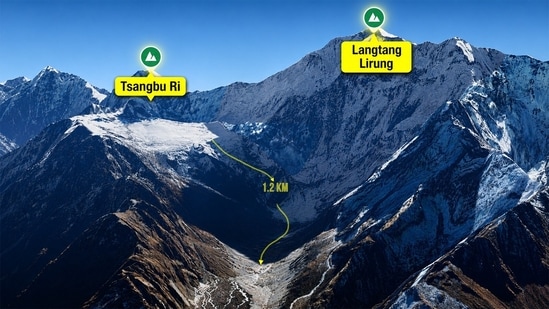
High in the Bhote Koshi headwaters, close to the Langtang Lirung peak, a section of glacier covering about 0.2 sqkm broke off at roughly 5,200 metres of elevation and fell more than a kilometre onto the valley floor.
Later satellite images reviewed by geomorphologists Kristen Cook (Université Grenoble Alpes) and Dan Shugar (University of Calgary) showed the bedrock beneath the glacier had given way too, taking the ice down with it.
Below: A combination of satellite images from August 24 and August 26 shows the glacier before and after it collapsed, which, according to experts, triggered flash floods and a mudslide. (Photo: Copernicus Sentinel-2 and Landsat 9/Handout via Reuters)
What seismic monitors caught
The impact registered as a magnitude-4.4 earthquake at 8.37am local time. A revised US Geological Survey analysis later confirmed there was no earthquake — the tremor was the glacier collapsing and triggering the floods.
How the flood formed
The falling mass entrained rock and sediment, briefly damming the Lhende Khola, a tributary of the Bhote Koshi. When that natural dam ruptured, a surge of water, ice and debris tore downstream.
{{/usCountry}}The falling mass entrained rock and sediment, briefly damming the Lhende Khola, a tributary of the Bhote Koshi. When that natural dam ruptured, a surge of water, ice and debris tore downstream.
{{/usCountry}}Water levels at Galchhi, on the Trishuli further downstream, rose by up to nine metres in half an hour.
How far it travelled
Roughly 170km south, from the Nepal-Tibet border up to Chitwan, near Nepal’s boundary with India.
Nepal-Tibet floods: Live updates
Affected areas
Rasuwa, Nuwakot, Dhading, Gorkha, Chitwan and Narayani were among the worst hit districts in Nepal.
Across the border in Tibet, the Gyirong crossing was hit by a linked mudslide. Chinese state broadcaster CCTV reported that some road sections were buried under more than two metres of mud.
Six hydropower and transmission projects have been hit, including Rasuwagadhi, Chilime, Trishuli 3A and Devighat. Two bridges were damaged, and a 42km road connecting Nepal to the Chinese border destroyed.
Below: This satellite image provided by Vantor shows a bridge and buildings on the Trishuli River in Syapru Besi, Nepal, before the flooding, and after the area was ravaged by the flash floods. (Photos: Vantor via AP)
Bodies swept into India
Seven bodies believed to be flood victims from Nepal were recovered from rivers in Uttar Pradesh's Maharajganj and Kushinagar districts on Thursday, about 70km downstream of the border.
The missing
Hundreds are unaccounted for. This includes foreign tourists, of which Indians make the largest group, 90 Americans, and Malaysian and other pilgrims heading to Mount Kailash.
Nepal has brought about 350 workers and residents to safety from a tunnel at the Trishuli 3A hydropower project. More than 100 remain trapped inside. Two helicopters were dispatched, though the army says even locating the tunnel entry points is proving difficult.
Also read: New lakes near Nepal, China border add to flood concerns
A new lake, and a paused rescue
Debris from the collapse formed a barrier lake on the Nepal-China border. By Friday, its reservoir had topped 2.5 million cubic metres of water, up from 1.5–2 million a day earlier, according to a Chinese engineering team’s aerial survey.
Below: A satellite image shows a barrier lake at the border of Nepal and Tibet, formed after the flash floods and a mudslide. (Photos: Reuters)
The lake has since begun overflowing, and China has withdrawn its rescue teams. Nepal has halted rescue operations, directed personnel and residents to higher ground, and warned of fresh flooding on the Bhote Koshi and Trishuli.